Thursday, September 29, 2016

Solomon's Temple was NOT in the City of David.

If you think it was, I suggest you read 1 Kings 8:1, the account of The Ark being placed in The Temple.
"Then Solomon assembled the elders of Israel, and all the heads of the tribes, the chief of the fathers of the children of Israel, unto king Solomon in Jerusalem, that they might bring up the ark of the covenant of Yahuah out of the city of David, which is Zion."
And also 2 Chronicles 5:2
"Then Solomon assembled the elders of Israel, and all the heads of the tribes, the chief of the fathers of the children of Israel, unto Jerusalem, to bring up the ark of the covenant of Yahuah out of the city of David, which is Zion."
David's Tabernacle was not on the same land as Solomon's Temple, that's where these "The Temple wasn't on The Temple Mount" people are confused.

The land that Solomon built The Temple on, David purchased after the whole Census and Plague episode recorded in 2 Samuel 24 and 1 Chronicles 21, (and referenced again in 2 Chronicles 3:1).  So it can't possibly be the same spot near the Gihon Spring where David placed The Ark when he began his reign in Jerusalem.

In 2 Samuel 24:23, though English translations sometimes obscure this, Araunah (Ornan in Chronicles) is called a King.  He was the King of a separate Kingdom, so the land he owned was clearly not within The City of David.

There are also many reasons why you wouldn't put a threshing floor anywhere near a spring.

Now I don't know if the Second Temple was on the same spot as the first.  But I believe the evidence places the Second Temple's Holy of Holies about where the Al-Kas Fountain currently is, and that the Antonia Fortress was where the Dome of The Rock is.

Prophetic verses get used to back up saying there is a spring or river under The Temple.  Ezekiel 40-48's Temple will be no where near the same spot as Solomon's, it's miles north of Jerusalem, I've argued about where Beth-El was. And by then events like the 7th Bowl of Wrath will have totally changed the geography of the region.

In both Poetic and Prophetic books Zion gets used poetically, it doesn't always mean it's strict Geographical definition it has in the two verses that started this post.

Friday, September 23, 2016

The Mormon Doctrine of Jesus and Lucifer being brothers

First this is about LDS Mormonism specifically, groups like Temple Lot that reject the Cosmic Pluralism of Smith and Young's later teachings view Satan about the same as Protestants and Evangelicals who are KJV only do.

Here is a Mormon Website defending Mormonism against this accusation.

Yes it is true that this Mormon doctrine makes all Angels and Humans brothers of Jesus and Lucifer also.  And indeed The Bible also calls all Angels including Satan "Sons of God" in Job and Genesis 6.  And The New Testament calls Adam and all Believers "Sons of God".  And I thank this webpage for reminding me of Hebrews 12:9 and how that could be relevant to the Nephilim view vs Sethite view debate.  But also just like in The Bible, Satan has a certain seniority over the others besides Jesus who is the First Born.

My objection to the Mormon view of how Jesus and Satan are related is not so much that it elevates Satan (my view of Satan may well be a more powerful entity then the LDS view, he's the Archon of the Kosmos), it's that it subtly demotes Jesus.

On that very page, in it's answer to "Q. What about the Jesus and Satan being brothers claim?" They say "However, Jesus chose to honor and glorify his Father while Satan chose to rebel against and dishonor Him.  Jesus and Satan are polar opposites–literally as different as any two individuals can possibly be." Meaning they're arguing the difference between Jesus and Satan begins with the choices they made, they were equal in creation.  I believe Jesus is the ONLY Begotten Son of God, John 3:16, not just the First Born, though First Born of Creation is also one of his titles.  He is The Word made Flesh.

The LDS view of Jesus and Lucifer is not unlike Manwe and Melkor in Tolkien's cosmology.  All the Anuir were created from the thoughts of Eru Iluvatar, but Manwe and Melkor were twins essentially as the First Born of his thought, but it was the choices they made that made them opposites.

I doubt Tolkien was copying Mormonism specifically, he was drawing on mythological motifs that are common and Ancient.  From Thor and Loki as rival sons of Odin to Vishnu and Shiva of Hinudism.  And the Zurvanism form of Zoroastrianism has Zurvan in the Elohim role, and Ahura-Mazda and Angra Manyu as the good and evil rivals he created.

But the beginning of this motif is perhaps Enlil and Enki as the chief sons of Anu in Sumerian Mythology.  Just do a Google search with Enlil, Enki and either Satan or Lucifer as the main keywords and you'll find many websites and articles saying Enlil is like Yahuah/Yahweh (LDS Mormons believe Jesus is Jehovah while Elohim is God The Father) and Enki is The Serpent of Genesis 3.  Sometimes from Christians saying this is Satan's earliest corruption of the Biblical world view.  Meaning they're not saying it's okay to worship Enlil, but that Enlil was devised in some ways to reflect how Satan wants people to view Yahuah.  Rob Skiba has also talked about this subject.

There is definitely a subtext to the Sumerian myths that present Enlil as bad compared to Enki.  Also the earliest Temple of Eridu (the original Babel) was devoted to Enki.  Enki is presented as the one who gave Mankind knowledge and civilization.  Enlil is presented as sending the Flood while Enki warned the Noah figure.  In Akkadian and some other Semitic Mesopotamian texts Enki is called Ea.

I wonder if Tolkien's account of how Luthien puts Morgoth to sleep to take one of his Silmarils could be his puerile re-imagining of the myth of how Inanna obtained Enki's me.

In the Baal Cycle and other texts of Ugarit, the Enlil role seems to be played by Baal (sometimes also called Hadad/Hadar/Adad/Adar) and the Enki role by Yam and maybe also Lotan, scholars disagree on if Lotan is Yam or an instrument of Yam.  And the role of Anu is played by El.

Baal worship is probably the most frequently condemned false Worship in the Hebrew Bible.  But remember God dislikes being identified with a Pagan god just as much as being rejected altogether, we see that in the Golden Calf incident where they called the Calf Yahuah.

Hosea 2:16 refers to Baal as a name or title Yahuah has been called, but as one he doesn't like.  Of course the main context there is how Ish and Baal are both words for Husband (marriage is the major theme of Hosea) but Baal also means Lord while Ish is a word for man as in male gender that is introduced in Genesis 2.  So I see this as mainly being about how the marriage of Genesis 3 will be done away with in favor of the marriage of Genesis 2.

The devout Baal worshipers Ahab and Jezebel named at least three of their children YHWH theophoric names, Athaliah, Ahaziah and Jehoram.

Zachariah 12, I have already mentioned before as possibly using Hadad-Rimmon as a title or idiom of Christ Crucified.

The Tel Dan Stele was made either by Hazael of Aram-Damascus or by Jehu, both were anointed Kings by Elisha on instructions originally given to Elijah by Yahuah.  Both should have known full well that Yahuah made them King, but the author of the Stele says Hadad made him King.  Jehu did continue the Sins of Jeroboam.

 In Hebrew Lotan could come from putting a Lamed as a prefix before Tan, the basic root word for Dragon, which would mean "To the Dragon".  Some have connected the Ugarit Lotan to the Biblical Leviathan.  The name Lotan does occur in Genesis 36 in the Horite genealogy.

Isaiah 27:1 has a phrase translated "the dragon that is in the sea".  But in the Hebrew this is only three words.  "Tanyin asher Yam", Yam being the Hebrew word for the Sea.  It could be this whole phrase is a name or title of Satan and that we have a Biblical basis for using Yam as a name for Satan.   I notice this could parallel Ehyeh asher Ehyeh "I Am that I Am", maybe it could be "The Dragon that is Yam"?

Psalm 74:13 could also be interesting in this context, and also Ezekiel 29:3.  Or Ezekiel 32:2 where the word for Dragon is translated "Whale" in the KJV.

Some Canaanite texts call Yam Judge-Nahar (Nahar being interpreted to mean river) Nahar is a name that could easily be related to Nahash, the word for Serpent in Genesis 3 and 49 and other places.   Rivers are Serpent like in a sense.

There is some evidence that Chemosh and Moloch were just the Moabite and Ammonite forms of the same deity.  Since Chemosh seems to have been depicted as a Fish god I'd say they're more likely a Yam/Enki figure.  And that the Philistine Dagon is the same as them also, Dagon comes from the Hebrew word for fish.

In Egyptian mythology the rival brothers are Osiris and Set.

While we're used to thinking of Set as the Satan figure particularly thanks to Aquino's Temple of Set.  In the context of the mythical motifs I'm discussing here, it should be noted that Set slew the Egyptian Lotan figure, the coiling Serpent Apep.  And that the Hycsos who came from the Levant seemed to favor Set because he was the easiest to identify with Baal being a storm god, albeit of sand storms.  Perhaps the Genesis 36 name Shobal is a shortening of Seth-Baal?

Maybe originally Osiris and Apep were the same or linked, but in time the enemy of the heroic Set and the enemy of the villainous Set were separated.  Osiris is often depicted as having Green skin, scholars usually explain this as being because he was a Vegetation god.  But I know of no direct connection with vegetation besides that modern comparative mythology logic seems to see every "dying and rising god" as either a vegetation god if now a solar one.

The fact that Osiris and Horus are so firmly linked to the person of the Pharaoh himself, makes the possibly of Osiris as a Serpent god interesting in light of Ezekiel 29 and 32.  And Egypt is also mentioned in Isaiah 27.  And also how Rahab (who is unfortunately sometimes transliterated the same as Rachab) is often interpreted as both a Lotan figure and as a name for Egypt or whoever rules it.

Orisis also has overlooked aspects of being a Goat god, from his connection to The Goat of Mendes, to his name being connected to the Hebrew Seir/Sayir.  How does that fit with my having just argued he's a Sea Serpent god?  Well the constellation Capricorn is depicted as Half Goat and Half Fish, and it's been depicted that way for over 3000 years.  The History and Mythology section of it's Wikipedia page says the Babylonians viewed Capricorn as a depiction of Ea aka Enki.

That can be interesting in light of my argument that every use of "Lamb" in Revelation is perhaps really Goat.  We'd have the Second Beast having Goat like Horns but speaking with a Dragon's voice.

Horus could then be equated to Marduk, the son of Enki who in the Enuma Elis takes on the position previously held by Enlil in earlier myths.

However Egyptian mythology can be confusing, partly because it changed over time, and much of it was different tradition of the Upper and Lower kingdoms being fused together. As such another Enki/Yam figure could be Sobek, who was depicted as a Crocodile, and also viewed an an embodiment of The Nile (paralleling Yam as Nahar).  And came to be linked to the Pharonic power similarly to Horus and Osiris.  And another Enlil/Baal figure could be Amon, who in Carthage was identified with Baal as Baal Hamon, (and with Zeus by the Greeks as Zeus-Amon).  And another Anu figure could be Atum.

And then there is that one Masonic ritual where the secret word is JaBalOm which is a merging together of the names of Jehovah, Baal and Amon into a single name.

Geb/Seb/Keb is also sometimes depicted as a Crocodile or Snake. And he is also described as the Father of Snakes, like Nehebkau.  He was the father of Osiris and Isis and Set and Nebthet.  Geb is also considered a god of the Earth, and Enki means "Lord of The Earth".

Perhaps Geb and Sobek were originally the same.  Of the sons of Enki, Marduk who went on to take aspects of Enlil could be equated to Set.  Dumuzid/Tammuz father is never directly stated, but his sister Ngeshtin-ana is called a daughter of Enki and Ninhurshag.  Hislop derived mythology makes Tammuz sound like Horus, but he was actually more like Osiris.

In the Sumerian poem Inana and Bilulu, one figure Inana gets revenge on for being involved in the killing of Dumuzi/Dumuzid is Jirjire, the son of Bilulu. Jirjire is turned into a Desert god of bad weather, making him a lot like Set, a god associated with the Desert and Sand Storms and other bad whether, which is why the Greeks sometimes identified him with Typhon.  Marduk seems like a god we only know by the name the Semitic Mesopotamians called him, as if he doesn't go all the way back to Summer.  Perhaps Jirjire became Marduk?

Set has somewhat of a minor solar deity association via his riding in Ra's Chariot to battle Apep. Marduk too however is while not the main sun god a name that meant "Solar Bull".

Inanna's position in the Anunnaki genealogy is often confused.  And I think this comes from the attempts to give aspects of Enlil to Marduk.  She is both the direct daughter of Anu, fitting Ashteroth/Astarte of the Canaanite panethon.  And a daughter of Ningal and Nanna, perhaps explaining the Greek Asteria who has a name related to Astarte and is a daughter of lunar deities.  And her being a twin Sister of Utu may relate her to the Eye of Ra or other feminine solar deities.  And she's sometimes a daughter of Enki, making her a sibling possibly of Ngeshtin-ana and possibly Dumuzi, making her fit Isis relationship to Osiris.  But I think Isis isn't the only Egyptian goddess who's a reflection of Innana, I think so is Iusaaset and possibly Hathor.

Because Greek mythology (which the Romans copied) did a lot of splitting up mythological roles.  The Sea-god (Pontus, Oceanos, Nereus, Poseiden, Triton, Neptune) and the Dragon/Monster to be slain (Typhon, Ophion, Ladon, Hydra, Cetus) figures become firmly separated.  So that in Tolkien, Ulmo and Osse are separate from Morgoth, Glaurung and Ancalagon.  Meanwhile Enki's status as a god of Wisdom and Prophecy gets taken by Apollo/Asclepius and Hermes/Mercury.  Mercury seems to have also been the Planet that Enki was associated with in Sumerian astrology.  And Apollo has a surprising number of Serpent associations, like Python, the "Spirit of Divination" in Acts 16.

Zeus seems to be both the Anu/El role and Enlil/Baal role depending on the context of the myth, same with Cronos, and Ouranos is the one who's name has the same meaning as Anu, the Heavens.  The original from of Zeus/s name was Dios, which like El also becomes a word for god in various forms in various languages, including Theos and Deus.  This caries over to the Roman mythology, where Zeus is identified with Jove and Jupiter.  I've argued before that the name Jove may be a corruption of Yahuah/Jehovah.  Dionysus/Bacchus/Bromis descends from Hadad's vegetation and fertility god aspects.

Gnosticism takes this basic mythological pattern and further complicated it with Platonic Philosophical concepts.   Often by identifying Yahuah/Yahweh with the Demiurge/Ialdobath, and the Serpent of Genesis 3 with Jesus.

In Vedic mythology Enlil/Baal is Indra, Enki/Yam is Vaurna, Anu/El is Dyaus, and the Lotan figure is Vritra.

I've talked before about how in Shinto mythology Susanoo can be viewed as Baal.  In that context Orochi is Lotan, but I also think Yam can be equated to Ryujin, the Sea-Dragon god ruling from his undersea palace Ryugu-jo.  The theory about the Ningi-Jimmu genealogy that suggests it's based on Jacob and Joseph puts Ryujin in the position of the Egyptian Priest of On, father of Asenath.  Which could be interesting in light of Egypt's relevance so far.

Other Far Eastern mythologies have Dragon King gods as well.  From the Arabian Knights, the tale of "Abdullah the Fisherman and Abdullah the Merman" also involves an undersea civilization.  Job 26:5 says "Raphaim are formed under the waters, and the inhabitants thereof".  Which can be interesting to compare to Psalm 74:13.

Rob Skiba talks about understanding The Bible from a mythological POV.  Much of where he goes with that I disagree with, but perhaps we should consider that the Beast "rising out of the sea" might be more literal then we at first assume?

The Greek word translated Sea in Revelation 13:1 is Thalassa, which in mythology is the name of the wife of Pontus, the most primordial sea god.  Thalassa was identified with Tiamat by Berossus, in which context Pontus is equated to Abzu of the Enuma Elis, in which Tiamat is slain by Marduk son of Enki.  But originally Abzu was just the name for the Abyss, the Enki Temple in Eridu was called the E-Abzu.  Thorkild Jacobsen has hypothesized that Abzu was an early form of Enki.

Pontus happens to also be very phonetically similar to the name of a Kingdom in northern Turkey who's royal family in the Hellenistic and Greco-Roman period was mingled with the Seleucid Dynasty.

Most assume the "Seat of Satan" in Pergamon/Pergamos was the Altar of Zeus, but I've argued on this Blog it was the Temple to Serapis.  Serapis was a Hellenistic cult that combined the Egyptian gods Osiris and Apis.  But Samuel Noah Kramer argued that Serapis was Enki.

While this kind of comparative mythology research is fun, it's important never to forget that The Bible is strictly monotheistic.  God The Father and God The Son are the same Person along with The Holy Spirit. But Satan is merely a created being, the most powerful created being perhaps, but still merely created.

Update June 12th 2017: I'm aware that counterarguments can exist for identifying YHWH with Enki/Yam rather then Enlil/Baal.  I want to address those.

 Saying Enlil and Baal are Satan I am fine with in the sense that all false worship serves the interest of Satan, and Satan can appear as any god if that's the best god to appear as in a given situation.

My problem with arguing for Enki/Yam as being the Pagan names for YHWH is how I fear that could serve the interests of a deception predicated on claiming Jesus is Baal and the New Testament Satan is YHWH and the Old Testament Satan wasn't evil.  There are ways to misuse viewing Ezekiel 38 and Revelation 20 as describing the same invasion to back that up.

There could be two sides to that hypothetical deception.  One is a Gnostic like cosmology being Pro-Jesus with it. But it could also be a False Jewish Messiah Claimant seeking to vilify Jesus and The New Testament.

The argument might start with the Son of Rehoboam who succeeded him as King of Judah being named both Abijah ad Abijam, a Yah theophoric name and a Yam theophoric name.  Being used to support them being names of the same being.  Abijah I think was born while Solomon was king, maybe even in the first half of his reign before he started going off course, since Rehoboam was a year old already when Solomon started his 40 year reign.  So I think he was named Abijah at birth.  But he was an idolator during his reign as King and so may have changed his theophoric to Yam to reflect his Polytheism.

One Ugrarit text says Yaw in place of Yam, which seems to be a scribal error, yet people try to use this to support saying Yam was YHWH anyway.  And it's been argued the Akadian name of Enki, Ea, could be how Yah would be appear in the Akkadian alphabet.  But that's about as valid as the theory of connecting Yah to the Egyptian name for the Moon.

The Bible does call Yahuah the "Lord of The Earth" which can equate to the meaning of Enki, En meaning Lord and Ki meaning Earth.  (Baal of course also means Lord, Adonai and Baal could be used as synonyms).  But that is because The Bible is Monothestic and not Polytheistic. Yahuah is the ultimate Lord of everything, but the New Testament does depict Satan as the current Archon of the Kosmos, who offered the Kingdoms of the World to Jesus and will in Revelation 13 give them to The Beast.  Yahuah being depicted as riding on Clouds fits Canaanite Baal imagery and the meaning of Enlil, Lord of the Sky.

Ahab and Jezebel broke with most Northern Kingdom rulers by worshiping Baal under that name and Astarte.  But at the same time they also continued the Sins of Jeroboam, they didn't view that is in conflict with the Baal religion.

When Enki and Yam are depicted as Animals rather then Human, it's usually as Aquatic, Amphibious Serpentine or Reptilian creatures, rarely as any Mammals.  The only Biblical basis for YHWH being seen that way is Jesus using the Brazen Serpent as a symbol of himself in John 3.

Usually when Israelites worshiped the Name of YHWH in an Idolatrous and Polytheistic fashion, it was as a Calf or Bull.  The Golden Calf in Exodus, and then the Calf Jeroboam set up at Dan and Bethel.  I've come to agree with Jeroboam's Dan being Baalbek.  Showing that Idol had the name of Baal applied to it.  This Calf imagery also appears in the Baal cycle of Ugarit when Baal fakes his death using the body of a Calf.

I repeat, I am NOT!!! arguing for it being okay to worship Baal.  We worship YHWH only under that name or the YHW Theophoric name of Yeshua/Iesous/Jesus, "Yahuah is Salvation".

The point is the mythology of Baal is tied to Satan's desire to vilify God.  Even the Baal cycle of Ugarit ostensibly written by people who worshiped Baal as their Patron Deity, depicts him as a usurper, El meant for Yam to rule.  Plenty have talked about how Enlil looks bad in the Sumerian stories.  And Japanese mythology mostly vilifies Susanoo, at least compared to their Matron Megami Amaterasu.

The primary basis for identifying Satan with Enlil is Ephesian 2:2 saying "Prince of the Power of the Air".  Thing is, there is no proof that is about Satan, it takes more then just being apparently about an evil spiritual entity.  Revelation 12 verifies that Satan, The Devil, the Old Serpent, The Great Dragon, and the leader cast out of Heaven in Isaiah 14 are all the same.  I think that Belzebub for example is probably distinct, Belzebub is the chief of the Demon, entities without physical forms of their own which Satan doesn't qualify as.

Friday, September 9, 2016

The Little Horn of Daniel 7

I've explained my basic view of how Daniel 7 relates to Revelation 13&17, and later elaborated on that.  Now I want to talk about the issue of The Little Horn, and how I've become unsure it's as directly relevant to The Antichrist issue as we assume.

I've explained that I view the Ten Horns as Ten Nations that emerged from the Western Roman Empire.  I've given two theories on how to identify those Ten.  The WEU theory, and the Danite theory.

This post also has some tangential relevance to my last Daniel 11 post.

Basically I have been considering that the Little Horn of Daniel 7 is an 11th Nation or Government to arise after those, rather then being necessarily the same as the Eight King of Revelation 17 or any other individual.  I have three basic theories to suggest on which nation that could be.

First is the United States of America.  Since the Little Horn isn't directly described as a King like the Ten are, perhaps that fits America being a Republic, that isn't in Europe but founded on European/Roman cultural pillars.

And perhaps the fact that since the U.S. was created, revolutions in Europe somewhat inspired by the American Revolution have removed some but not all European Monarchies.  Could have something to do with the Three Horns being uprooted.

This could overlap with my American Antichrist theories.  And perhaps also my America and Egypt observations as well dependent on how much you think the Little Horn of Daniel 8 is connected to the Little Horn of Daniel 7.

Second could be the European Union (or whatever it becomes) itself as a transnational Government.  Which could fit better with the WEU theory on the Ten Horns.  And perhaps #Brexit is the beginning of Three Horns being uprooted.

Third candidate could be Modern Greece.  Officially it gets counted as the 10th Nation to join the EU when it joined in the 80s, which Bible Prophecy enthusiasts made a big deal of.  But since the UK can be considered two nations in one (England and Scotland), you could also argue Greece was really the 11th.

That theory works best for making The Little Horn of Daniel 8 still the same Little Horn.  And I've discussed Modern Greece's possible relevance to Bible Prophecy before, in the Last Roman Emperor post, and my main Historicism post.

Saturday, August 6, 2016

America and Egypt

I posted recently about reasons to potentially associate The Beast with Egypt.  But I've also discussed the possibility of an American Antichrist, (and tied that into Lost Tribes speculation and Mormon eschatology).  In this post I want to explain why those ideas need not be mutually exclusive.

My Egypt post was largely geographical, and was clear that the West/EU would be the source of his military strength.  Which means we could be dealing with a U.S. backed Egyptian leader, or a U.S.  military presence in Egypt.  But one could also go the other way, and since America is ethnically diverse suspect it'll be a U.S. President of Egyptian ancestry.  Or maybe a combination of those factors.

But let's talk about why it could make sense thematically.

The thing I find really funny about all these right wing Christians saying "America needs to support Israel to be right with God", is that in The Hebrew Bible God constantly condemned Israel for turning to Gentile Nations instead of Him, defining it as a lack of faith in Him.  That nation was most commonly Egypt, especially for the Southern Kingdom/Judah, though the Hasmoneans turned to Rome in First Maccabees Chapter 8.  Interestingly after Augustus conquered Egypt the Roman Caesars took over the Pharonic Worship in Egypt.

But for modern Israel it is the United States of American they keep turning to instead of God.  In that sense we are very much the modern Egypt.

As far as the desire to identify America with Manasseh (which I've considered) goes.  We should remember the mother of Manasseh and Ephraim was an Egyptian, Asenath, the daughter of the High Priest of On.

It's interesting then that our Great Seal is all Egyptian imagery with Latin writing, derived from Masonic Symbolism.  The Eagle was a Roman symbol, but Albert Pike wrote that in Masonic Imagery sometimes an Eagle really represents the Egyptian Bennu bird, called the Phoenix in Greco-Roman writings.

The Washington Monument is also molded after an Egyptian Obelisk.  But there was also a lot of Roman architectural influences in Washington DC.

Freemasonry uses a lot of Egyptian symbolism in general.  But some forms of it are particularly Egyptian.  One was the Order of Memphis-Misriam founded by Cagliostro in 1776, the same year on the base of the Pyramid due to being when the Declaration of Independence was signed.

America like Ancient Egypt has been divided between North and South.  And has a Capital at the border of that division but also the midst of the original 13 Colonies.  And America like Ancient Egypt enslaved many Black Africans.

So the relationship between America and Egypt is something to keep an eye on.

Update September 2017:  I've pretty retracted this assessment with my England and Egypt study.   Though what I've talked about here can help back that up given how much American's History is tied to England's.

Thursday, July 14, 2016

Zechariah 12-14, I think may need some serious re-evaluation

First thing's first, all three of these chapters are one big Prophecy.  The modern chapter divisions weren't in the original texts, chapter 12 begins with the terminology that indicates a new Prophecy is starting and that's the last time such terminology appears in Zechariah

I'm a Futurist in my overall view of Bible Prophecy because I'm Pre-Millennial, I reject the Day=Year theory, and view the Seals, Trumpets and Bowls of Revelation as affiliated with a seven year period of time the proceeds the start of the Millennium.

However there are certain prophecies I'm willing to entertain a Preterist or Post-Millennial interpretation of over the traditional Futurist ones.  But Matthew 24 and the Thessalonian Epistles are not among those.

The Pastor who I do not like to name did a sermon on Zechariah 12 where even though he too is a Futurist over all, he argued that Zechariah 12 is about the time of Christ.  The allusions to Jerusalem being attacked he said are only hypothetical and that the mourning is of Jesus, because The Gospels do record many people mourning him.

I do not want to link to this sermon or promote him because of the hateful rhetoric he preaches elsewhere, but over all his argument was fairly convincing.  But he didn't mention how 13 and 14 are still the same prophecy, the beginning of 14 is in no way hypothetical in it's talk about Jerusalem being under siege.

He didn't mention in that Sermon what I've read about recently of how Hadad-Rimmon is thought to allude to a myth about Baal Hadad dying and being mourned, like the myth recorded in the Ugarit Baal cycle.  Generally Christians reject this view, but I think it's possible that God could have been talking about the mourning for Jesus and comparing it to a pagan custom of mourning a dying god in a way that is derogatory to the pagan deity.

Or maybe one could argue the actual Hebrew meaning of Hadad or Adad and Rimmon (Pomegranate) could work as a title of Christ.

Many Jews believe it is the mourning of Josiah this future mourning is being compared to.  Since Kings often had more then one name, that's possible.

Many including myself in the past have overlooked the detail of the beginning of Zechariah 14 that the Siege of Jerusalem recorded there does result in a captivity, it's not thwarted.  And since Zechariah wrote this down after the Babylonian captivity, I feel the opening of Zechariah 14 makes the most sense to view as being about 70 AD.

Now critics might insist that "All Nations" gathered against Jerusalem is not literally fulfilled in 70 AD.  In certain contexts what I mean when I say I take The Bible literally would not exclude hyperbolic or exaggerative language.  Rome did have help from many allied and client kingdoms.  Including a controversial claim that the Nubian Queen at the time sent troops to help Rome put down this revolt.

The thing I've come to accept that many of my fellows Futurists do not. Is that the part of Revelation about before the Millennium starts, chapters 6-19, feature no siege of Jerusalem, either a successful or a failed one.  Not unless you think Babylon is Jerusalem, but I refute that in my Great City post and my initial Mystery Babylon post.  The gathering at Armageddon is to march on Jesus at his return, not a City, and I don't think Jerusalem is where he will be till after Chapter 19 is over.

The only Siege of Jerusalem in Revelation is the Gog and Magog invasion after The Millennium.  But that is entirely thwarted, there will be no captivity there.

Being Trodden under Foot of the Gentiles in Chapter 11 (that I feel we need Luke 21 and Romans 9-11 to full understand) could imply a siege happens before the seven years starts, but that's speculative.  It can be viewed as still Trodden Under Foot from the 70 AD siege, due to the Muslim presence there.

It is possible that Zechariah jumps from 70 AD to the End Times between 14:2 and 14:3.  But it sounds immediate, either way verses 3 and up is the most difficult part for a Preterist interpretation of this Prophecy.

I'm not sure entirely what to think yet.  But I think many assumptions we tend to make about this Prophecy are wrong and more research needs to be done into it.

Monday, June 6, 2016

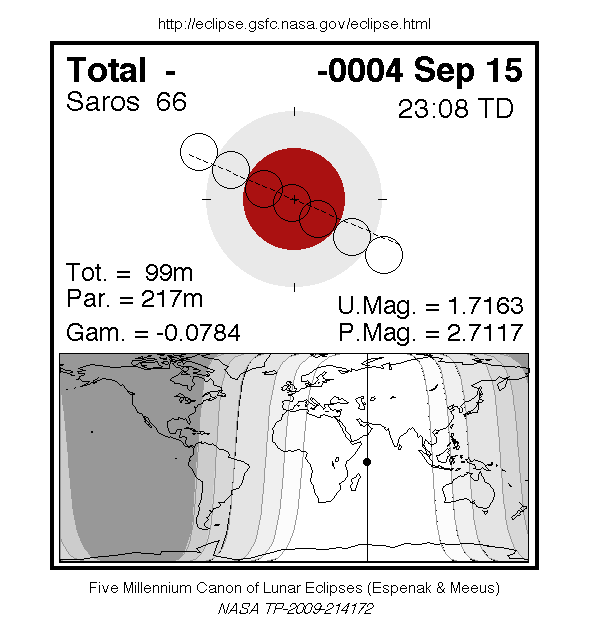
The Lunar Eclipse preceding the Death of Herod The Great

I have in the past long favored the January 1 BC Eclipse.  But I have recently come to feel the mainstream view of it being the March 4 BC Eclipse is more supportable then we thought.

This may change my view on the year Jesus was born but it won't significantly for when in the year.

Herod died when Passover was the next High Holy Day no matter what, and I still feel strongly convinced that comparing Matthew and Luke's accounts must place Herod's death before Jesus was presented in The Temple on the 40th Day.  Unless some really shocking chronological argument can be made.  Because I feel it doesn't make sense for the presentation to happen in Jerusalem before the Magi arrive.  So Jesus was most likely born in a winter month.

Taken from this exchange.
There are three principal reasons why the 4 B.C. date has prevailed over 1 B.C. These reasons were articulated by Emil Schürer in A History of the Jewish People in the Time of Jesus Christ, also published in the 19th century. First, Josephus informs us that Herod died shortly before a Passover (Antiquities 17.9.3, The Jewish War 2.1.3), making a lunar eclipse in March (the time of the 4 B.C. eclipse) much more likely than one in December.
Second, Josephus writes that Herod reigned for 37 years from the time of his appointment in 40 B.C. and 34 years from his conquest of Jerusalem in 37 B.C. (Antiquities 17.8.1, War1.33.8). Using so-called inclusive counting, this, too, places Herod’s death in 4 B.C.
Third, we know that the reign over Samaria and Judea of Herod’s son and successor Archelaus began in 4 B.C., based on the fact that he was deposed by Caesar in A.U.C. (Anno Urbis Conditae [in the year the city was founded]) 759, or A.D. 6, in the tenth year of his reign (Dio Cassius, Roman History 55.27.6; Josephus, Antiquities 17.13.2). Counting backward his reign began in 4 B.C. In addition, from Herod the Great’s son and successor Herod Antipas, who ruled over Galilee until 39 B.C., who ordered the execution of John the Baptist (Mark 6:14–29) and who had a supporting role in Jesus’ trial (Luke 23:7–12), we have coins that make reference to the 43rd year of his rule, placing its beginning in 4 B.C. at the latest (see Morten Hørning Jensen, “Antipas—The Herod Jesus Knew,” BAR, September/October 2012).
Thus, Schürer concluded that “Herod died at Jericho in B.C. 4, unwept by those of his own house, and hated by all the people.”
Jeroen H.C. Tempelman
New York, New York
While I know you can play games on how to reckon what Josephus said of the length of Herod's reign.  The argument we've made that the reigns of Antipas and Archelus must have included Co-Regencies simply doesn't work.  The death of Antipater is synchronized to the Death of Herod, Herod died 5 days later.  So you can't move Herod's death to a later year but keep Antipater's in 4 BC as I've seen some but not all 1 BC arguments do.  It was after Antipater died that Herod changed his will to the arrangement that wound up happening.

The reference connecting the Eclipse to a Fast has been used by 1 BC and September 5 BC advocates to support making it Yom Kippur.  This connects to a desire to see any unspecified Fast as Yom Kippur even though that day isn't stickily a Fast day though it's popular to Fast on it, and is not even the main fast day of it's own month. (that would be Yom Gedlaiah, the third of Tishri).

Here is the thing I've noticed that even most arguing for the March 4 BC Eclipse overlook.  What Josephus says is that the Eclipse of the Moon happened the night the Fast day ended, no gap.

First in case you didn't know, Jewish days begin and end at Sunset.

Second the Biblical New Moon/Rosh Codesh is the first visible crescent, not the day the Moon is invisible.  So Full Moons (the only day a Lunar Eclipse can happen) are the 14th day of each Hebrew Month, not the 15th as the Blood Moon theorists claimed.

In other words, this Fast must have been the Thirteenth day of it's Hebrew Month. So that doesn't fit Yom Kippur which is the 10th, or any of the 4 major Fast days linked to the fall of Jerusalem which are the 9th, 17th, 3rd and 10th days of their months.

The only Jewish Fast day we know of that was being kept at that time that would have been the 13th day of the Month, was the Fast of Esther, which is the 13th of Adar, the day before Purim.  Meaning this Full Moon was Purim, meaning of the 4 lunar eclipses considered likely, only March 4 BC fits.

Now I should mention that since I and others have seen "Blood Moons" on Full Moons that neither Stelarium or other Astronomers recognize as such (like in August of 2015).  I'm not confident the Eclipse Josephus mentioned can be identified by any modern means at all.  But either way it must be a 14th day of a Month and of known Fasts only Adar has one on the 13th.

Now the argument still remains that one month between the Eclipse and Passover doesn't quite seem enough for everything Josephus says happened.  It could be there was a Second Adar (Modern Rabbinic Judaism observes Purim in 2nd Adar but the Biblical reckoning favored by Kariates which may have still been the one used at this time clearly defines it as in the 12th Month which second Adar wouldn't be).  Or maybe all these events caused Passover to be pushed back to Second Passover.  Or maybe Joesphus who sometimes was less chronological then you'd expect wasn't putting as much in that time-frame as we think.

Some have calculated 20 or 21 days from the Death of Herod till Passover.  Which could put the Death of Herod on the 25th of Adar, same day traditionally viewed as the Death of Nebuchadnezzar (Jeremiah 52:31).

Is it possible Jesus was presented in The Temple on the first of Nisan?  Same day the Tabernacle was first set up according to Exodus 40?  Or that his birth was Shevet 24, the day Zechariah was given the Prophecy recorded in Chapter 1 verses 7-16?  Would not quite match the traditional date but be closer to it then others.

The main reason why many Christians regardless of what day of the year they favor feel the need to push Herod's death later is assumptions that I feel are mistaken about what we're told in Luke 3.

 Another factor is a desire to affiliate the Census of Luke 2 with a 3 or 2 BC Oath of Obedience to Augustus, which I've argued for myself in the past.  But I now just focus on that the main Imperial Censusus Augustus ordered he allowed 5 years to be carried out in the various regions, so you can go with the 8 BC Census and still have it carried out in Judea, Syria and Cyrene anywhere between then and 3 BC.

The first error of how we commonly view Luke 3 is saying it placed the Baptism of Jesus when he began to be about 30 in the 15th Year of Tiberius.  But it doesn't, the reference to the 15th Year of Tiberius at the start of the Chapter is totally unconnected to the Baptism account.  Paul in Acts 13 says John "Completed his course" before he Baptized Jesus. I'm not sure what that means exactly. but I think it's good evidence against assuming the Baptism was the same year John began his ministry or any other key event of Luke 3.  But doesn't rule it out entirely either.

BTW, I've become convinced of an argument that what Luke meant by the Greek phrase translated "Began to be about 30" was that Jesus was "almost" 30.

Luke 3 is clearly not being purely strictly Chronological since verse 20 has John put in Prison then verse 21 describes his Baptism of Jesus.

Luke 3:1-2 tells us that the "Word of God" came unto John in the wilderness in the 15th Year of Tiberius.  Then we get a basic account of who John was and what he was doing.  Then it talks about him preaching against Antipas and Heordias and getting imprisoned for it.

It could be the 15th Year of Tiberius is when he preached against Herod Antipas marriage to Heordias, (perhaps because that was the year he married her) and was imprisoned for it.  And that this doesn't tell us when John began his ministry at all.  And so both that and Jesus Baptism could have preceded the 15th year of Tiberius.

My argument above would have Jesus turn 30 before Passover in early 27 AD.

I'm not entirely willing to throw out the chronology of Jesus Birth I argued for before.  But I feel I must acknowledge that the 4 BC Death of Herod is fitting pretty well with my latest research.

I absolutely still believe Jesus ministry was less then a year.  And still heavily favor 30 AD as the Crucifixion. date.  What I'm now willing to consider is that there was more time then you'd expect between the Baptism and the beginning of His proper Ministry.

Luke 4 tells us his time in the Wilderness and Temptation was soon after his Baptism.  Then He returned to Galilee and had a local ministry of sorts for an unspecified amount of time (Luke 4:14-15).  Then Luke 4:16 begins the account of His proper main Ministry.

Returning to the Eclipse in question.  The argument for the Fast being Yom Kippur is the emphasis on the High Priest having duties that day.  As the Jewish Encyclopedia says.  While Yom Kippur is the busiest day of the year for the High Priest, it's not the only day he has responsibilities.  At any-rate if Josephus was exaggerating when he made it sound like the Eclipse was the very next day, which is what you'd have to argue for it to be Yom Kippur, then the statement mostly becomes chronologically useless.  If it was Yom Kippur then it still must have been the next full moon which makes only the September 15 5 BC fit in which case the next Passover is still the same Passover.