Monday, June 6, 2016

The Lunar Eclipse preceding the Death of Herod The Great

I have in the past long favored the January 1 BC Eclipse.  But I have recently come to feel the mainstream view of it being the March 4 BC Eclipse is more supportable then we thought.

This may change my view on the year Jesus was born but it won't significantly for when in the year.

Herod died when Passover was the next High Holy Day no matter what, and I still feel strongly convinced that comparing Matthew and Luke's accounts must place Herod's death before Jesus was presented in The Temple on the 40th Day.  Unless some really shocking chronological argument can be made.  Because I feel it doesn't make sense for the presentation to happen in Jerusalem before the Magi arrive.  So Jesus was most likely born in a winter month.

Taken from this exchange.
There are three principal reasons why the 4 B.C. date has prevailed over 1 B.C. These reasons were articulated by Emil Schürer in A History of the Jewish People in the Time of Jesus Christ, also published in the 19th century. First, Josephus informs us that Herod died shortly before a Passover (Antiquities 17.9.3, The Jewish War 2.1.3), making a lunar eclipse in March (the time of the 4 B.C. eclipse) much more likely than one in December.
Second, Josephus writes that Herod reigned for 37 years from the time of his appointment in 40 B.C. and 34 years from his conquest of Jerusalem in 37 B.C. (Antiquities 17.8.1, War1.33.8). Using so-called inclusive counting, this, too, places Herod’s death in 4 B.C.
Third, we know that the reign over Samaria and Judea of Herod’s son and successor Archelaus began in 4 B.C., based on the fact that he was deposed by Caesar in A.U.C. (Anno Urbis Conditae [in the year the city was founded]) 759, or A.D. 6, in the tenth year of his reign (Dio Cassius, Roman History 55.27.6; Josephus, Antiquities 17.13.2). Counting backward his reign began in 4 B.C. In addition, from Herod the Great’s son and successor Herod Antipas, who ruled over Galilee until 39 B.C., who ordered the execution of John the Baptist (Mark 6:14–29) and who had a supporting role in Jesus’ trial (Luke 23:7–12), we have coins that make reference to the 43rd year of his rule, placing its beginning in 4 B.C. at the latest (see Morten Hørning Jensen, “Antipas—The Herod Jesus Knew,” BAR, September/October 2012).
Thus, Schürer concluded that “Herod died at Jericho in B.C. 4, unwept by those of his own house, and hated by all the people.”
Jeroen H.C. Tempelman
New York, New York
While I know you can play games on how to reckon what Josephus said of the length of Herod's reign.  The argument we've made that the reigns of Antipas and Archelus must have included Co-Regencies simply doesn't work.  The death of Antipater is synchronized to the Death of Herod, Herod died 5 days later.  So you can't move Herod's death to a later year but keep Antipater's in 4 BC as I've seen some but not all 1 BC arguments do.  It was after Antipater died that Herod changed his will to the arrangement that wound up happening.

The reference connecting the Eclipse to a Fast has been used by 1 BC and September 5 BC advocates to support making it Yom Kippur.  This connects to a desire to see any unspecified Fast as Yom Kippur even though that day isn't stickily a Fast day though it's popular to Fast on it, and is not even the main fast day of it's own month. (that would be Yom Gedlaiah, the third of Tishri).

Here is the thing I've noticed that even most arguing for the March 4 BC Eclipse overlook.  What Josephus says is that the Eclipse of the Moon happened the night the Fast day ended, no gap.

First in case you didn't know, Jewish days begin and end at Sunset.

Second the Biblical New Moon/Rosh Codesh is the first visible crescent, not the day the Moon is invisible.  So Full Moons (the only day a Lunar Eclipse can happen) are the 14th day of each Hebrew Month, not the 15th as the Blood Moon theorists claimed.

In other words, this Fast must have been the Thirteenth day of it's Hebrew Month. So that doesn't fit Yom Kippur which is the 10th, or any of the 4 major Fast days linked to the fall of Jerusalem which are the 9th, 17th, 3rd and 10th days of their months.

The only Jewish Fast day we know of that was being kept at that time that would have been the 13th day of the Month, was the Fast of Esther, which is the 13th of Adar, the day before Purim.  Meaning this Full Moon was Purim, meaning of the 4 lunar eclipses considered likely, only March 4 BC fits.

Now I should mention that since I and others have seen "Blood Moons" on Full Moons that neither Stelarium or other Astronomers recognize as such (like in August of 2015).  I'm not confident the Eclipse Josephus mentioned can be identified by any modern means at all.  But either way it must be a 14th day of a Month and of known Fasts only Adar has one on the 13th.

Now the argument still remains that one month between the Eclipse and Passover doesn't quite seem enough for everything Josephus says happened.  It could be there was a Second Adar (Modern Rabbinic Judaism observes Purim in 2nd Adar but the Biblical reckoning favored by Kariates which may have still been the one used at this time clearly defines it as in the 12th Month which second Adar wouldn't be).  Or maybe all these events caused Passover to be pushed back to Second Passover.  Or maybe Joesphus who sometimes was less chronological then you'd expect wasn't putting as much in that time-frame as we think.

Some have calculated 20 or 21 days from the Death of Herod till Passover.  Which could put the Death of Herod on the 25th of Adar, same day traditionally viewed as the Death of Nebuchadnezzar (Jeremiah 52:31).

Is it possible Jesus was presented in The Temple on the first of Nisan?  Same day the Tabernacle was first set up according to Exodus 40?  Or that his birth was Shevet 24, the day Zechariah was given the Prophecy recorded in Chapter 1 verses 7-16?  Would not quite match the traditional date but be closer to it then others.

The main reason why many Christians regardless of what day of the year they favor feel the need to push Herod's death later is assumptions that I feel are mistaken about what we're told in Luke 3.

 Another factor is a desire to affiliate the Census of Luke 2 with a 3 or 2 BC Oath of Obedience to Augustus, which I've argued for myself in the past.  But I now just focus on that the main Imperial Censusus Augustus ordered he allowed 5 years to be carried out in the various regions, so you can go with the 8 BC Census and still have it carried out in Judea, Syria and Cyrene anywhere between then and 3 BC.

The first error of how we commonly view Luke 3 is saying it placed the Baptism of Jesus when he began to be about 30 in the 15th Year of Tiberius.  But it doesn't, the reference to the 15th Year of Tiberius at the start of the Chapter is totally unconnected to the Baptism account.  Paul in Acts 13 says John "Completed his course" before he Baptized Jesus. I'm not sure what that means exactly. but I think it's good evidence against assuming the Baptism was the same year John began his ministry or any other key event of Luke 3.  But doesn't rule it out entirely either.

BTW, I've become convinced of an argument that what Luke meant by the Greek phrase translated "Began to be about 30" was that Jesus was "almost" 30.

Luke 3 is clearly not being purely strictly Chronological since verse 20 has John put in Prison then verse 21 describes his Baptism of Jesus.

Luke 3:1-2 tells us that the "Word of God" came unto John in the wilderness in the 15th Year of Tiberius.  Then we get a basic account of who John was and what he was doing.  Then it talks about him preaching against Antipas and Heordias and getting imprisoned for it.

It could be the 15th Year of Tiberius is when he preached against Herod Antipas marriage to Heordias, (perhaps because that was the year he married her) and was imprisoned for it.  And that this doesn't tell us when John began his ministry at all.  And so both that and Jesus Baptism could have preceded the 15th year of Tiberius.

My argument above would have Jesus turn 30 before Passover in early 27 AD.

I'm not entirely willing to throw out the chronology of Jesus Birth I argued for before.  But I feel I must acknowledge that the 4 BC Death of Herod is fitting pretty well with my latest research.

I absolutely still believe Jesus ministry was less then a year.  And still heavily favor 30 AD as the Crucifixion. date.  What I'm now willing to consider is that there was more time then you'd expect between the Baptism and the beginning of His proper Ministry.

Luke 4 tells us his time in the Wilderness and Temptation was soon after his Baptism.  Then He returned to Galilee and had a local ministry of sorts for an unspecified amount of time (Luke 4:14-15).  Then Luke 4:16 begins the account of His proper main Ministry.

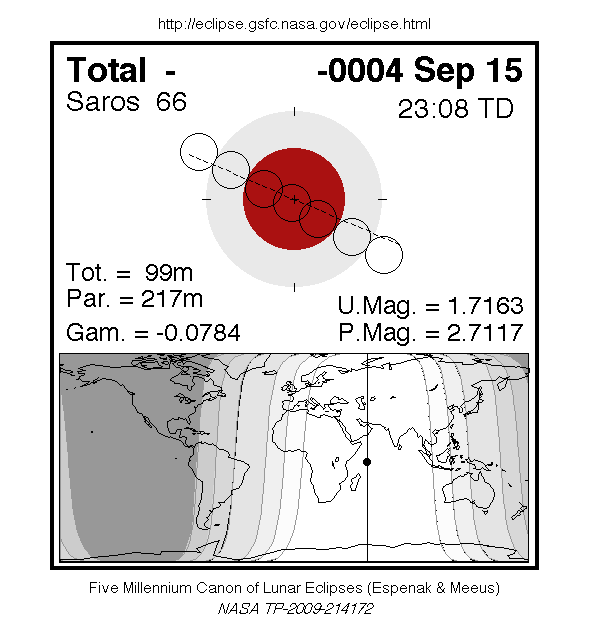
Returning to the Eclipse in question.  The argument for the Fast being Yom Kippur is the emphasis on the High Priest having duties that day.  As the Jewish Encyclopedia says.  While Yom Kippur is the busiest day of the year for the High Priest, it's not the only day he has responsibilities.  At any-rate if Josephus was exaggerating when he made it sound like the Eclipse was the very next day, which is what you'd have to argue for it to be Yom Kippur, then the statement mostly becomes chronologically useless.  If it was Yom Kippur then it still must have been the next full moon which makes only the September 15 5 BC fit in which case the next Passover is still the same Passover.

Friday, June 3, 2016

The Day-Year theory

This theory is pretty much vital to Historicism as traditionally understood, that model largely can't work without it.

The cited Biblical precedent comes from Numbers 14:34 and Ezekiel 4:6.  In both cases a literal period of days did happen.  Numbers connected the 40 days of spying to the 40 years in the wilderness.  And Ezekiel is told to do something for a period of days to represent a period of years.

This is not consistent with how the theory gets applied to the numbers in Daniel and Revelation.  Neither verse justifies saying when God predicts a period of days will happen it really means years.

Even IF I conceded that flawed argument, that doesn't change the verses that refer to 42 months or a "time times and half a time".  You don't get to just say "a month is 30 days" because it actually isn't universally.

In both Hebrew and Greek the words used for month were also forms of their words for Moon.  While I believe the 42 months and 1260 days are referring to roughly the same periods, I don't believe what's specifically said of the months (one of which is the time period of the Beast's reign) has to be calculated to the day, it just means 42 New Moons will happen.  The Bible would not have used this terminology if it didn't want us keeping the Moon in mind for deciphering it.

What I'm saying is, unless you can find a way to make 30 years or about that also relevant to The Moon, the Historicist position on 42 months simply can't work.

And it is 42 Months that Revelation 13 defines the reign of The Beast as lasting, as well as the Holy City trodden under foot of The Gentiles in Revelation11.

Of the three ways this time frame is described in Revelation/Daniel, I think the "time times and half a time" is the easiest to interpret differently.  But Daniel 4 uses a similar concept where if the "seven times" aren't years they are probably shorter periods rather then longer ones.

And even if I conceded all that.  It doesn't change that the clear chronology of Revelation does not allow the 1260 days of Revelation 11 to be the same as the 1260 days of Revelation 12, the latter can't begin till the former ends, and that transition point is where The Rapture happens.

But even following all of that flawed logic.  Every model I've seen (which are all The Papacy is the Antichrist models) has the mortal wounding of the Beast ending the 42 months (usually with Napoleon's conquest of the Papal States).  While I feel the logical reading of Revelation 13 is that 42 months is the time the Beast is allowed to continue following the Wound being healed.  As well as that the wounding was specifically to one of the Heads.

This Historicist argument tends to be the only time when the fraudulent Donation of Constantine is actually treated as real by Anti-Catholics, as it is sometimes used to determine the start date.

Interestingly enough though, the Day-Year theory doesn't remove Three and a Half years from Bible Prophecy altogether, because Revelation 11 gives us Three and a Half days from the Deaths of the Two Witnesses till their Resurrection and Rapture.

Has any Historicist ever addressed the Five Months affiliated with the 5th Trumpet in Revelation 9?  I believe their purpose is partly to echo the timeline of The Flood narrative.

I can't entirely condemn their desire to see the 6th head as not actually contemporary with when John wrote Revelation since I've argued for that myself in the past though it's not my current main view on the Seven Heads.  But I've never seen a strong Papal View argument for why this was expressed to the John from that viewpoint.  Mostly it seems to be expressed now days with Pope John Paul II as the 6th head, the contemporary Pope while many modern Day-Year theorists defined their views.

I feel if we accept that 6th Head as not actually when Revelation was written it must be either a time already in the Past when John wrote, something contemporary readers could have seen as significant.  Or the 6th is during the Eschatological Week, perhaps reigning as it starts.  As far as an already past modern historical time goes, only the founding of Israel in 1947-1949 is a remotely viable option.

The Papal fixation is dependent on the "Temple in II Thessalonians 2 is really The Church" error.

It's interesting how Historicism seems to have the least variety in it's Antichrist views.  Even Preterism occasionally has options besides being a Roman Emperor.

I could hypothetically devise a Non-Papal view that can be just about as consistent with all the flawed arguments made above.  It focuses on the Eastern Roman Empire rather then Western, and thus on Eastern Orthodox Christianity as the Harlot.

It begins with arguing that the Split of the Empire really happens in 193 AD in April when Pescennius Niger was proclaimed Emperor in Syria.  Then the 1260 days ends with the fall of Constantinople in 1453 AD.  Then, since Modern Greece views itself as a successor to that state, it's Seven Kings were the Seven Heads, and in that case the 6th was reigning in 1948.  I considered that idea from my purely Futurist perspective here.

But again, that view would have mostly the same problems.

Historicists tend to share the bias Futurists have for wanting to believe the Millennium will start within our lifetime.  And since they tend to feel the start of these periods needs to be after Revelation was written.  It'll be awhile before any are willing to suggest there are two 1260 years periods, with the second starting about where the first will end.  To me the plain reading of Revelation does not allow the two periods to be happening at the same time.

Historicism is not as inherently objectionable to me as Full Preterism, or Amillenialism.  Since it does not require denying a literal Bodily Resurrection of believers.

And I am kind of rejecting the Individual Antichrist as it's usually defined.  But the Abomination of Desolation I will always see as a specific event three and a half or seven years before the Millennium starts.

If you want to convince me of an Historicist model, you need to find a way to make it work without the Day-Year Theory.

Wednesday, June 1, 2016

Mid-Trib possibly predates Pre-Trib

As I said before, I believe a view popping up late is not an argument against it, which is why I disagree with trying to use that logic to refute Pre-Trib.  At any rate only Post-Tribers can use that argument consistently because only that view existed among the Pre-Nicean fathers. 

But Mid-Trib (which my view vaguely qualifies as, but isn't traditional Mid-Trib as defined by Wikipedia) has to deal with a perception that clearly Pre-Trib and Post-Trib both came first and it was merely created as a compromise.  (But the undeniably far younger Pre-Wrathers can't accept that argument so they focus on calling us "a Defunct view").

Pre-Tribulationism along with Dispensationalism are traditionally attributed to Darby in the early 19th Century.  Though the truth is Darby was just copying and repackaging the views of Edward Irving who lived about the same time.

The attempts of Pre-Tribbers to give their view a greater antiquity include Ephraim the Syrian which claim I've already debunked.  A statement in the Apocalypse of Peter which is ambiguous but at the very least is clearly predicting The Church to face Tribulation first.  And attempts to read it into any reference to "Imminence" among the Church Fathers same as they do The New Testament itself.

Also Increase and Cotton Mather of the Seventeenth Century are claimed, but from what I have been able to read they seem pretty post-Trib to me, but Increase was adamant about a future conversion of the Jews which modern Post-Trib tends to reject.

Another name thrown out is Manuel Lacunza who died in 1801.  He was a Jesuit Priest who's eschatological work was published under a false name.  His book can be read online and I've seen nothing Pre-Trib in it and have seen others say outright that those labeling him Pre-Trib are lying.

However there is one claim of a Pre Irving and Darby teacher teaching a Rapture separate from the Revelation 19 event that holds up under scrutiny.  And that is Morgan Edwards a Baptist preacher who lived from 1722-1795.  However his timeline placed the Second Coming and Resurrection and Gathering of Believers not Seven but Three and a Half years before the start of the Millennium.
"The distance between the first and second resurrection will be somewhat more than a thousand years. I say, somewhat more—, because the dead saints will be raised, and the living changed at Christ's "appearing in the air" (I Thes. iv. 17); and this will be about three years and a half before the millennium, as we shall see hereafter: but will he and they abide in the air all that time? No: they will ascend to paradise, or to some one of those many "mansions in the father's house" (John xiv. 2), and disappear during the foresaid period of time. The design of this retreat and disappearing will be to judge the risen and changed saints; for "now the time is come that judgment must begin," and that will be "at the house of God" (I Pet. iv. 17)."-Two Academical Exercises on Subjects Bearing the following Titles; Millennium, Last-Novelties.
His model is different then my view still based on how he defined Tribulation and when he places the time of the Two Witnesses.  Here is a Pre-Trib site talking about him.

So the best evidence for a Pre-Darby separate Rapture is clearly a Mid-Trib one.

The only Medieval example that can be found of a Futurist view other then Post-Trib was a cult leader trying to give a special Last Prophet status to himself.  His timeline is complicated and confusing but clearly allows no more then Three and a Half years.
"Again, [Dolcino believed and preached and taught] that within those three years Dolcino himself and his followers will preach the coming of the Antichrist. And that the Antichrist was coming into this world within the bounds of the said three and a half years; and after he had come, then he [Dolcino] and his followers would be transferred into Paradise, in which are Enoch and Elijah. And in this way they will be preserved unharmed from the persecution of Antichrist. And that then Enoch and Elijah themselves would descend on the earth for the purpose of preaching [against] Antichrist. Then they would be killed by him or by his servants, and thus Antichrist would reign for a long time. But when the Antichrist is dead, Dolcino himself, who then would be the holy pope, and his preserved followers, will descend on the earth, and will preach the right faith of Christ to all, and will convert those who will be living then to the true faith of Jesus Christ."
Source [Gumerlock's translation of the Latin text in Gumerlock, "A Rapture Citation," pp. 354-55.].

Mid-Trib is often accused of not popping up till the early or mid 20th Century.

But between Edwards and that point is a book predicated on claiming Louise-Napoleon III was the Antichrist (written while he was still Emperor) that predicts the Rapture to happen during the third year of the seven years, which is discussed in Chapter V (pages 77-81).  So a weird view, but shows that alternatives to Pre or Post Trib were always being considered.

Going back to Pre-Darby, other 17th and 18th Century references cited are all vague, some do sound like they view the Rapture and the start of the Millennium as separate, but the exact timing is not made clear.  They may not have picked a side in Pre-Trib vs Mid-Trib at all.  These include Peter Jurieu, and Thomas Collier.

Peter Jurieu clearly did not teach a Secret Rapture, he refereed to it as a Glorious Apparition.  Some criticisms of attempts to find early examples of Pre-Trib are discussed here.  But it's unaware of Morgan Edwards.

Update February 7th 2018:  I've read now some critics of seeing Edwards as Pre-Trib.

Some will respond that Morgan Edwards seems to have been a Historicist and not Futurist at all.  He seems to have had some Hsitoricsts elements (it being ingrained in Protestant tradition has Futurists to this day saying things that sound Historicist).  But his limiting the ministry of the Witnesses to the three and a half years between the Resurrection and the Millennium makes him clearly not a pure Historicist.

The only basis for three and a half years in a pure Historicist Day=Year theory model would be the three and a half days between the Death and Resurrection of the Two Witnesses.  That makes it pretty difficult to have exactly three and a half years between the Rapture and the start of the Millennium.

Historicism inherently has more in common with Mid-Trib then Post-Trib because it's more open to accepting the Chronology of Revelation at face value.

This Morgan Edwards was a Historicist argument takes this quote. "there are no more than about 204 years between now and their death: I should therefore expect that their appearance is not far off." as supporting him being a Historicist.  If their death was 204 years away at most, then the Hisotricist model should have had them appear over a Thousand Years before Edwards' own time.  The fact is Edwards took the Witnesses far to literally for proper Historicism.

The Hisotricist elements in what he taught involved stuff about the Ottoman Turks being a Beast and the Papacy being the Man of Sin of 2 Thesselonians 2.  Stuff I've seen plenty of Futurists incorporate into Futurist models.  For the former I myself believe the Beast Empire will emerge out of Geo-political entities that already exist, and what role Turkey might play in that my mind has changed on a few times.  And for the latter, there is no shortage of Futurist Papal-Antichrist views within Protestant circles.  In fact I was encountering it long time before I even learned it was traditionally associated with a non-Futurist model.

Here is another quote from Edwards on the Subject.
Another event previous to the Millennium will be the appearing of the son of man in the clouds, coming to raise the dead saints and change the living, and to catch them up to himself, and then withdrawing with them, and observed before, This event will come to pass when Antichrist be arrived at Jerusalem in his conquest of the world; and about three years and a half before his killing the witnesses, and assumption of godhead.
It certainly shows he was not teaching a Historicist view on the Two Witnesses.  In a sense it hurts reading him as Mid-Trib in that it places the Abomination of Desolation three and a half years after The Rapture.  Some tend to place when  he conquers Jerusalem as about the same time as the Abomination.  I personally am not sure he'll "conquer" Jerusalem at all.

So I may now have to retract what was the central example of this post.  It seems he may well effectively fit the proper definition of Pre-Trib, but simply sees the total time-frame in mind as only three and a half years.  It's weird that he doesn't place the Abomination of Desolation at the halfway point, but about a month before the Millennium starts.

Pre-Tribbers aren't trying to keep his quotes out of context, as the RaptureReady website posts the whole work.   http://www.raptureready.com/morgan-edwards/.  Though I had trouble getting the first part to load.  The third part contains the quotes used to make him seem Historicist. However he goes on to say.
"The abomination intentioned by Daniel is supposed to be that which Antiochus Epiphanes set up in the temple; but that was before Christ time many hundred years; the Romans set up no abomination in the temple; for it was destroyed before they could gain possession of it; therefore Christ refers to a thing that is yet to come; and to a temple that is not yet extant."
Something that is inherently Futurist.

The context of the 204 years quote was him saying he thinks the Witnesses will appear in some sense before they begin the proper 1260 day Ministry.   He also argued for the Witnesses being Elijah and John who wrote Revelation.  So no he was not supporting any Day=Year theory here.

He also clarified the Antichrist will be the last Pope.  He was not saying All Popes are collectively The Antichrist.

At the end of section 3 he clearly separates the Second Coming from the Rapture, which is a fairly inherently Pre-Trib thing to do.

I get really frustrated reading on, as he clearly anticipates a lot of conventional Dispensational memes.  Like separating the Gog and Magog of Revelation 20 from Ezekiel 38.  He also teaches the Zionism typical of Darby inspired Dispensationalism.

And I've found a PDF link where you can read all of it.
http://www.pre-trib.org/data/pdf/Edwards-TwoAcademicalExercis.pdf

Morgan Edwards may very well qualify as the first Futurist of the English Speaking world, and maybe also the Protestant world.  Everything else I've studied about 16th-18th Century Eschatology debates pretty much treats Premillenialism as synonymous with Historicism.

Update April 9th 2019:

 The PDF Link I provided for reading Morgan Edwards online doesn't work anymore, however the Rapture Ready website seems to have fixed the problem they had for Section 1.

The Apocalypse of Elijah is another text I've seen Pre-Tribbers throw around as Ancient Precedent for a Pre-Trib Rapture.  But again this text clearly fits Mid-Trib far better, as it clearly has The Antichrist persecuting Christians and martyring Enoch and Elijah in chapter 4, before the Rapture in chapter 5.

I can't be certain what Methodius of Olympus over all chronology for Revelation was.  But his teaching that The Man-Child is the Saints rather then Jesus is pretty hard to reconcile with Post-Trib.

Thursday, May 26, 2016

Isaiah 19 possibly about Ptolemaic Egypt?

I've argued before for a large part of Isaiah 19 being about 20th Century Egypt and the Aswan Damn.   And I'm still compelled by that, but it requires significant gaps to tie in with other parts of the Prophecy.

Given my recent realignments in how to think of Egypt's role in Bible Prophecy over all.  I decided to go over this chapter again, and I think a strong argument can be made for it being about some Ptolemaic History, maybe crossing over at the end into the Time of Christ.

Let's go over it verse by verse.
The burden of Egypt. Behold, Yahuah rideth upon a swift cloud, and shall come into Egypt: and the idols of Egypt shall be moved at his presence, and the heart of Egypt shall melt in the midst of it.
The first verse is arguably the strongest argument for this being End Times, with Yahuah riding on a Cloud, but such imagery is not uncommon in the Hebrew Scriptures.
And I will set the Egyptians against the Egyptians: and they shall fight every one against his brother, and every one against his neighbour; city against city, and kingdom against kingdom.
Some people have argued the "Kingdom Against Kingdom" statement here may be what Jesus was drawing on in the Olivite Discourse.  But in the context of Ancient Egypt this terminology is likely meant to make one think of Egypt's traditional division between Upper and Lower Egypt.

Now we often think of that as not a factor in Ptolemaic Egypt.  However during the reign of Ptolemy IV Philopater, a rebel named Horwennefer/Ankhwennefer proclaimed himself King in Thebes (Upper Egypt).  Ptolemy IV is also the villain in the controversial 3 Maccabees which I intend to discus in the future, but isn't relevant to this subject.
And the spirit of Egypt shall fail in the midst thereof; and I will destroy the counsel thereof: and they shall seek to the idols, and to the charmers, and to them that have familiar spirits, and to the wizards.
Ptolemaic Egypt was very important to the history of the occult.  Particularly the cult of Serapis.  But also Gnosticism was born from combining aspects of Platonic Philosophy and Egyptian religious ideas, then later the most famous forms of it gave it Judeo-Christian dressing.
And the Egyptians will I give over into the hand of a cruel lord; and a fierce king shall rule over them, saith the Lord, Yahuah of hosts.
The brief independence of Upper Egypt was put down by Ptolemy IV's son, Ptolemy V Epiphanes.  (Coincidentally he has the same infamous epithet as as the Seleucid Antiochus IV, who is so often a subject of Bible Prophecy discussions.)  Ending Horwennefer's reign wasn't the only internal conflict he dealt with either (going back to verse 2).

Wikipedia twice uses the word "cruel" dealing with Ptolemy Epiphanes putting down these insurgents.  For one of them citing this Historical Source as a reference.
The king, says Polybius, "treated them cruelly, and fell into many dangers."
Which in turn quotes Polybius.

Verses 5 through 10 are the center piece of the Aswan Damn argument.  And I still partly feel only what happened then can (so far) fit the full scale of what's described here.  But Ancient Egypt had many famines caused by the Nile drying up.  Is there evidence of a similar event during the time of Ptolemy V?

The argument that Imhotep is Joseph is largely dependent on the Famine Stele.  It is the only source linking Imhotep to a Seven year Famine.  But it still lacks the Seven years of plenty and other details about Joseph.  And Imhotep doesn't have his dream in advance, he's given a solution after there has already been seven years of famine.  And in The Bible it's the Pharaoh not Joseph who has the dream, making the Famine of Neferkasokar closer to being the same scenario but still not quite.

The reason I mention it here is it's an incredibly late Stele, it's Ptolemaic and even been specifically dated to the reign of Ptolemy V.  I've read some websites claim Imhotep was very popular during the reign of Ptolemy V.

What if it was a story told about a more ancient figure as a commentary on contemporary events?  Saying either that someone in their time did what is attributed to Imhotep here, or as a more critical commentary saying someone should have done what Imhotep did.

Verses 11-15 mentions Zoan.  What is meant by the Biblical Zoan is rather controversial.  The City of Tanis most likely meant in Isaiah's time was only strictly speaking the Capital during the 21st Dynasty.  I support the Revised Chronology view that the 21st Dynasty overlaps the Persian and Ptolemaic periods, and that a 21st Dynasty inscription mentions Alexander The Great at Siwa. [I've changed my mind on Revised Chronology, it's not really important here.]

Verses 16-17.
In that day shall Egypt be like unto women: and it shall be afraid and fear because of the shaking of the hand of Yahuah of hosts, which he shaketh over it.  And the land of Judah shall be a terror unto Egypt, every one that maketh mention thereof shall be afraid in himself, because of the counsel of Yahuah  of hosts, which he hath determined against it.
This is the most difficult part for this theory.

It was during the reigns of Ptolemy IV/V that Judea changed from being under Ptolemaic control to Seleucid under Antiochus III The Great.  This point in the Prophetic narrative of Daniel 11 is around verse 14&15, which has been taken as implying this happens because the people of Judah themselves sided with Antiochus over Ptolemy.  Josephus possibly supports this in Antiquities of the Jews Book 12 Chapter 3 Section 3.

If what 3 Maccabees claims about Ptolemy IV's treatment of The Jews has some truth to it, that could explain this change in allegiance.
In that day shall five cities in the land of Egypt speak the language of Canaan, and swear to Yahuah of hosts; one shall be called, The city of destruction.  In that day shall there be an altar to Yahuah in the midst of the land of Egypt, and a pillar at the border thereof to Yahuah.
Now we enter the part that is often taken one of two ways, sometimes both at the same time.  That this can only be Millennial, and that the Pillar/Altar is the great Pyramid.  That latter view I've debunked elsewhere, the former had been my main assumption, but now I'm thinking maybe not.

The five cities speaking Hebrew could well refer to Jewish settlements in Egypt made during and after the time of Alexander.  Which includes Alexandria which Josephus and Philo tell us was 2 Fifths Jewish in their time.

The argument that the "City of Destruction" is Heliopolis is absolutely valid.  From Wikipedia.
In the time of the major prophetsIsaiah made a reference to the City of the Sun as one of the five cities of Egypt that would come to speak Hebrew. However he made a wordplay on "city of the sun" (’ir hašemeš) by writing ’ir haheres which literally means "city of destruction".[Freedman, Myers, & Beck. Eerdmans Dictionary of the Bible, (ISBN 0802824005ISBN 978-0-8028-2400-4), “City of the Sun”, p. 261] These play of words were a prophetic description later reinforced by both Jeremiah and Ezekiel.[Isaiah 19:18 NLT] The Hebrew name, Beth-shemesh, where Beth means "house" and shemesh means "Sun" was also used to describe Heliopolis by Jeremiah. He prophesied this city's fate specifically when he declared that the king of Babylon, Nebuchadnezzar, would shatter the obelisks of Heliopolis and burn the temple of the sun in fire.[Jeremiah 43:13 NASB; Compare NIV] Jeremiah’s contemporary Ezekiel, reinforced this message by saying that the "young men of Aven (or Beth-Aven) would fall by the sword". Like Isaiah, Ezekiel also made a word play on the original Hebrew name of Heliopolis that was used in the time of Joseph, the city of On. The Hebrew word aven means "folly" or "iniquity", so that his reference implied "temple of folly" or "temple of iniquity".[Ezekiel 30:17 NIV]
So while I'd in the past like most assumed Onias IV's desire to apply this to his Temple in Leontopolis (a city in the district of Heliopolis) was totally spurious.  I'm now thinking it may not have been.

If the Elephantine Temple was still in use or at least partly still standing it could explain the Pillar at the border.   Some traditions from the Ethiopian Beta Israel community implies their ancestors still had a presence on Elephantine till the fall of Alexandria in 30 BC.

It was Ptolemy VI, the son and successor of Ptolemy V who gave Onias permission to build his Temple.
And it shall be for a sign and for a witness unto Yahuah of hosts in the land of Egypt: for they shall cry unto Yahuah because of the oppressors, and he shall send them a saviour, and a great one, and he shall deliver them.
Is it possible we've now leaped forward to the time of Christ?  Most uses of the peculiar noun form of this Hebrew word for "save" that the KJV renders "Saviour" (Moshiah) are taken as references to Jesus.  Egypt was under Roman occupation when Jesus was born.  Is it possible Jesus family visited the Onias Temple during their time in Egypt?

The talk of Assyria that follows could very well refer to Adiabene which became Jewish at this time, and also Osroene/Edessa, and the Highway to Roman Roads.  But Assyria in Isaiah's time would have included much of what was Roman Syria, including Antioch which became a major center of early Christianity.

Many Christians want to build a negative image of Alexandria's role in Church History because they say the Alexandrians were mentioned negatively in Acts 6.  But if you read all of that story it arguably implies these Alexandrians and Cyrnecians were eventually won over by Stephen's arguments.  Meanwhile Apollos we are told was from Alexandria.

This is one option for this Prophecy.  But I am open to other theories.

Wednesday, May 25, 2016

A Pre-Tribber on interpreting Revelation Chronologically

They and various forms of "Mid-Trib" like me seem to be the only ones inclined to take it Chronologically.

https://gracethrufaith.com/ask-a-bible-teacher/reading-revelation-chronologically/


Reading Revelation Chronologically


Q. John’s gospel is the least chronological of the four gospels. Events are out of order and a very unequal amount of verses are applied to certain events versus other events in Jesus’ life. So it would seem unlikely then that John’s book of Revelation would be completely in time order. Perhaps some parts of the Revelation are chronological, and others are placed thematically. This is a critical issue, since from reading your material it appears the primary basis of your belief in pre-Trib is because Rev 4 & 5 in chapter order precede the rest of the book. Can you please enlighten me as to how you see it and why?
A. I’ve read lots of opinions about whether the Revelation is chronological or not, and the only exceptions to a chronological reading that makes sense to me are;
1) John could only write about one thing at a time so there are places where multiple things are happening together and he could only describe them one at a time,
2) where he brought a particular subject to its conclusion before back tracking to pick up another train of thought, or
3) where he’s providing some background to help us understand something. These are all obvious. Otherwise, I don’t think it makes sense to depart from a chronological reading.
It’s not fair to compare the Revelation with John’s gospel. In the Revelation John was essentially “taking dictation” from the Lord, and the writing style is so different that some scholars debate whether he even wrote it.
Finally, there are several much stronger proofs for a pre-trib rapture that make a chronological reading of Revelation unnecessary to support the case for one.
My first objection is that taking it chronologically inherently helps Pre-Trib, Pre-Trib sees The Rapture not in Revelation at all so really it's chronology should be irrelevant to them.  I see it clearly in the middle of the book, from the latter part of Chapter 11 through chapter 14, with the key moment being The Rapture of the Man-Child.

1), His intent was clearly to try as much as possible to write things down as he saw them.

2), Certain subjects ARE clearly scattered about, the book is clearly not organized by subject, even The Beast gets a reference before his formal introduction.

3), This I assume is mainly about the mystery of the Seven heads, and maybe the various time statements.

The reason Revelation's Authorship confuses people is indeed because it was really written by Jesus with John as his stenographer.  It's actually wrong to say Jesus wrote none of The Bible.

Since Jack Kelly knows John's Gospel is the least Chronological, I wonder if he is wiling to admit Jesus ministry wasn't three years but only one tops.

Wednesday, May 18, 2016

Many of Chris White's videos seem to be down.

Youtube Videos to be exact.

Which is a problem for me given how often I used them as a source on this blog.  Some posts were nothing more then my commentary on what he said.

Tuesday, May 3, 2016

Middleism

Is a school of Eschatological thought I've recently been made aware of.

The description of it given to me is that they hold a Futurist view of Revelation and a Preterist view of Matthew 24.

So on Revelation we agree basically, that's good.

I've already argued against Preterist views of Matthew 24 in previous posts with the Preterism, 70 AD and Matthew 24 labels.

I assume they must also be Preterist on the other Olivte Discourse chapters, since Matthew's is literally the most difficult to make a Preterist interpretation work.  Much of Luke 21 I believe is about 70 AD.  At the same time Luke has a clear tie in to Revelation 11 with the part about Jerusalem being trodden under foot of The Gentiles.

I'm not sure what their views on 1 Thessalonians 4 and II Thessalonians 2 would be.  I have argued before they are essentially Paul's commentary on Matthew 24.

So the only things I should need to say specific to Middleism is how to prove with Scripture that Matthew 24 correlates to things in Revelation.  Since I've before criticized connecting the Four Horsemen to the "Non Signs" and gone back and forth on how if at all I feel the Matthew 24 Abomination of Desolation statement ties into Revelation 13.  I'm perhaps less able to do that then other Futurists.

But I do believe Matthew 24:14's statement about the Gospel being Preached to the whole world probably ties into Revelation 14.

Also Matthew 24 and Revelation are the only parts of Scripture that use the specific phrase "Great Tribulation" in Revelation 7 it's used of the multitude that is clearly the same multitude of martyrs seen in the Fifth Seal.  They all are Christian martyrs not just of a specific time period which is what puts me in conflict even with most Futurists.  As long as Christians are still being martyred (they are in most of the world, we just have it easy in the West) the Great Tribulation isn't over.

And I believe the Last Trumpet is the Seventh Trumpet.

And I believe the "Sign of the Son of Man" refers to either the Ark of the Covenant being seen in Heaven in Revelation 11 or to the signs of Revelation 12 which I believe will literally be seen in the Heavens before the Rapture.

And I believe the Son of Man coming on a Cloud is fulfilled in Revelation 14.

P.S.  Looking back on my earlier post about the Eschatological views of those who reject Paul as a False Prophet.   They were essentially a form of Middleism, believing Matthew 24 was a warning about Paul basically, but seemingly still treating Revelation as yet future.