This Blog is retired, for now check out this one. https://materialisteschatology.blogspot.com/
Friday, March 4, 2022
I now believe the Image of The Beast is going to be an NFT project of some sort.
Saturday, November 13, 2021
Eschatology views Tier Ranking
I'm going to rank various positions on Eschatology in terms of how I personally feel about them at the time of my writing this post on Saturday November 13th of 2021.
S Tier: The Position(s) I currently favor.
I'm currently a Pre-Millennial Futurist with a Rapture Position that can be called "Mid-Trib", but not what many assume Mid-Trib means in that what The Rapture is I view mostly the same as Post-Tribbers, it is the Second Coming, and from my position's own POV the Tribulation by definition ends at The Rapture. And The Last Trump is the Seventh Trumpet.
I also consider some Idealist readings of Revelation also true, it is also a symbolic summery of The Entire Biblical Meta narrative, but that doesn't conflict with it also being future events, because that's what every good final episode of a saga should be.
A Tier: Positions I'm currently very open to being converted to.
Historicism in it's Pre-Millennial form, Partial-Preterism and Revivalist post-Millennialism, or something that combines elements of those.
I kind of want to be convinced of something like that now given other things I believe. But it wouldn't be likely to be any in their current most well known forms, since my hypothetical Preterism wouldn't be 70 AD focused (not for Matthew, Mark or Revelation anyway) and my Historicism would be less fixated on The Vatican viewing Christian Monarchy in general as the Abomination of Desolation.
If I did abandon Futurism I would probably retire this blog and start a new one.
B Tier: Views I consider firmly wrong but not in any way heretical.
Middleism, only in that separating Matthew's Olivette Discourse from Revelation I view as untenable, whichever time period one is about so is the other.
Also any views where my only or main objections come down to not interpreting Revelation as Chronologically as I do. But thus far everyone I've seen doing that is also guilty of something down below, (It's mainly associated with Post-Trib, Chris White's Pre-Wrath and Preterism).
C Tier: Views I consider tied to Heresy but merely minor ones
Dispensationalism (Pre-Trib, some forms of Mid-Trib, the Pre-Wrath view of Chris White), Supersecessionism (Most forms of Post-Trib, probably some hypothetical forms of Mid-Trib, and also today most Non Futurists).
And also Domminionism which mainly manifests as Reconstructionist Post-Millennialism but can be made compatible with other views.
D Tier: Views heretical in their rejections of core doctrines of the Faith.
Any view that denies a literal bodily Resurrection of The Dead. Which is firmly required for Full Preterism and Amillenialism.
F Tier: Basically not even really Christian at all anymore.
Any view that identifies the Satan of The New Testament with YHWH The God of The Hebrew Bible. Like Marcionism and the most well known forms of Gnosticism.
Often goes hand in hand with throwing out Revelation altogether as a False Prophecy. But they may also selectively use stuff from Revelation. Also these people are generally also doing the D Tier Heresy.
Friday, October 2, 2020
The Languages of The Table of Nations
Genesis 10 says the Nations were divided according to their Languages, not bloodlines or DNA Haplogroups or geopolitical alliances, and then Genesis 11 explains how and why that happened.. If you study what the word "Ethnos" meant to the Ancient Greeks the same implication exists, language more then anything else decided what an "Ethnos" was, hence Barbarian originally meaning "non Greek speakers". There is also Biblical Support for what god you worship being equally a factor, but that's where Liturgical Languages come in.
On the subject of Japheth, almost every Liturgical Language of the Eastern Orthodox Church is Indo-European, the only exception is the Georgian Language interestingly, Georgia's ancient demographic relationships to the lands around it are uniquely complicated.
The big issue for trying to define Languages Biblically however is that the language of the ancient Canaanites is in the same Language Family as Hebrew, and very closely related in fact. Thus modern Linguistic Scholars classify it as a Semitic Language.
When Abraham and his nephew Lot left Mesopotamia for Canaan and then lived there a few generations before the captivity in Egypt, I think it's highly probable they dropped the language of their homeland and adopted the language of the Canaanites, or became Bilingual. And Isaiah 19 does in fact call the Language the Israelites and other YHWH worshipers were speaking the "Language of Canaan", so the Hebrew Bible itself defined this Language as belonging to Canaan not Heber. It's not till the New Testament during Greco-Roman times we start seeing that language called Hebrew.
Basically I think Abraham's family did the same thing Diaspora Jews of the Christian Era have repeatedly done, developed a modified form of the language of the people they sojourned among.
The same thing happened with the Philistines, they did not originate as descendants of Canaan but wound up speaking a Canaanite language after settling in the Gaza strip.
So the Language Family called Semitic today I think is Biblically Canaanite. But scholars also use Canaanite for a specific subgroup of that family (the one that includes Hebrew), that sub group I shall call Sidonian since that Tribe had the most influence over that immediate area.
Looking at that break down of the Semitic Language Family I got from Wikipedia, it's clear that the Abrahamic Tribes came to dominate some entire Branches. Nabatean and Aramaic both descend from Ishmael, Nabatean from Naboth, Kedar, Tema and Dumah, and than Aramaic from Hadad who was the name of the Patron deity of the earliest Aramaic speaking pagans. And then Arabic originated among the sons of Abraham by Keturah, perhaps chiefly Dedan son of Jokshan..
How can Genesis 10 Aram not be the father of the Aramaic Language? Well we know from Deuteronomy 26:5 that Abraham was sometimes called Aramean even though his direct Patralineal descent was from Arphaxad, I think some Ishmaelite Tribes may have had a similar idea.
One detail of that Map is out of date and that's implying Aramaic first emerged in Mesopotamia, linguistic scholars now agree it first emerged in the general area of Damascus. The city of Damascus proper wasn't truly founded till after 2000 BC and thus well after when I place even the latest events of Genesis. So I think it was Ishmaelites who founded that city and named it after the Damascus of Genesis 14-15 possibly because it was in the same area. Damascus is included in what I interpret to be the inheritance given to Ishmael, which is all of the Trans-Jordan part of what was Promised to Abraham. Zobah is probably where these Ishmaelites of Hadad lived first however, and then 1 Kings 11 explains how an offshoot of their civilization became a King of Damascus.
We know from 1 Chronicles 5 that the Jetur and Naphish tribes of Ishmael also resided in South West Syria, the region known as Iturea in New Testament times.
Ugarit I suspect was the original city of the Girgashites, and then the Amorites are who you'd assume they are, The Torah does hint a few times that the Amorite Language is distinct from the Sidonian Canaanites. Eteocyptriot if it's Semitic (there is dispute about it) may just come from Ugarites who colonized Cyrpus. [Update: my perspective on the Girgashites has changed, and my view on Ugarit now is them being an Amorite colony.]
Ebla and the Hamathite are the same in my current theory. Ironically the name Akkad itself is not Semitic, that city was originally Sumerian. It was Sargon's Empire that imposed this Semitic Language on all of Mesopotamia, and that makes me suspect Azupiranu was the actual Akkadian name of Akkad. Actually I think I should just identify the Hamathites as the ancestor of the entire Eastern branch.
The South Semites descended from various groups who traveled South and their history may be the subject of their own post in the future. But it is worth noting that Josephus said Abraham's children by Keturah were given Arabia Felix. I think the entire South Semite region of that map is what the Egyptians called the Land of Punt. Still I do think there may have been Canaanites who traveled there first. Actually I have decided to identity the Sinite with the South Semitic branch because of the Sinim in Isaiah 49:12.
Qahtan is traditionally identified with Joktan, James A. Montgomery however has pointed out that the etymology of that doesn't work. My theory that it refers to descent form Keturah isn't perfect either, but it at least begins with the right letter. So the Sheba of Yeman I do now unlike in the past identify with the Keturite Sheba. I also believe the Mineans of ancient Yemen were the descendants of Teman son of Eliphaz son of Esau.
Spiritual/Religious descent from the Canaanites is dead, any modern Neo-Pagan groups using Canaanite names for their gods have no actual continuity with them. So the Churches who's Liturgical Rites are East Syraic/Aramaic I view as the Eschatological Assyria of Isaiah 11 and 19 alongside the Coptic Churches as Mizraim.
If the Semitic Language Family is Canaan then that fits it's larger Afroasiatic Family being Ham, with Mizraim as Egyptian, Cush the Cushitic Languages and the Berber Languages as Phut.
"What about the Afroasiatic Families that don't fit into one of those four categories?" You may ask? Maybe Ham did have more offspring then the four the Table of Nations specified, after all he does have the least mentioned. Or maybe they can be explained by named Grandsons of Ham via Mizraim and Cush? I also agree with those linguistic scholars who argue for adding the Nilo-Saharan languages to the Afro-Asiatic family. Some linguists do think Chadic languages are closely related to Berber, which can make them also Phut. And some think Omotic can be classified as Cushitic.
The Abyssinians (modern Ethiopia and Eritrea in Africa) are people speaking South Semitic Languages closely related to those of Ancient Yemen, but they were in antiquity surrounded by Cushetic speaking peoples on all sides. I think they were the "Arabians that were near the Cushites" of 1 Chronicles 21:16 and that those captive wives and children of Jehoram (who I don't believe included any by Athaliah) may have became the actual ancestors of the Solomonic dynasty of Axum.
Another Biblical reference to this region may be the land "Beyond the rivers of Cush" in Isaiah 18, the rivers of Cush here I think are the rivers that flow into The Nile, what we call the White Nile, Blue Nile and the Atbarah also known as the Black Nile.
Some Canaanites may have came here first, certain Tribes in the region are traditionally believed to be Canaanite with three specific sons of Canaan cited. However these are mostly tribes who spoke non Semitic Languages making me suspect the Abrahamites of the region often just called the local Heathens Canaanites, but it's still possible clans from those three sons were the first Semitic speakers in the region and their relationship to later groups was complicated.
The first Abrahamites of the region may have been Keturite Arabs, some scholars have speculated reasons to associate Epheh and Epher of Midian with Africa. But I think some Edomite tribes may have came here too, cousins of Teman/Mineans.
What languages do I think descend from the non Abrahamic sons of Shem? Well first of all Sumerian the language of Ur would probably be the language of the family of Arphaxad and perhaps others of Shem who lived in Mesopotamia (Abraham is also called an Aramean), and thus Sumer might have been named after Shem.
And maybe the special language the Chaldean Magicians were using was actually Sumerian? It could be the only reason the language we call Aramaic is called that is because of the assumption that the language being referred to in Daniel 2:4 is the same Language that the book is written in from that point till the end of chapter 7.
Elamite is the Language of Elam, yes that's right Elamite is not a Semitic Language but rather one seemingly unrelated to any other known languages. Last year I made a post where I used that fact to justify making that Elam not Biblical Elam but I've now changed my mind on that. Elamite may also be related to Dravidian according to some theories, and thus to Y Chromosome Haplogroup H, and thus maybe the modern Elamite Diaspora foretold by Jeremiah 49 are the Romani and related groups?
The Gutians have been theorized to descend from Aram's son Gether before. And I think the Lullubi could be of Aram's son Hul. I also have a hunch the Hattic Language is Aram's son Mash. The Hurro-Uratian Language family including the Kassites could be the original language of the Assyrians and/or some Arameans before they adopted the Akkadian language. Or maybe Lullubi is better positioned to be Asshur.
The Kartvelian language family including Georgian I think is Lud, since Y Haplogroup G ties the Georgians to Lydia implying they may descend from the original pre-Indo-Europeans of Lydia. Or Lud could be another candidate for the Hattic Language. Or Lud could be the other West Caucasian Language family.
Actually the above statement on Sumerian assumes the popular belief that Ur Kassidim was the Sumerian Ur. I've increasingly come to favor a North of Harran location for Ur Kassidim. Sumerian maybe simply was the Pre-Babel Language and the few people who kept the original language after the confusion were the ones who stayed in the general area.
The common theory on the Etymology of Eve/Havvah being the same as the Hurrian Goddess Hepat I find interesting. It could be all or most other early Genesis figures had their names translated to an equivalent Semitic meaning but hers lacked an easy direct analogue so it was transliterated. A Hurrian origin for Abraham would fit Urkesh being Ur Kassidim (but it could fit Ur being Urfa/Urshu later called Edessa as well). That would make the Hurro-Uratian language family the one that comes from Peleg. The Book of Jubilees says Arphaxad was allotted the region of Ararat itself, which is often identified with Urartu, the name of Aram/Arame is also associated with Urartu but I think that's the Aram of Genesis 22:21 not Genesis 10. I also support the theory that the Kassadim/Chaldeans are the same people as the Kassites who's original language is theorized by some to have been of the Hurro-Urartian family, and I think they can be connected to the Chesed of Genesis 22:22.
Joktan's thirteen sons are a subject I need to completely rethink now. I had made a post criticizing those who would place Joktan in the East rather then Yemen, but now I'm more open to that, maybe the Mormons are right about two Joktanite sons contributing to early Native American populations and giving his name to the Yucatan. However the Mormon route would still be wrong, they would have to also contribute to Eat Asia. Or maybe some did pass through Yemen then crossed the Bab-el-Mandeb and became ancestral to the non Afroasiatic Languages of Arica.
As a Young-Earth Creationist who still favors a Global Flood I would of course like to make Shem ancestral to all of the Languages that are neither Indo-European or Afroasiatic. And even in the context of considering something similar to InspiringPhilosophy's view of the Flood but still more Literalist then him on other issues, we're really only allowed one Non-Noahtic Language, the Pre-Babel Language.
Some Hebrew Roots types may be hostile to the thesis of this post. They are invested in Extra-Biblical traditions about Hebrew being the Pre-Flood language and becoming named after Heber when he didn't go along with Babel and/or Nimrod.
And they could see the agenda behind arguing Abraham abandoned an earlier language for Hebrew as justifying Mainstream Gentile Christian Churches abandoning Semitic Languages for Indo-European ones. And yes one of the lessons I think we should learn from this conclusion is that the true worship of YHWH is not tied to any single language. But that's not what motived me to come to it. I simply feel this is the most logical explanation of the evidence.
Tuesday, June 2, 2020
I'm sorry but Magog is Russia
I also agree with Chris White that Meshech and Tubal (and Rosh if it's a name) are in the area of Armenia, Georgia and Azerbaijan. Tbilisi is the name of Georgia's Capital. Actually it seems like Georgia alone (Iberia in antiquity) can account for both Meshech and Tubal. (And Rosh is the one that's disputed whether it's a name at all.) Attempts to make a Turkish identification for Tubal are entirely dependent on a nation called Tabal. Tabal might not even have been where most historians think it was, our documentation on it is sketchy, it could have always been the same place as the Georgian Tubal. And this southern Anatolian location is essentially the same region that elsewhere is Biblicaly Tarshish. Also clerically the head of the Georgian Orthodox Church's full title is Catholicos-Patriarch of All Georgia, the Archbishop of Mtskheta-Tbilisi and Metropolitan Bishop of Bichvinta and Tskhum-Abkhazia.
But it’s amusing to me how much White thinks those identifications debunk associating this prophecy with Russia. Because in fact that region has a long history of being under the hegemony of Russia, the Tsars captured lost and recaptured that region multiple times, it was part of the USSR (in fact Stalin was ethnically Georgian) and now Putin is asserting his power over that region in multiple ways, last I checked he was still only militarily in Georgia but it’s safe to say all former USSR nations are part of his ultimate ambitions. But again I’m not gonna predict how successful he will be in that, I only mention Putin here because he adds to the precedent of that region being one Russia seeks to control.
Josephus identified Magog with the Scythians. And there is no dispute the region that is pointing to is north of the Black Sea, all in parts of modern Russia and Ukraine, another country that has frequently been part of the Russian empire and could be again in the future if Russia has its way.
Chris White and others attempt to deconstruct the significance of that identification by pointing out how “Scythians” was a term the Greeks used for many nomadic tribes of this region who may not have been as closely related to each other as the Greeks often assumed. But that really doesn’t matter.
1. Magog is not the only Genesis 10 name to have multiple people groups descended from them, remember all the nations are supposed to go back to these names and there are way more then 70.
Even if not all the Scythians were Magogite by strict patrilineal descent, Josephus is still clearly telling us this is the area to look for Magog in.
2. The fact is there is no solid alternative to what Josephus told us. And the arguments for putting Magog in modern Turkey are entirely based on past attempts to interpret Ezekiel 38-39 Preteristically by identifying Gog with Gyges of Lydia.
Meanwhile the Caspian Gates tradition shows that throughout Late Antiquity and the Early Medieval period north of the Caucus Mountains was where Christians, Jews and Muslims believed the hordes of Gog and Magog lived. One of the most popular proposed locations for the Gates is in the Russian province of Dagestan. Another is the Darial Pass in Ossetia-Alania The third is the Wall of Gorgon which is roughly the barrier between Iran and the former USSR republics east of the Caspian Sea, but I consider that the least likely of the three candidates since north of the main Biblical Lands is the point.
"In 1840, John Nelson Darby wrote that Gog, referred to in the book of Ezekiel6 , was the contemporary state of Russia, which was “extending her power over the nations who will be found under Gog” (quoted in Boyer, 1992, 154). While not the first to make this interpretation of the Bible, it was Darby’s preaching that influenced John Cumming, the man who popularized Russia’s hypothesized role in the Endtimes with his book, The End (1855), published during the Crimean War."
One dispute often brought into this discussion is whether the uses of Genesis 10 names in Bible Prophecy should be interpreted strictly geographically or if they can be “bloodlines” them as people groups that may have moved around. Though it’s primarily those taking the Geographical position who are very hardlined that it should always only be that method. Feeling that movements of people groups though out history is so complicated and uncertain that it can be used to make anything work.
The problem is it’s absurd to me to suggest that it should be universally the same method every time. The context of the reference needs to be considered in determining whether it’s about the land or the people. And in the case of Ezekiel 38 within one chapter the context of how different names are mentioned changes.
Magog, Meshech and Tubal are definitely references to their lands geographically, the word "land" is used in that verse. But with Gomer and Togarmah it’s the opposite, their “bands” are what are being referred to not their locations. But even more specifically than that with Togarmah it says the “House of Togarmah”. Every Biblical reference to the “House of David” is agreed to refer to the family of David wherever they may currently be, not the land David ruled. It could be these "bands" refer to mercenary or volunteer troops and not the proper nations those names refer to at all.
Persia, Cush and Phut are a little less clear which method is most appropriate. Fortunately those three groups haven’t significantly moved. Some of them have migrated and can indeed now be found on every continent. But primarily the Persians are still in Iran, the Cushites are still in Sudan and the Berbers are still in North Africa west of Egypt.
So yes the original settlement of Togarmah was the Anatolian city of Tegarama who's exact location is disputed. But as Bill Cooper documents in After The Flood they were conquered by the Assyrians who did to them the same thing they did to Israel. Many traditions have identified many tribes in and around the Caucus mountains to be descendants of Togarmah. But what’s most interesting to me is how the Khazzars who partly converted to Judaism identified their people as descendants of Togarmah. The core of their land was entirely within modern Russia to the north of Georgia. Christian of Stavelot in his Expositio in Matthaeum Evangelistam (860–870s) refers to the Khazzars as Gazari and says they lived in the lands of Gog and Magog. However there are also traditions that associate Armenia with Togarmah. Of course this opportunity to associate the Khazzars with Gog and Magog is sometimes abused by Anti-Semities, no the Ashkenazim aren't Khazzars.
Now because of what I believe about how to deal with the sons and grandsons of Noah’s sons I will not consider Ashkenaz or Riphath relevant to these chapters. Gomer does clearly originally refer to the Cimmerians who were in Anatolia, but again the Cimmerians moved around. The most solid argument for connecting them to Russia is Crimea. But it’s also possible the Scandinavian tribes who eventually came to Russia in medieval times could be at least partially of Gomerite stock. And according to Herodotus the original homeland of the Cimmerians was between the Thyras and Tanais rivers (Dinester and Don) much of the same location he associates with the Scythians, Ukraine and parts of Russia.
Russia is not the only place descendants of these two Genesis 10 names can be traced to. But the point is I already made a strictly geographical argument for Russia being the Land of Magog, so evidence of Gomer and Togarmah both winding up also in Russia further backs that up.
On it’s own I would not consider the “uttermost parts of the north” to prove anything since it could just mean anywhere North of Israel. But since we have other good reasons to place Magog in Russia that identification only further makes things fit.
You can find a few articles online arguing for Magog being Babylon, based on arguing Magog itself being a cipher for Babel similar to Sheshech in Jeremiah, and other thematic connections, like Babylon otherwise being missing from Ezekiel's prophecies of Judgments on the nations. However in the context of Mystery Babylon I should point out how the Tsars claimed Moscow was the Third Rome and that like the original Rome it too was a city on Seven Hills.
Tarshish, Sheba and Dedan are mentioned in the prophecy not as allies of the invaders but as nations criticizing the invaders. If anyone in this chapter is definitely Turkey it’s Tarshish which was Tarsus. (Though it is amusing how multiple competing Tarshish theories can be brought together by just saying Tarshish represents NATO here.) At least one of Sheba and Dedan would definitely be Saudi Arabia, maybe both are, or the other could be Jordan, Kuwait, Dubai or Yemen.
Again I do NOT believe in an imminent Gog and Magog invasion, this is the conclusion I’m coming to about Magog with genuinely no dog in that fight. Chris White tries to make himself seem just as unbiased by taking basically the same timing position I do. But White I feel has a tendency I used to have towards wanting to be contrarian on issues like this, he wants to deconstruct the Russia identification because it’s popular and so often tied to other views he’s against.
Joel Richardson wants to deconstruct the Russia identification because he feels it better fits his Islamic Antichrist view to make it Turkey. I am still undecided on exactly what I believe about the cultural/religious background of the "Antichrist". But Islam is the world’s fastest growing religion and it already has a very strong presence in parts of Russia, and even more in many former USSR nations. Putin is devoutly Eastern Orthodox but a future leader could take them in a Muslim direction. The identifications I have made here could fit seeing the invaders as the Shiiites (Iran and Azerbaijan are the two leading Shiite nations) and those criticizing them as the Sunnis. Dagestan interestingly is a province of Russia that is already majority Muslim, as is neighboring Chechnya and Ingushetia.
Tuesday, April 28, 2020
How much Patristic support is there for Preterism?
But preterists both full and partial, amillenials and post-millennialism in all it's forms don't have that option even when they are nominally protestant. If the history of The Church is the fulfillment of the Thousand Years refereed to in Revelation 20 and/or New Jerusalem, then we should have known that from the start.
I don't necessarily expect the reverse to be true though, the whole point of Pre-Millennialism is that we consider the age of Grace to be one where the follows of the true God are just as capable of getting things wrong as we were before, even at the earliest stage, The Apostles themselves kept misunderstanding Jesus while He was right there correcting them.
So I'm not even making this investigation because I think it could be the ultimate death nail to other views. It's because I care about history being represented properly, and because I do respect the early Christians, even the ones I most disagree with, and so don't want to see their views misrepresented for the sake of an ideological argument by anyone on my side or agaisnt it.
First let's talk about what does not inherently make someone a Preterist in their view of Revelation.
1. Referring to what happened in 70 AD as being foretold by Jesus.
There seems to be some straw-manning of Futurism going around where some think any acknowledgment that Jesus "not one stone" comment refers to 70 AD is incompatible with Futurism. When the truth is I've rarely seen that connection denied by even the most extreme futurists.
First of all I don't think we even need the three "Olivte Discourse" chapters to find Jesus foretelling it, in Luke especially he refers to it a lot. I personally see 70 AD in more prophecies then most of my fellow Futurists. Of the the three chapters in question I only have a definitively futurist stance on Matthew 24. However there is also a position called Middleism which takes a Preterist view of Matthew 24 but a Futurist view of Revelation, these terms didn't exist in antiquity but it looks to me like that position was a common one in the Early Church.
2, Viewing the 70th Week of Daniel as already fulfilled.
Lots of Post-Trib Futurists and Historicists (who are generally Pre-Mill and so more akin to Futurism on what I think matters most then Preterism) also view the 70th Week as already fulfilled. My own view is that the 70th week was 30-37 AD, so on that issue I'm more preterist then the people who obsess over 70 AD.
Basically those are the two most prominent examples of a more general fact that what someone says about other prophecies proves nothing about their view of Revelation.
Yes your view of Revelation will effect how you view other things because it's referencing older Prophets all the time. But there is no consistency even within a basic view to what conclusions believers will make from those connections. In my own view sometimes Revelation is claiming to be what that older Prophecy was actually about all along, but sometimes it's more like history repeating itself and/or making an analogy to help us understand what it's talking about.
3. Identifying The Church as now the true Israel in some capacity.
Like the 70th Week example it seems a lot of people opposing Futurism treat it as if Pre-Trib Dispensationalism is the only form Futurism comes in. Post-Tribbers pretty much all take this view in some way, and I as a form of Mid-Trib hold a position between the extreme Dispensationalism of Chuck Missler and the extreme conflation of Post-Tribers.
There are multiple non Dispensational views on how The Church and Israel relate. Two-House theology is predicated on specifically equating The Church or at least the "Gentile" Church with Ephraim. Mormonism is actually based on a form of that view but it's also popular in the Hebrew Roots/Torah Observant movements.
Rob Skiba likes to call "Replacement Theology" a straw man, he says the Dispensationalists are the true Replacement theologists. He stresses how even in The Torah citizenship in the Nation of Israel was not predicated solely on bloodlines, people not biologically descended from Jacob or even Abraham could be counted in as long as they got Circumcised and kept the Torah. To him it's about us being the continuation of Israel.
But that's not a Strawman when applied to 70 AD Preterism. I was recently watching a Partial Preterist's video on Revelation 11 and the Two Witnesses and he made it explicitly clear, God divorced one wife to replace her with another, there will be no redemption for the divorced wife. This view is known as Supersessionism. And make no mistake there are Post-Trib Futurists who also see it that way not Rob Skiba's way. And the sad thing is that seems to be the way the "Early Church" talked about this issue and is the main reason I have no real desire to agree with them, Anti-Semitism creeped into the Greek Speaking Church very early on.
Even when someone is talking specifically about Revelation some things are simply not as inherently Preterist as Preterists looking for support will assume.
4. Identifying Mystery Babylon with Jerusalem isn't inherently Preterist either.
Chris White is a "Pre-Wrath" Futurist who wrote a book on Babylon being Jerusalem, and he was willing to do that even though he's just as much of a Dispensational Zionist as the Pre-Tribbers. When he says he intends nothing Anti-Semitic by it I believe him, he's simply misguided. Among the openly Anti-Semitic Conspiracy theorists there are people like Texe Marrs who was Post-Trib from what I've read.
This 4th example I kinda didn't need to include because I'm currently aware of no early Patristic support for it, though I certainly could have missed something. In fact from what I've seen so far Babylon as Rome is the only Mystery Babylon view I've seen among them. Instead the Anti-Semitism of the Early Church manifested in viewing the "Antichrist" as a Jewish Messiah claimant The Jews will accept. So literally the polar opposite of the standard modern Preterist view on the bad guys of Revelation.
A website called Preteristarchive has pages devoted to a number of early fathers where they concede the Futurist stances of some but spend a lot of time engaging in the above distractions and other tactics to mislead people. It does not have pages for Tertullian or Methodius and wrongly classified Ambrose of Milan and Eusebius as Ante-Nicene.
Froom is the name of a Historicist who wrote a book called The Prophetic Faith of Our Fathers that you can find online. He generally avoids trying to make anyone sound more in agreement with his views then they actually were, instead trying to speculate on why they were sometimes wrong in his view. His one mistake in that area was claiming Tertullian made a connection he didn't actually make regarding The Temple of God as The Church and the Temple in II Thessalonians 2. While I don't always agree with him his book was a key source in the research I did for this post.
An interesting thing about the most popular forms of Historicism is during the Pre-Nicene and even early post Nicene era their view on at least The Antichrist would have still been a pretty Futurist one. None the less there were still things you could believe back then pretty incompatible with proper Historicism.
His book documents pretty well how Pre-Nicaea it was pretty much only the Alexandrians and maybe Victorinus of Potiou who entertained any position other then Pre-Mill on Revelation 20.
Justin Martyr is the oldest definitely known example of anyone referencing The Revelation at all. Maybe The Didichae had Revelation 12's description of The Dragon in mind when it says "the world deceiver", if so that was a futurist application inserted into what seems like a futurist application of Matthew 24 (it's very possible Matthew was in fact the only NT writing the Didichae used at all).
The Preteristarchive has a page on Justin Martyr, and it takes a lot of things he said out of context to make it seem like he's explicitly rejecting Pre-Mill, but they exist in the context of him debating with a Jew about the Rabbinic Jewish Sabbath Millennium concept. Today many Dispensationalists and Hebrew Roots types like identifying the Revelation 20 Millennium with that Rabbinic concept, but Justin clearly didn't. I myself have come to not like defining the Millennium as a "Sabbath" Millennium because 1 Corinthians 15 defined it as a period that isn't a "rest" at all.
They failed however to quote the one and only time Justin explicitly refers to The Revelation. I shall provide it here.
Dialogue with Trypho 81.4 "And further, there was a certain man with us, whose name was John, one of the apostles of Christ, who prophesied, by a revelation that was made to him, that those who believed in our Christ would dwell a thousand years in Jerusalem; and that thereafter the general, and, in short, the eternal resurrection and judgment of all men would likewise take place."Pretty clearly and unambiguously a Pre-Mill interpretation.
More then one website and blog trying to paint the Early Church as non Pre-Mil as possible will inevitably concede the Pre-Mill Futurism of Hippolytus of Rome and to some extent also his "mentor" Irenaeus.
The problem with conceding him and trying to paint him as the ONLY one is NOT their alleged connection to John which I feel is overstated and don't care about. It's that only he actually wrote in depth on Bible Prophecy at all, it was really not a major priority of the surviving writings we have from the Early Church especially Pre-Nicaea. It mostly comes up when refuting Gnostics and Origen on The Resurrection, in which context it frequently comes across that the "Proto-Orthodox" clearly seem Pre-Mil when stressing a literal Bodily Resurrection. Only Hippolytus wrote an entire book on specifically the subject of The Antichrist. And in so doing expressed many views on the matter I no longer and/or never did agree with, but his view on the matter was definitely a Futurist one. And he was not speaking as if he was massively breaking with the norm, he spoke as if some of his specific details may be new but the gist was basically what everyone already agreed on..
And when the only unambiguous counter example(s) to pre-mill are Origen and some other Alexandrians linked to Origen, then your side is on the shakier ground since he was condemned as a Heretic at a Synod in the 540s. He's connected to a lot of Heresy, but none of his earliest critics like Methodius of Olympus ever objected to his Soterology, it was his Pre-Existence of Souls doctrine and how that effected his view of The Resurrection that was the core issue.
I'm not an Origen apologist the way most of my modern fellow Universal Salvation proponents often are, because I know that Soteorlogy was also supported by many others who shared none of Origen's issues, and a few condemned for going in the opposite direction on the literal/allegorical dichotomy.
I actually feel like 70 AD Preterism is far more incompatible with a God of Love who Saves ALL then Futurism, because as I stressed above they are adamant on YHWH's refusal to forgive Israel, they make YHWH's promises to never permanently cast Israel aside into bold faced LIES.
Origen's view of Revelation was probably more Idealist then 70 AD focused Preterism given his approach to Scripture in general.
On both Tertullian and Hippolytus one Amill blog admits they were Pre-Mill but says "not like modern Premillenialism", by which they mainly must mean not being Pre-Trib Dispensationalists. Hippolytus was clearly Post-Trib on his timing of the Parusia, though he did support the gaps in Daniel 9 and 11 that are today usually typical of Dispensationalism. I myself even in how I view The Millennium's nature am not like most modern pre-Millers, but my disagreement puts the Patristics I've looked at as closer to them then to me.
Tertullian was influenced by the Montanists and so occasionally viewed with suspicion by later generations of The Church, but still not as much suspicion as Origen. Again Froom tried to paint him as the one Pre-Nicene father who seemed compatible with his Historicism, and indeed Tertulian is the earliest example I've seen of explicitly identifying Babylon with Rome. But he also clearly identified The Two Witnesses with Enoch and Elijah.
Eusebius of Caesarea was agaisnt the Millennium but because of that questioned the Canonocity of Revelation altogether. Thing is a lot of writers at this time saw the Diocletian Persecution and it's relief under Constantine as the fulfillment of the future Kingdom happening then not back when The Church was founded. Constantinople was in turn viewed as the New Jerusalem as much as it was a New Rome.
Athanasius, Ambrose, Hilary and Jerome all spoke about things like The Antichrist in ways that show a futurist understanding of that issue, even Gregory of Nysaa the one time he mentioned The Antichrist clearly viewed him as yet future. Both versions of the Nicene Creed rule out at least Full Preterism by clearly defining the Parusia as having not happened yet..
In 380 Ticonius published a Revelation commentary that became the foundation of Post Millenialism as we know it today, and was in turn the basis for Augustine of Hippo's eschatology.
Over the course of the next few centuries the leadership of the Church became increasingly either Post-Mill or not Prophecy concerned at all as now Jesus overthrowing the current world system became no longer desirable to them. However the Popular literature of this era implies Futurism was still the preferred eschatology of the masses, like the Apocalypse of Pseudo Methodius and other texts related to The Last Roman Emperor tradition. Meanwhile The Book of The Bee shows that understanding of Prophecy continued to thrive among the "Nestorians" into the 13th Century.
Also identifying The Two Witnesses with Enoch and Elijah seemed pretty universal when they came up all.
Saturday, April 25, 2020
Pre-Trib Imminence is argued for the same way Endless Torment is argued for
https://bibleprophecytalk.com/a-hopefully-more-clear-refutation-of-an-imminent-rapture/
I'm listening to how baffled he is at the way a verse just being about The Parusia at all is enough to make Pre-Tribbers label it a proof text for Imminence, when in fact there are passages that that refer to certain things clearly happening first.
I'm ironically sympathetic because Endless Torment is defended the same way. When some traditional Christian just lists verses that "prove" the doctrine in a context where they won't be challenged on them. What they give are mostly a list of verses showing that God will judge sinners, a couple where it might be necessary to argue what a certain Greek word means, but most of them don't even include that word.
There are Bible verses that show God's Punishments/Chastisements are for Correction, from Habakkuk 1:12 to Job 37:13 to Proverbs 3:11. Jesus affirms in Matthew 5, Luke 12 and Matthew 18 that the punishment is till the price is paid. Deuteronomy 29-30 to Hosea to Ezekiel 16 all show that God's judgments on Israel are to bring her to repentance and that even Sodom will be restored. Malachi 3 says the fire of God is for purging and purification and promises the children of Jacob they will not be consumed.
To them that proof texting is what's inappropriately picking and choosing in ignorance of the grander context. And again like how Pre-Tribbers approach their Imminence passages feeling like anything less then their most extreme interpretation is tantamount to rejecting the passage entirely. And both groups apply the same tactic to how they struggle to claim as much support as they can from the Pre-Nicene fathers
Endless Torment is only more respectable then Pre-Trib because it's been around longer. But Pre-Trib won't go away and so if the Age of Grace lasts long enough we'll reach a point where Pre-Trib has more antiquity then Endless Torment has now. Endless Torment was not unambiguously taught by anyone not later condemned as a heretic before Augustine of Hippo who couldn't read Greek at all.
Chris White's Pre-Wrath view does believe in a very similar kind of Imminence, just that it doesn't become Imminent till after the Abomination of Desolation. I believe it's Imminent after that but not in a "nothing specific happens first" sense but in a it happens immediately sense, 10 days at the absolute most and that is being generous. The Pre-Wrath position is functionally the same as Partial Preterism and Historicism, they just think we are already in that point on the timeline between what must happen first and the Rapture.
Tuesday, December 24, 2019
The Rapture still hasn't happened at the end of Revelation Chapter 7
So that kills the Rapture view of Chris White, Revelation 7 explicitly tells us the Rapture is still yet future. The scope of the Chapter is showing us Church Age saints on Earth and the souls of martyrs in heaven.
So I feel like I can now firmly declare "Pre-Wrath" to be dead.
Tuesday, December 17, 2019
I now view The Last Trump as Yom Kippur
But I need to lay some groundwork first.
Chris White likes to draw a strong distinction between the Shofar and the Silver Trumpets of Numbers 10 and 31:6, saying it is only the Silver Trumpets that the Prophets associated with the Day of The LORD.
First of all I think drawing such a strong distinction between them is invalid. Hosea 5:8 used both in the same verse in a way that could justify seeing them as synonyms. The assumption that the Shofar was a Ram's Horn is not really Biblically proven. Joshua 6 does once use Qeren (Horn) to describe those Shofars, but that word is also used of the Horns of the Brazen Altar so we know it can refer to objects made of metal. Every time the KJV of Joshua 6 says "Ram's" however it's actually using the word Yobel, the word for Jubilee, none of the Hebrew words for Ram, Goat or Lamb are in that chapter.
But if they are distinct then it's only the Shofar that is explicitly tied to the Day of The LORD. Most explicitly in Zephaniah 1:14-18 which I'll discus more later. But also Joel 2:1, 15-16, where my personal theory is verse 1 is the Sixth Trumpet when the Day of the LORD is nigh but not quite here yet, and then 15-16 is the Seventh Trumpet and a pretty solid description of the Rapture. Psalm 81 which I've discussed before also uses Shofar.
Isaiah 27:13 is also interesting. Now when Pre-Tribbers (or more specifically an old Prophecy In The News episode) try to make that verse about the Rapture they argue the word for "perish" can be translated "disappear" or "vanish" to help their Secret Rapture doctrine, I'm not gonna support that. What I think is that those ready to perish are believers who because of their Faith in the Resurrection are prepared to die for their Faith in the Messiah. Remember pretty much all non Pre-Tribbers agree the Rapture happens during a time of persecution.
There are other uses of Shofar in the Prophets and Psalms that could be about the the Eschatological Trumpets of Revelation 8-11, but these are the ones I'm most strongly interested in.
It is also the Shofar that is used when YHWH's voice is described as being like a Trumpet in Exodus 19:13-16, 20:18 and Isaiah 58:1. So that shows that Revelation 1:10& 4:1 have the Shofar in mind, and Hebrews 12:19 is probably the same. And since the Greek is using the same word in those verses as every reference to the Rapture Trump and the Seven Trumpets it's likely they too are Shofar.
Also in the Hebrew Bible only the Shofar is associated with the number 7 thanks to Joshua 6. In the Torah it's always singular when it is used, but the Silver Trumpets are inherently a pair, a duo.
Chris White and one Kariate website I used to visit argued that there is no Biblical proof for Yom Teruah of Leviticus 23:24 and Numbers 29:1 being about Trumpets. In the past on this blog I'd argued against their position, but now I've come to agree with it.
The word Teruah is associated with the Silver Trumpets in Numbers 10 and the Shofar in places like Joshua 6. But there are also plenty of places where it doesn't seem to involve Trumpets at all. And to make things even more confusing thanks to Leviticus 25:9 the First day of the Seventh Month isn't even the only Holy Day the word Teruah is directly linked to.
In Leviticus 25:9 Teruah is used of the sounding of the Shofar on the Yom Kippur that comes six months prior to the Jubilee year. The KJV confusingly translated the word "Jubilee" here, but every other time "Jubilee" appears in the KJV including the very next verse it is Yobel.
I had even very recently tried to use Zephaniah 1:16 as smoking gun proof that the Day of the LORD is Yom Teruah. But the word "Day" is not used directly of Teruah in that verse but rather of the Shofar, it is the day of the Shofar's Teruah. And in the Torah that day is the Yom Kippur of the 49th Year.
I still think the Resurrection and Ascension of the Two Witnesses possibly happens on Yom Teruah. I'm thinking of connecting the 10 days that would begin there and end with The Rapture to the 10 days of tribulation refereed to in the message to Smyrna, and typologically to the ten days of Genesis 24:55. But that's a conjecture and maybe all of this happens on the 10th or at least the evening of the 9th.
In my last post discussing Yom Kippur I showed that the "fast" of Yom Kippur ends at Sunset of the Tenth day. I shall speculate that that is also when The Trumpet sounds.
Naturally making the Day of the LORD the pre Jubilee Yom Kippur backs up seeing the Jubilee as a type of the Millennium.
I was suprised how rarely the word Shofar is actually used in the Torah. Three out of five uses are saying the voice of YHWH is like a Shofar. Only this Yom Kippur prior to the Jubilee verse uses it of an instrument the Israelites sound.
I'm not in this post going to make any date setting guesses based on theories about the proper Jubilee cycle. But since even arguing the Rapture happens on Yom Kippur is treated as date setting by Pre-Wrathers, I shall direct you all to my post refuting the anti date setting argument.
Monday, December 2, 2019
The Rapture and the In-Gathering of Israel
You see his version of "Pre-Wrath" allows you to be not Pre-Trib but still basically fully Dispensationalist. They still place Gaps in Daniel 11 and 9 for example And most importantly they have to violently reject any implication that The Church is Israel.
I reject full Dispensationalism because I understand Romans 11 and Galatians 3. The Church is a part of Israel and Gentile believers are being grafted into Israel "agaisnt nature".
Now you can say I'm still partially Dispensationalist because unlike Post-Tribbers and most non Pre-Millennials I don't think that means biological Israel doesn't matter. In fact even most Pre-Tribbers think post Pentecost Jews who die without ever believing in Jesus will not benefit from the Eternal fulfillment of God's promises to the Patriarchs and David. I however understand that after the Fullness of the Gentile is grafted in ALL Israel shall be Saved.
The problem with Chris White's acting like saying Matthew 24:31 is the Gathering of Israel is just as stupid as denying it's the Rapture of 1 Thessalonians 4, is that when Jesus says "from the four winds, from one end of heaven to the other", He is basically quoting Deuteronomy 30:4. And many scholars throughout history have recognized that, rejecting that began with Darby.
Now the thing about Deuteronomy 29 and 30 is it's about events that will happen multiple times, and not always looking exactly the same, it's about the cycle of Israel's disobedience then punishment then redemption. Nehemiah 1:9 quotes this same verse as fulfilled in his day, and I do think it's in a sense fulfilled by what happened in 1948. And I think there may be a final fulfillment that doesn't happen till after the Millennium but before New Jerusalem descends. But Jesus clearly also wants us to understand The Rapture as a fulfillment of this as well.
In Revelation 12-19 during the second half of the Week terrestrial Israel isn't scattered, she is The Woman in a place prepared for her in the wilderness.
White strongly argues that Daniel 12's Resurrection passage is about the Rapture. Well guess what that entire massive Prophecy of Daniel was entirely about God's Covenant with Israel.
Chris White like Post-Tribbers points out how much of Matthew is clearly Church specific, especially 24 and 25 being a discourse given only to the 12. And yet Matthew is also the most Jewish Gospel, Pre-Tribbers didn't make that up. It more then any other focuses on Jesus as the rightful King of Israel and how He fulfilled Old Testament Prophecy. The other Synoptics expand on how Jesus is the Savior of all not just Israel (a seed already planted in Matthew) and then John is the most Theological.
This is why Matthew's came first, because Paul said The Gospel was for the Jews first and then the Gentiles. The least Jewish of the Synoptics is the one that doesn't directly refer to the In-Gathering in it's Olivite Discourse. This is also why only Matthew's Parusia passage mentions the Trumpet, because the significance of that is inherently Jewish coming from the Shofar, the Jubilee and Numbers 10.
Also this a good place to remind people of my belief that Joel 2:15-16 is also a Rapture Passage.
Tuesday, November 26, 2019
The Timing of The Rapture is not The Point of the Olivte discourse Parables
Pre-Tribbers and Post-Tribers and Pre-Wrathers all talk about MOST of these parables as if the timing of the Rapture is their point, and both sides of the "Imminence" debate will try to argue these parables support their position.
I don't believe the timing of the Rapture is the point. I do believe they are about the Parusia in a sense, but whether the people involved were or should be expecting prior events or not isn't the point.
I should remind everyone that building doctrine on Parables is always sketchy.
Here is the thing, I'm Anti Pre-Trib, early in this blog's history I made a trilogy of posts debunking Imminence (both Pre-Trib and Pre-Wrath versions of it). But if the timing of the Rapture was the point of these parables I'd have to agree they support Pre-Trib more. I know Chris White keeps saying "what's the point of watching if there is nothing to watch for" but Pre-Tribbers view it as you're not watching for the return if you're instead watching for prior events.
In these parables the narratives in question have no prior events, the Bridegroom or Thief or whoever just shows up. If the point is about timing then the point is the bad servants and foolish virgins seemed to think they had more time then they actually did.
And these are warnings given specifically to believers, most appear only in Matthew who's version was a speech given ONLY to the 12. So the common Post-Trib and Pre-Wrath explanation that it's the World who it comes on like a Thief doesn't hold up in this context, maybe when 1 Thessalonians 5 uses that idiom but not here.
The problem with applying the Pre-Trib interpretations of the Parrables to the actual Doctrine of the Rapture is that they imply you won't be Raptured if you weren't properly watching for it. And that's not how the Rapture will actually work. when it's directly described all believers regardless of what they are doing get Raptured.
I said most up above, but you see the Sheeps and Goats parable that ends chapter 25 is treated differently, no one thinks that one's point is the timing of The Rapture, it's usually viewed as either a Post-Armageddon judgment Revelation doesn't mention or as the White Throne Judgment. But the opening of the parable is just as explicitly about the coming of the Son of Man as all the others, so separating it so it's about something different isn't justified. Revelation 11 refers to a Judgment of the Saints after the Seventh Trumpet.
The moral point of the Sheeps and Goats Judgment is that we should act as if Jesus is already here regardless. And I think the other parables are the same.
I think the best modern expositor on the Parables is Peter Hiett, even though I don't agree with his basic views on Revelation and Genesis.
Tuesday, November 19, 2019
The Removal of restraint happens in Revelation 9.
Revelation 11:7 and 17:8 both tell us that at least one of the Beasts ascends out of the Bottomless Pit aka the Abyss aka the Great Deep. At the beginning of Revelation Chapter 9 the Abyss is locked but after the Fifth Trumpet is sounded it is opened and entities in that Abyss begin to leave. Revelation 20 further tells us that in the future this is where Satan will be restrained for a Thousand years.
This argument is not dependent on identifying either Beast with any specific personage in Revelation 9, the facts I just laid out should be enough to make it obvious. None the less I feel a strong argument can be made for Apollyon being the Son of Apoleia.
It annoys me that this simple answer to the Restrainer mystery is so rarely what Prophecy teachers argue for. The Early Church Writers tended to think the Restrainer was Rome for some reason, today most Pre-Tribbers say it's the Holy Spirit to try and make this obviously Pre-Trib destroying passage compatible. And the "Pre-Wrath" view of Chris White tends to say it's Michael doing what he does in Revelation 12 and Daniel 12 even though that makes no grammatical sense at all, not to mention how it makes no Chronological sense in the context of Pre-Wrath, that makes more sense as a Midway Point argument.
In his most recent Podcast while addressing Pre-Tribbers Chris White says that Matthew 24:38's description of people "eating and drinking, marrying and giving in marriage" makes no sense in a context where any of the Trumpets have already happened but specifically singled out the Fifth. He makes a similar argument about the "peace and safety" from I Thessalonians 5:3.
The problem with that argument is Revelation 11:10. I view that verse of Matthew 24 as that same three and a half day period, same with the "peace and safety" verse. Doesn't matter how much bad apocalyptic stuff had already happened, people think it's over now. And I still think the End Times deception will be partly based on people thinking the first half of the 7 year period is the second half.
If you think "as the days of Noah were" must mean nothing catastrophic had happened yet, I direct you to this post where I discus overlooked details of Genesis 6.
https://midseventiethweekrapture.blogspot.com/2018/08/the-flood-did-not-destroy-earth-it.html
Saturday, November 16, 2019
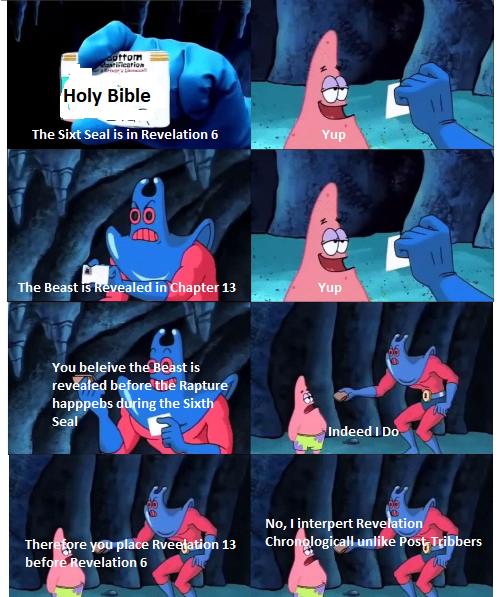
I made that Anti-PreWrath Meme I mentioned.
And I think actually a brief Twitter exchange with Christ White which I'll copy/paste here.