Showing posts with label Zion. Show all posts

Friday, November 27, 2020

Another post on The Temple Mount

 This can be viewed as a follow up to this post.

https://midseventiethweekrapture.blogspot.com/2020/04/there-is-lot-of-misinformation-related.html

To further back up why I have come to support The Temple being on The Temple Mount I recommend these two videos, the first one is shorter and from a more Evangelical perspective.

Nelson Walters

https://www.youtube.com/watch?v=XBT2UPaV_Z0

Temple Institute

https://www.youtube.com/watch?v=dh5yQiPYuo0

I'm not exactly in 100% agreement with these videos, they support the Dome of the Rock view which I still have issues with.  And they of course are unaware of my argument that the Biblical City of David was Bethlehem.

But for helping to explain why the Gihon Spring view doesn't hold water they are a good starting place.

Friday, April 24, 2020

An Argument for Zion of Revelation 14 being Earthly Zion

First of all if you're seeing this as a complete reversal of a certain post I made earlier this month, that was a post directed at Preterists rhetorically assuming certain Preterist presuppositions.

In Revelation 14 I definitely believe the Parousia is already in progress.  And the only apparent smoking gun that this Zion must be in Heaven not on Earth is the 144 Thousand being "Before The Throne".  But remember Daniel 7:9-14 is the foundational Hebrew Bible source material for how Jesus defined the Parousia, and that passage seems to involve YHWH's flying Chariot-Throne.  It could be The Throne is The Cloud or on it.

Hebrews 12:22 is the other major New Testament basis for a "Heavenly Zion", though it's actually Jerusalem Paul calls Heavenly there.  Paul does sometimes use Heavenly as a synonym for Spiritual.  That passage is about how we are Citizens of The Kingdom regardless of where we dwell or who controls any Earthly location.  And also about how the architectural final form of the City is currently under construction in Heaven.  It doesn't contradict the connection to a Terrestrial location.

Psalm 48 can be seen as the Old Testament basis for a Heavenly Zion since it links Zion to the "sides of the north" a term also used in Isaiah 14 about Satan's yet future fall from heaven.  But I think the relation of geographical terms in both these passages may be complicated.  If The Tabernacle of David were located where I currently hypothesize it was then it was indeed on a slope north of The Mountain's Summit.  And "Sides of the north" is used in some translations of where Beth-Togarmah is located in Ezekiel 38.  Since I believe Isaiah 14 is about End Times events it could refer to Satan and The Beast wanting to set up their own Throne on Mt Zion which will ultimately fail.

I should perhaps mention here how I don't think Zion was the location most people think it was.  I have argued on this Blog that Bethlehem is the City of David.  My current theory is that the Summit of Mt Zion is where the Mar Elias Monastery currently sits which is the highest elevated summit in the region, and I have a hunch that the Tabernacle of David stood where the fifth century Church of Mary's Seat was located to the north of the summit.  But even if that theory is wrong my position on this chapter doesn't change.

And thus this view can be compatible no matter what city you think Babylon and/or The Great City is.

It is frequently assumed that the Mount of Olives is where Jesus will Return to.  Now it could be involved in how all this plays out.  But the Biblical basis for it is weak in my view.  In Acts 1 what the Angel says is about Jesus Returning the same way He Ascended, it's not meant to be about the location of a landing spot.  And I think a strong argument can be made that the Zechariah 12-14 was fulfilled in 30 AD.  Still it could be He returns first to the Mount of Olives to begin the Resurrection there and then sets up His Throne on Zion.

It is often assumed the reference to "Heaven Opened" in Revelation 19 means a door opening in heaven and that the Rider on the White Horse and His Army are traveling from heaven to earth at that moment.  But that's not necessarily borne out by the text either.

Earlier in Revelation 11 a reference to Heaven being "shut up" is agreed by all to be a reference to it not raining, showing how the Witnesses echo the ministry of Elijah and using language from 1 Kings 8:35, 2 Chronicles 6:26 and 7:17.  In Genesis 7-8 the Windows of Heaven being Opened is terminology linked to the flood waters.  So this Terminology in Revelation 19 could be linked to the "latter rain" of Joel 2, or 2 Peter 3 talking about how the End Times Judgment will echo The Flood but with Fire instead of Water.  But I also now believe the ministry of the Witnesses is the same 1260 days as the Woman hiding in the Wilderness, so Heaven being Opened in Revelation 19 is the end of their shutting up of heaven.

This further proves the point that both Pre-Tribers and Post-Tribers are wrong on Revelation 19 being in any way the Second Coming, this is happening after He's already Returned.

My belief in The Man-Child being The Church means I see The Rapture as a second fulfillment of many Prophecies that were also about the Birth of Christ, like Micah 4 and 5.

Tuesday, April 14, 2020

Friday, December 28, 2018

I think I might be prepared to support Bob Cornuke's location for The Temple.

And perhaps also his corresponding site for Golgotha, even though I had been hostile to it at first.  But aspects of how he makes the argument are still wrong.

First because Zion the City of David was not Jerusalem at all but Bethlehem.  But what that means is verses saying the Ark was taken out of the City of David when placed in the Temple are no longer against Cornuke's site.  I do believe what we today call the Old City was Jebus, and perhaps remained the entirety of Jerusalem until the return from Captivity.  Perhaps Nob and Gibeon were what we now call The Temple Mount?

Another argument against Cornuke's site is saying a threshing floor wouldn't be near a Spring because of contamination risks.  But I have also argued that The Temple wasn't on the threshing floor, the threshing floor must be east of Jerusalem since Yahuah stopped there approaching Jerusalem.  Maybe 1 Chronicles 3:1 is just saying aspects of the Construction began there, perhaps materials were built and ritually purified there before being moved into the city.  Genesis 22 tells me that Moriah is the site of the Crucifixion not The Temple.

Stephen in Acts 7:44-50 says Solomon didn't follow David's intent for The Temple.  I think the Eschatological Tabernacle will be Zion.

As far as if what we today call the Gihon Spring is the Biblical Gihon, well what the name Gihon refers to is the most confusing subject of all, since it's a River in Genesis 2.  And if you don't think that's the same Gihon then you can't prove the Gihon associated with Solomon's coronation is the same one associated with Hezekiah either.

I still think it's possible the first and second Temples weren't on the same spot. If Cornuke's site is only one of them it's probably Solomon's.  The thing is so much debate about The Temple focuses on what Mountain or Hill it was built on when I suspect Solomon's Temple wasn't on a mountain at all, I think when he was at the High Place at Gideon Yahuah made him realize the Tabernacle shouldn't be on a High Place.

I spent over a year being very interested in the theory that The Temple was were Justinian built the Nea Eklessia of the Theotokos, where now stands the Armenian Church of the Archangels and the Garden of the Resurrection.  And I still think Justinian might have believed he was rebuilding The Temple.  But there are some issues with this argument.

They use quotes from Medieval Rabbis saying the Gentiles never built on the site of The Temple, maybe the Nea had been forgotten by the Jews by that time, but it's also possible the "Market of the Jews" actually refereed to the Old City not what we now call the Jewish Quarter.

And the thing about the orientation of that first century synagogue is, I don't think the idea of needing to Pray in the direction of The Temple existed yet in the first century, neither Testament of The Bible alludes to such an idea. I think it's a post 70 AD Rabbinic custom that influenced the development of Islam.

I think maybe the next archeological mystery Cornuke should tackle is The Nativity, I don't think Jesus was born at the traditional site of the Nativity which was an Adonis Cave. I've talked about how the Church of St David by King David's Wells claims to be where David was buried, well right by it is a Church of St Joseph.  I believe Jesus was born in a House Joseph owned.  And Conruke could also look for the Migdol Eder while he's at it.

I don't agree with the traditional site of Kiriath-Jearim either, since it's too far north.  As a city that like Jebus marked the border between Benjamin and Judah I think it was probably on close to the same latitude as the Old City.  But since it's ultimately on Judah's side unlike Jebus which was on Benjamin's side, that makes it if anything a little south of the Old City.

If it was west of Jebus, then I think it may have been on what we today know as the Western hill, primarily south of the modern Zion Gate of Suiliman's Wall.  But if it was East of Jebus, then perhaps the Ark once rested where Jesus was buried,.  A possibility I consider symbolically interesting since one of the few times that Hebrew word for Ark is used in reference to something other then The Ark is also the first time it's used, in the last verse of Genesis where the KJV translates it "Coffin" referring to the burial of Joseph who was a type of Christ.

Saturday, October 14, 2017

Was the Second Temple even built on the same location as The First?

As I've repeatedly engaged in the ongoing debate of where The Temple was located, usually favoring the Southern Conjecture.  This question has been in my mind, and I think I even alluded to it on this Blog before, but I've held off on going too deep into that issue.

The Book of Ezra's account of the Second Temple's construction never named Mt Moriah, or refereed to a threshing floor, nor said anything else to indicate they made sure it was the right spot. In fact the only books of The Bible they seem to have consulted were The Torah.  And it had been over 50 years.  Ezra also seems to imply they didn't even know the proper Hebrew language anymore.

And since The Tabernacle had been set up at multiple locations before The Temple, Yahuah may have not cared if it was built on the same spot anyway. 

When Zerubabel's Temple was completed, it's said that the older generation wept because of how unlike the original Temple it was.  This is generally taken to just mean it was inferior in terms of size or magnificence.  But perhaps there is something deeper.

In my investigation into if The Tabernacle and perhaps also Solomon's Temple had a Dome design rather then the Box shape Josephus describes Herod's Temple having.  It has been suggested that perhaps this mourning was partly because the new Temple had the wrong shape and wasn't a Dome.  Perhaps the second Temple's construction was intentionally or subconsciously influenced by Pagan Temples like the one at Ain Dara, since they had spent so much time in exile among Pagans.

But perhaps they were also mourning it being built at the wrong location.  Maybe those two things correlate, if the Temple's shape was changed because it was built on a squared rather then circular foundation?

Solomon also built a magnificent Palace complex for himself, that took nearly twice as long to build as The Temple did.  1 Kings 7:1-12 focuses on this.  What if the site of Solomon's Palace was where the Second Temple was built by mistake?  They assumed the largest ruin in the city was where The Temple was?

The Second Temple I still believe was about where the Al-Kas fountain is, or maybe I could accept the Al Aqsa Mosque view.  But the Dome of The Rock was the Antonia Fortress, of that I'm certain.

Now when I first came to consider this I was working under an assumption many people have that Solomon's Palace was right by The Temple.  Josephus seems to have thought it was to The South of The Temple.  So that had me considering it being where the Al Aqsa Mosque was, and Solomon's Temple at the Al-Kas Fountain.   I'd also thought of looking typologically at Ezekiel's Temple, how the Nasi's house is just west of the Holy of Holies.  But Solomon's palace complex was larger and more complex then that one.

I notice however that Pharaoh's Daughter was moved to her house in II Chronicles 8:11 specifically to keep her at a distance from any place the Ark of the Covenant had been housed.  So now I'm thinking perhaps Solomon's Temple was not in any place we're used to looking for it.  This also refutes a suggestion I've seen that it's a misunderstanding Solomon built a house for himself and that 1 Kings 7 is just elaborating on The Temple complex, since 1 Kings 7 also clearly places the house for Pharaoh's Daughter here.

II Chronicles 3:1 is another important verse for refuting the Temple was in the City of David view.  And perhaps working against it being in Jerusalem proper of David's time at all.

In this verse Mt Moriah is considered part of Jerusalem at this time.  But it's clearly identified as the threshing floor of Ornan the Jebusite, also known as Araunah in II Samuel 24.  Verse 23 of that chapter calls Araunah a King in the Hebrew, Wikipedia accuses English translations of obscuring this fact, but I feel it's implied well enough in the KJV reading.

Both the Samuel and Chronicles accounts of the Plague and buying the Threshing floor clearly place it outside Jerusalem at that time.  David's purchase expanded what was considered part of Jerusalem, but when The Angel of Yahuah held off there, it's presented as approaching but not yet reaching Jerusalem.

Now my past assumptions about what Mount is Mt Moriah would say this must have been north of Jebus.  But the Plague had already afflicted Israel "from Dan to Beersheba" so both to the north and south.  So actually it may have approached from a different direction.  Since the hills east of Jerusalem are where Solomon placed his Idols in 1 Kings 11 (The Mount of Olives), I feel like deducing this was approaching from the West.

I have since taking the Augustus view of Daniel 11:36-45, concluded that the Appeden of Daniel 11:45 is the Antonia fortress.  Appeden is a Persian term that means "Audience Hall", and I've seen people describe one of the buildings mentioned in 1 Kings 7 as part of Solomon's palace as an Audience Hall.  So what if the Antonia Fortress was built over Solomon's Temple?  Maybe Solomon's Judgment Seat in 1 Kings 7:7 is about where Pilate's judgment seat was when he sentenced Jesus?  Which would thus mean it included the Dome of The Rock, but maybe covered the entire Temple Mount.

So, if I'm going to look West for Solomon's Temple, where should we begin?

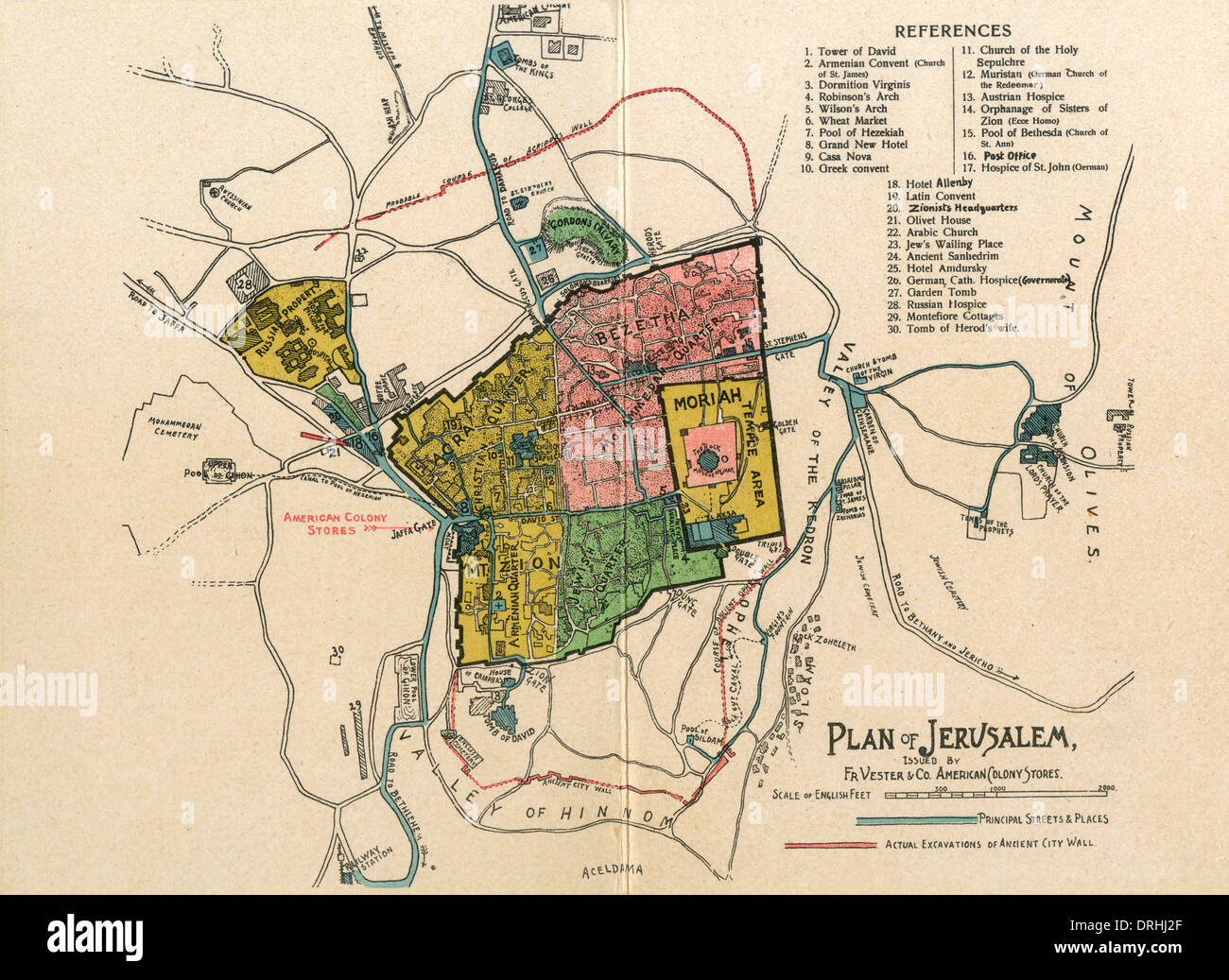
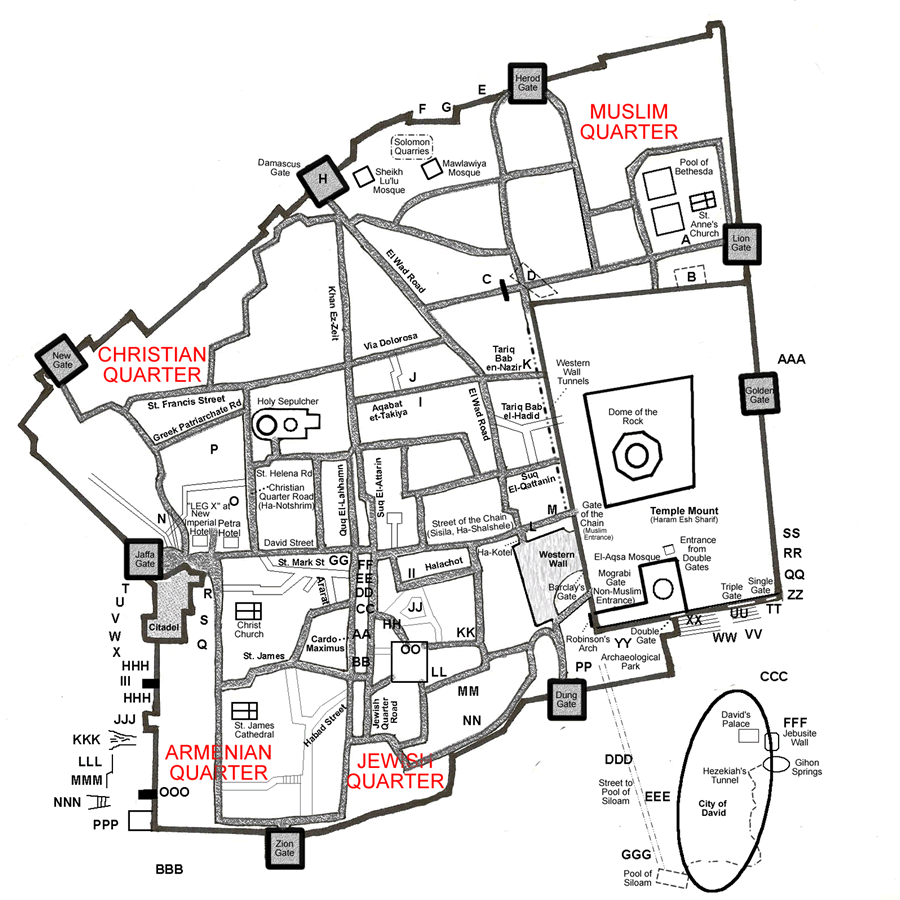
I decided to look at Maps of modern Jerusalem.

http://www.generationword.com/jerusalem101-photos/2010/jerusalem-map-for-site-location-1500.gif
 http://c8.alamy.com/comp/DRHJ2F/the-plan-of-jerusalem-town-map-layout-DRHJ2F.jpg

South of the Temple Mount is a Circle that is basically what Tradition now calls the City of David, where Bob Cornuke thinks The Temple was.  I have argued the City of David is Bethlehem but do think that site was the Core of the Jebus David originally captured.  David had palaces in both cities.  And I place neither Temple in either.

Wikipedia acknowledges three traditional candidates for the Hill that is Mt Zion.  I think Zion is none of those but in Bethlehem.

The one within the supposed "City of David" is what Bob Cornuke thinks The Temple was built on.  The second is simply applying the term to the main Temple Mount, the traditional Mt Moriah.

The third, the Western hill, which is South of the Armenian Quarter. is a site Christian Tradition has called Mt Zion, and that has it's own claimed site for King David's Tomb (in the same compound as the traditional site of the Upper Room of the Last Supper and Pentecost), but that Jewish tradition knows most certainly was not Zion and probably not part of David's Jerusalem at all. 

Justinian built an important Church on this "Zion", the Nea Ekklesia of The Theotokos, which Porcopius describes in a way that is designed to parallel the account of Solomon's Temple.  It was originally thought to be where the Al Aqsa Mosque is, but we now know it was on the Western Hill.

Earlier was built there the Church of the Holy Apostles (not to be confused with many more famous churches of that name) and the Hagia Sion which is now the Abbey of the Dormition.

Perhaps the Western Hill is the real Mount Moriah and one of these Churches was built where Solomon's Temple was? Since I firmly believe Solomon's Temple would not have been built on the full top of the Hill, I think the Nea possibly fits best.

So, I hope that was enlightening.  This is mostly speculative so I can't be sure of anything yet.

Update October 15th: And the day after posting this, I found that at least someone before me has argued the Nea Ekklesia is where Solomon's Temple was.   Their reasons for coming to this conclusion may be different from mine, I haven't read all of what they've argued yet.  (They mistakenly think The Mercy Seat was a Throne like many.)  They seem to believe the Second Temple was also at this site, which I'm open to.
https://haheykal.wordpress.com/.

I was also off a little on where I thought the Nea was.  It's more where the Jewish and Armenian Quarter meet, between the Zion and Dung gates, and includes the HaTkuma Garden.  This blog places the Holy of Holies under the current Deir al Zeitune Armenian Church, which is an interesting coincidence given it's a Church with a Dome.  According to tradition that Church was the house of High Priest Ananias, which could easily have been near The Temple.  Perhaps High Priests often lived just west of the Holy of Holies to try and fit the imagery of Ezekiel's Temple.

But again, given the starting premise of this post, it could be Ananias house was built over where Solomon's Temple was.

Update October 23rd 2017:

On a website about this Church, it says the Church's traditions also linked it to  2 Samuel 24:16-17 and I Chronicles 21:15-16, which is about the Threshing Floor of Ornan. Seemingly not noticing that that is the site of Solomon's Temple.

The Armenians' traditions also associate Queen Helena and King Abgar with founding the Church at this location, figures who've interested me for a few reasons.  And the Armenian traditional history of the site seems to skip the period when Justinian's Nea Ekklesia would have been here.

I also found a YouTube Video on the Theory.

The Olive Tree associated with this site is also interesting, when you study references to Olive Trees in The Bible. Both literally and symbolically.

Update March 25th 2018: Based on this recent post of mine, I've now sorta switched. I think the Nea Eklessia was where the Second Temple was, and maybe Bob Cornuke's location was Solomon's Temple he's just wrong on how he makes much of that argument.

Wednesday, July 5, 2017

The Books of Tobit and Judith

Originally I was going to do this on my Revised Chronology blog.  But the theories about these books relevant to that are mainly the ones I'm going to be the most critical of.

I don't consider them Canon, as I already explained in my post on the Deutercanonical Books.  But they can be historically interesting to contemplate.

These books have in common being clearly mainly fictional narratives, that at least in the forms we have them contain some difficult to explain geographical errors, and much more so with Judith, apparent historical anachronisms.

Damien F Mackey attempts to explain the geographical issues in Tobit by saying Media is actually regions in Arabia, (Midian, Medan, Medina).  However this ignores the context of it clearly being about the deported Northern Israelites.  II Kings is clear, many were taken to Media and all of then to east of the Euphrates.

 I've mentioned before about how Tobit as we know it is the product of a time where First Cousin marriages were strongly encouraged.  But I also have reasons to suspect Tobias's bride maybe wasn't his cousin originally before it was revised.

With the references to Ahikar we are told exactly how he fits into Tobit's genealogy, even though that character is only someone refereed to and not really part of the story (like the Author of Tobit wanted to create a Shared Apocryphal Universe).  However we're not told how Sarah or her father Raguel fit into it, just that she is Tobias' cousin somehow.  That could be consistent with her being a cousin being a detail added to the text later.

Sarah is the Hebrew word for Princess.  According to Herodotus it was around the time frame depicted in this book that the first King of Media lived.  And she is living in Ecbatane the capital of Media.  Could the original narrative have been about Tobias marrying a Median Princess?  And maybe the book of Judith calls the king of Media Arphaxad because they descended from Arphaxad via deported Northern Israelites?

The last verse of the book refers to the fall of Nineveh to "Nabuchodonosor and Assuerus".  A lot of people assume Ahasuerus here is another name for Cyaxares I of Media.  But there is evidence his son and future successor Astyages was also involved in the taking of Nineveh, and Nebuchadnezzar was also at that time the Crown Prince of his father Nabopolassar.  Ahasuerus being a name for Astyages would agree with Josephus calling the Darius son of Ahasuerus of Daniel 5 a son of Astyages.  Which in turn agrees with that Darius being the same as Cyaxares II of Xenophon's Cyropedia.

Damien F Mackey's theory about The Book of Judith is that the "Nebuchadnezzar" of that book is really Sennacherib under his Babylonian Throne Name.  And that this is the same attempted invasion of Judah recorded in 2 Kings and Isaiah 36-39.  My main problem with that theory is Judith doesn't record an Angel destroying Assyria's Army.

His argument for this largely begins with theorizing that the Ahikar of Tobit and the Story of Ahikar is the same person as Achior of the Book of Judith.  I see why those names seem kind of similar, but not enough to be a smoking gun.

The revised Chronology comes into it via saying Sennacherib is the same as Nebuchadnezzar I of Babylon, conventionally dated to the end of the 12th century BC.  And if I were still inclined to agree with that theory, I'd consider identifying Holofernes, a name often said to seem Egyptian, with Horemheb based on Velikvosky's view of Horemheb.  But I'm not.

Three major mainstream theories about what historical context might have inspired Judith are Nebuchadnezzar as Artaxerxes III, as Ashurbanipal and as Tigranes The Great of Armenia.  Of those three the Ashurbanipal one is the main one I want to talk about here briefly.

It speculates the lack of a King in Judah is because it's while King Manasseh was being held in Babylon.  Which makes it interesting that Judith is called the Widow of a Manasseh. The only wife of King Manasseh mentioned in Scripture is Meshullemeth the mother of King Amon.  But the Kings of Judah frequently practiced Polygamy.  And some have speculated the name of Judith itself to be a symbol or code, as a feminine from of the name of the Southern Kingdom.

And since Tobit lived to see the fall of Nineveh, Ahikar could likewise have lived into the reign of Ashurbanipal.

Even if I were willing to consider changing when Nebuchadnezzar I lived.  He actually fits the time of Ashurbanipal better.  Ashurbanipal's brother Shamam-shum-ukin was King of Babylon during some of his reign.  A similar event involving a statue of Marduk being returned to Babylon transpires during this period.  Nebuchadnezzar I celebrated a victory over Elam that seems similar to Ashurbanipal's.  And Nebuchadnezzar I conquered the "land of the Amorites" which could well refer to Canaan, where the Amorites originally came from, even Jerusalem specifically was sometimes linked to the Amorites.

However my own revised chronology theories generally leave the Mesopotamian Kings Lists unaltered, as supported by Vellikvosky's own writing about Hamurabi and the 12th Dynasty of Egypt.

The city or village refereed to as Bethulia, which is not otherwise known to have existed but seems to be near Jerusalem, I think is possibly meant to be Bethlehem.  Both names begin with Beth. Bethulia seems to come from a Hebrew word for Virgin, Micah 4-5 tells us Bethlehem is where The Messiah will be born.  And in the context of my argument that Bethlehem is Zion which is the City of David, three Bible verses refer to the Bethulah daughter of Zion, (2 Kings 19:21, Isaiah 37:22 and Lamentations 2:13).  Micah 4-5 also refers to the Daughter of Zion giving birth in Bethlehem.  And if Judith was a wife of King Manasseh, it ties into the element of Bethlehem remaining a city linked to the house of David all through the Kingdom Period.

Now for my own personal theory.

Today a Jewish tradition has developed to read the Book of Judith during Hanukkah.  And to identify the character of Holofernes with Nicanor, both wind up beheaded for example.  I haven't yet however read any theory that the Maccabees were the original inspiration for the book.  But Judith 4:3 does seem to allude to The Temple being recently rededicated following a desecration. 

Syria is a Greek name derived form Assyria, so calling the Seleucid Empire an Assyrian Empire is just as valid as calling the Ptolemies Egypt.  And the Megalit Antiochus conflates the different Seleucid kings together in a way that explains how Judith could have one Assyrian ruler ruling over the entire career of Nicanor.

Who is Judith in this context?  Well in II Maccabees in particular in 14:24, Nicanor seems to be attracted to Judas Maccabeus.  Judith is the feminine form of the name Judah, which often becomes Judas in Greek Texts.

Did the author(s) of the book of Judith swap out a woman for Judas because of heteronormativity?  Or is it the product of some tradition the more mainstream historians who wrote the books of Maccabees and whatever other sources Josephus used would have ignored, that Judas Maccabeus was what we'd today call a Trans Woman?

Of course a potential Queer subtext for the Book of Judith on it's own is Judith and her unnamed maid.  If I made a film based on the story, I'd rename the city of Bethulia as Bethlehem, and give the name Bethulia to the maid.

Update July 2018: Or maybe it makes more sense to interpret Judas as a Trans Masculine rather then a Trans Woman?

It is natural that one's first assumption is such an Ancient History would record a Trans Person under their Assigned Gender, and it'd be left to something more poetic to regard their true identity.  But those assumptions could be wrong.

Whatever their true inner Identity or assigned Biology was, Judas Maccabeus was definitely publicly presenting as male during his political and military career.  And Judas was regarded as being particularly Masculine, and that it seems is what Nicanor was attracted to.

Saturday, January 28, 2017

Misconceptions about the Magi and the Census

Matthew 2:1 clearly says.
Now when Jesus was born in Bethlehem of Judaea in the days of Herod the king, behold, there came wise men from the east to Jerusalem
And yet today the notion is constantly being promoted that the Magi arrived 2 years later, or at least over a year.

The first argument for this presented is saying that Jesus was called a "child" not a "baby".  However the same Greek word translated "child" in Matthew 2:8, Luke uses in the same form in 2:17 to refer to the newborn Jesus on the day He was born.  And the form of the word used in Matthew 2:9 is used in Luke 2:21 of Jesus at his Circumcision.  So that whole argument is based on ignorance of the Greek.

That Herod ordered everyone under two years old to be killed was probably him grossly rounding up.  Matthew 2:16 clarifies Herod determined this from when they saw the Star.  And at the time Herod asked when they saw it they both may have thought the birth happened when they saw the star, but they were Human. 

God's inspired Word in Matthew 2:1 clearly and unambiguously synchronizes the Birth of Jesus to when the Magi arrived in Jerusalem, not when the Star was first seen.  God used the Star to bring them to where He wanted them when He wanted them.  And I think even if the Magi told Herod the King was probably born now not then, Herod would not have wanted to take a chance on it.

Matthew 2:8 says Herod told them to "search diligently" so he may have given them plenty of time before realizing he'd been snubbed. So I don't think the two year time frame in question cleanly begins or ends with the Birth of Jesus.

"You're placing the Presentation in The Temple between the Magi's Visit and Herod ordering the massacre" You may object. Herod wasn't always in Jerusalem, in fact most years he usually wasn't.  He may have been there when Jesus was born simply to be there for Hanukkah or whatever Holiday you think correlated to The Nativity.  So it's easily possible he wasn't there 40 days later when the Presentation happened.

Or maybe the language of Matthew 2:1 can allow the Magi to show up a little later after the 40 days, but certainly not two years.  

But there is one last argument against The Magi arriving in Jerusalem when Jesus was born, and I saved that for last because I want to use it to transition into something else.

That argument is that in Matthew 2 Jesus and His parents are living in a House not an Inn/Stable.  In the past I'd argued simply that a few days could be enough time for them to find better living quarters, as not everyone in Bethlehem when they first arrived was gonna stay there, some the Census may have been making travel even further.  But my views on that changed which I want to explain below.

The problem is much of how we picture the Birth of Jess is indeed not Biblical.  There is no Biblical account of them seeking room in an Inn and finding none.  Nor does it anywhere say He was born in a stable or a cave, that tradition comes from Christianized Rome wanting to make a cave for worshiping Adonis into a Church, thus we get the current Church of the Nativity.

The one occurrence of the word "inn" in the KJV of Luke 2:7 is mistranslated.  The Greek word is Katalumati.  The other two times it is used it is translated in the KJV "guestchamber".  It means a guest room of sorts usually located on the upper floor of a house.  It is used of the Upper Room of the Last Supper in Mark 14:14 and Luke 22:11, one of those is the same author as this verse.  In Luke 10:34-36 Luke uses a completely different Greek word for a commercial Inn, Pandoceion.

And this statement that there was no room in the Katalumati comes after Jesus is born not before, it's about where to place Him after being born.

Luke 2 also doesn't even say Jesus was born as soon as they arrived in Bethlehem.  Verses 1-5 tell us the Census brought them to Bethlehem, and then verse 6 says while they were there the time for Mary to give Birth came.   They could have been in Bethlehem for weeks or even months.  Which also addresses the common criticism of making Mary travel this far at a full 9 months.  I now think that she may well have been only 4 or 5 months pregnant when they traveled to Bethlehem.

Here is a decade old article I found arguing much of what I've argued here, though some aspects of it I may disagree with. 
http://www.biblearchaeology.org/post/2008/11/08/The-Manger-and-the-Inn.aspx
[Better Link]
https://biblearchaeology.org/research/chronological-categories/new-testament-era/2803-the-manger-and-the-inn

Some theories about the nativity bring up a question of "how did the Shepherds know where in Bethlehem to look" something brought up for both the Migdal Eder theories and supporting the traditional site saying it was a famous rock formation that looked like a Manger.  However I don't think finding them was difficult because I think only one baby was born in that city that day and it was probably the talk of the town.

So there is in fact nothing in Luke's account to definitively contradict a theory that Jesus was born in a house that Joseph (or his family) owned.  Yet I myself was still clouded by these misconceptions when I made all my previous Christmas relevant posts.  

It's possible there was no room in the guest chamber because others of the House of David were also staying there at this time.

Which is why I want to move on to the Census now.

When refuting the common assertion that a Roman census would never require such traveling on message boards I would copy/paste the following which I no longer remember where exactly I got it from.
First of all, lets look at a few early census accounts taken from history and see how they matchup with the Bible:

The following is a record of a census taken in the year 104 A.D. which contains similar wording to that found in the Gospel:

"From the Prefect of Egypt, Gaius Vibius Maximus. Being that the time has come for the house to house census, it is mandatory that
all men who are living outside of their districts return to their own homelands, that the census may be carried out."

Another census was uncovered from 48 A.D.which also records a return of the people to their native land for the census. It reads as follows:

"I Thermoutharion along with Apollonius, my guardian, pledge an oath to Tiberius Claudius Caesar that the preceding document gives an accurate account of those returning, who live in my household, and that there is no one else living with me, neither a foreigner, nor an Alexandrian, nor a freedman, nor a Roman citizen, nor an Egyptian. If I am telling the truth, may it be well with me, but if falsely, the reverse. In the ninth year of the reign of Tiberius Claudius Augustus Germanicus Emperor."

It is interesting to note that these two census accounts required a person to return to their homeland to be registered. The same is true of the Gospel account.
The response I got (that at the time I wasn't ready to respond to) was that the point of these was to bring land owners to where they owned their land, not the hometown of a distant ancestor from a thousand years ago.  (Another objection is that these were Egyptian customs, but it's logical to speculate that similar ones were done in neighboring provinces).

That notion seems inconsistent with the Nativity narrative only because of the extra-Biblical assumptions I just addressed.

The reason these Census instructions were needed is because clearly many people were living somewhere other then where they actually owned their property.

Remember, the word translated "Carpenter" in reference to Joseph could also very likely imply he was actually an Architect.  He may have been in Galilee because of a construction project, perhaps one of Herod's many.  And of course those insisting Nazareth is too young a city to be the Biblical one suggest it was at most brand new when Jesus was born.  Maybe Joseph was helping build Nazareth?  Or Sepphoris which wasn't too far away?

This Census, (whichever one it was, I'll try to tackle that in the future), then required him to return home sooner then originally planned.

And if my argument that Bethlehem is "Zion, which is the City of David" is true. Then that adds a lot to the above observations.  As we now see that David's family never stopped being linked to Bethlehem after they became Royalty.

Now I've seen someone argue that Nazareth not Bethlehem must be their hometown in Luke because of Luke 2:39.  Well Luke 2:3 says they are to return to their "own city", so if Luke 2:39 is calling Nazareth their "own City" in contrast to Bethlehem then you're not even dealing with an inconsistency with other sources but accusing Luke 2 of being inconsistent with itself.  Since no one accuses Luke of being garbled together from different authors like they do some other books, that option isn't really viable.  Luke 2:39 is simply about Nazareth becoming their new hometown after deciding to move there permanently, with Matthew 2 providing the reasons why this change in residence happened.  It may be that the English simply words this misleadingly.

Now this doesn't change that events of Matthew 1 take place while Mary and Joseph were in Nazareth even though Matthew doesn't mention Nazareth in that chapter.  But Matthew doesn't mention Bethlehem in that chapter either, Bethlehem is first mentioned in Matthew 2 when Jesus was born, and six to nine months separated the events of chapters 1 and 2.  In fact the way Bethlehem is specified in Matthew 2:1 could be taken as implying that's not where they were previously.

And it's still possible that Mary was indigenous to Nazareth.  Maybe Joseph met and courted her while in Nazareth on business.  Or maybe this arranged marriage is what first brought him there.  But the fact that Luke gives us the impression that the events of Matthew 1 didn't happen till three months into Mary's pregnancy makes the most sense if we presume Joseph was living in Bethlehem when the Annunciation and Visitation happened, and came to Nazareth for the wedding a few months later.

Friday, January 13, 2017

My view on Modern Israel in Bible Prophecy

I don't believe in traditional Dispensationalism, or Two House Theology, or Catholic and Mainline Protestant understandings of "Replacement Theology".  So what do I think about Modern Israel?

I agree that most of the Bible Prophecies that Dispensationalists and Christian Zionists want to cite as being about 1948 like Isaiah 11:11 are clearly about something far more Supernatural and Messianic, where they return in belief.  However I disagree with Rob Skiba that they are about the Millennium.  I think they are about the New Heaven and New Earth and the descent of New Jerusalem.

Well, Ezekiel 37 is an exception, that is the one directly linked to the Resurrection, so that is possibly about the Millennium, though I think it may be possible it'll take the entire Millennium for all of it to be fully fulfilled.  And then Ezekiel 38 is about what happens between the end of the Millennium and the White Throne Judgment.  And then Ezekiel 40-48 are about the New Heaven and New Earth.

Psalm 48 is about New Jerusalem.  I've already argued that Isaiah 65-66 define themselves as being about the New Heaven and New Earth.  Leviticus 26&Deuteronomy 29 is where Bible Prophecy about the regathering of Israel begins, they I have come to view as not fully finally fulfilled until the descent of New Jerusalem.

I have talked before about how The Millennium is not as Utopic as people are assuming it will be.  For Believers it'll certainly be better then the world is now.  But most of the World will be obeying Jesus out of Fear not Love during this time.  This is where I think Zechariah 14 ends.

The Rothschild involvement in the 1948 birth of modern Israel is grossly overstated by Conspiracy Theorists.  Some of them financially supported it, but they were not the masterminds of it.  And to this day some Rothschilds are still Anti-Zionists.

Anti-Zionist Christians like to say it can only be God doing it if it's blatantly Supernatural.  And when we remind them about Cyrus they dismiss that by saying that God would tell his people through his Prophets if he was going to do it that way.  Well I'm a Continuationist, and the fact is throughout the 19th and early 20th Century many Christians seemed to know the time of Israel's return was approaching, and history vindicated them.

God tells us it was Him who scattered them, even though to terrestrial eyes it was Gentile Nations.  So who says their return can't be done the same way?

The Roman Captivity was very much a repeat of the Babylonian Captivity, right down to events playing out on the same days.  Chad Schafer has been talking a lot about Egypt's overlooked significance to the Roman Captivity, well Egypt was very vital to the Babylonian Captivity as well.  Jeremiah tells us that many Jews went to Egypt after Jerusalem fell, and that is part of why Egypt was carried away into Captivity by Babylon.

So it makes sense that the Return from the Roman Captivity would be very similar to the return from the Babylonian Captivity.  Truman however was not the Cyrus of 1948 like he sought to claim to be, he had nothing to do with making it happen.  Great Britain was in the role of Cyrus, and it's King at this time interestingly had Arthur in his full name.  Great Britain cemented their status as a modern successor to Rome when they defeated Napoleon and erected the Wellington Arch.  Just as Cyrus had taken the throne of Nebuchadnezzar.

However another layer of Typology is that I see the Seven Years King David ruled from Hebron as a type of the Seven Year period over which much of Revelation will play out.  And the time David Ruled from Zion and Jerusalem a type of the Millennium, and the early Reign of Solomon, when he was doing well, as a type of the full Messianic Kingdom.  In which context it's interesting to remember that before that was the reign of King Saul.

Could Modern Israel's destiny be to become the House of Saul to the Returning Jesus's David?  It's interesting that the current Prime Minister is named Benjamin, after Saul's Tribe.  I also alluded to reasons based on Jeremiah 6 for associating modern Israel with Benjamin in a Revelation 12 theory I came to last year.  In which case it's interesting that Ishbosheth ruled in the Trans-Jordan, near Mount Hermon.

The secular Capital of Modern Israel is Tel-Aviv.  The Ancient City that Tel-Aviv is adjacent to is Joppa/Jaffa.  Acts 9:32-28 refers to Lydda as being nigh to Joppa.  Lydda is in the Hebrew Bible Lod which is identified as a town of Benjamin (1 Chronicles 8:12; Ezra 2:33; Nehemiah 7:37; 11:35).

It's interesting that most Ahskenazim (and to a lesser extend many Shephardi) families that claim descent from David, do so via Rashi who did so via Hillel The Elder.  Hillel claimed through his mother descent from David's son Shaphatiah by Avital.  But Tribal Identity was traditionally determined paternally, and Hillel's father was a Benjamite, since he was born in Babylonia he may have come from the same Benjamite clan that Esther and Mordecai did, which came from a relative of Saul.  Gamaliel was Hillel's grandson, Paul claimed to have studied at his feet, and we know Paul was a Benjamite and originally a namesake of Saul, could Paul have been a relative of the House of Hillel?

The Khazar myth about where the Ashkenazim come from can be easily debunked, like in this video by Chris White.
 https://www.youtube.com/watch?v=HDWUZ6EqWHc
[Update: or this one from Casual Historian.]

There is a small truth to it in that yes some Khazars intermarried into Jewish families, so many Ashekanazim may have some Khazars in their ancestry, but that does not contradict also descending from Jews who were in Israel at the Time of Christ.

Some like Britam and Veilikovsky (in Beyond the Mountains of Darkness) have sought to claim Lost Tribes descent for the Khazars.  But I find it more interesting that Benjamin had a son named Rosh (Genesis 46:21), and that the name of Rosh can also be linked to the same region as Meshech and Tubal, which is the land where the Khazars emerged, between the Black and Caspian Seas (something Chris White has also talked about).

I obviously disagree with the aspects of Velikovsky's argument that involve reinterpreting where Assyria first took them, I've built much of this Blog on that they were taken to parts of eastern Iraq and northern Iran.  But it's also possible that just as some remnants of the northern Tribes existed in Judah, that some Benjamites might have been among those deported when Samaria fell.  When the division first happened the border was mostly Benjamite territory on Judah's side.  But later there were times were Israel was winning in it's wars with Judah and so the border moved further south.

There is at least one website out there seeking to argue the Spanish came from Benjamin.  What they wound up making is a strong argument for the Shaphardi Jews coming chiefly from Benjamin, but Shaphardi Jews are genetically distinct from the gentile populations of Spain in-spite of how much they may look the same.  Another connection between Benjamin and Spain is Paul himself who in Romans expressed a desire to go to Spain which later traditions say he did.

The term Mizrahi Jews refers to Jewish communities of Iraq/Persia, and the Mountain Jews also associated with the same region as the Khazzars and Rosh.  Also the Oral Traditions of the Mountain Jews claim they came specifically from Jerusalem.

As far as the Jewish communities of Iraq/Persia go, we know the family of Esther and Mordechai dwelt there coming from a relative of Saul.  And that the Descendants of Hillel were based there during the time the Babylonian Talmud was composed.  The Exilarchs (traditionally descendants of David via Zerubabel) were also in Iraq for a long time.  But the Rabbinic Jewish traditions about them skip right form when the TNAK ends to the time of Hadrian, maybe their claimed David descent was not unlike Hillel's.  At any-rate most families today claiming descent from the Exilarchs do so via a lot of intermingling with the descent from Rashi.

Temani/Yemenite Jews I theorize mainly descend from Simeon (probably from the clan of Jamin) Simeon and Levi were both destined to be scattered among the other tribes.

I also see a poetic logic in the early Jewish Communities of Rome (who existed at least as early as the first Pentacost) coming from Benjamin.   Given the wolf association of both.

I think some remnant of Judah may exist among them.  But mostly I think Judah went to Africa after 70 AD.  Though I also think the descendants of the half-siblings of Jesus, and of Jesus Apostles, inevitably became absorbed into gentile populations.

David promised Johnathon Ben Saul that his seed would be preserved.  And we see him keep that later when he spared Johnathon's son Mephibosheth from the killing of descendants of Saul done to appease the Gibeonites.  Often such promises correlate to that line having a role to play in Eschatology.

Benjamin was the only son born in the Promised Land.  Maybe that is a reason for it to make sense he would be the only one who's Nation at the time of the Regathering would be already in Israel.

Thursday, September 29, 2016

Solomon's Temple was NOT in the City of David.

If you think it was, I suggest you read 1 Kings 8:1, the account of The Ark being placed in The Temple.
"Then Solomon assembled the elders of Israel, and all the heads of the tribes, the chief of the fathers of the children of Israel, unto king Solomon in Jerusalem, that they might bring up the ark of the covenant of Yahuah out of the city of David, which is Zion."
And also 2 Chronicles 5:2
"Then Solomon assembled the elders of Israel, and all the heads of the tribes, the chief of the fathers of the children of Israel, unto Jerusalem, to bring up the ark of the covenant of Yahuah out of the city of David, which is Zion."
David's Tabernacle was not on the same land as Solomon's Temple, that's where these "The Temple wasn't on The Temple Mount" people are confused.

The land that Solomon built The Temple on, David purchased after the whole Census and Plague episode recorded in 2 Samuel 24 and 1 Chronicles 21, (and referenced again in 2 Chronicles 3:1).  So it can't possibly be the same spot near the Gihon Spring where David placed The Ark when he began his reign in Jerusalem.

In 2 Samuel 24:23, though English translations sometimes obscure this, Araunah (Ornan in Chronicles) is called a King.  He was the King of a separate Kingdom, so the land he owned was clearly not within The City of David.

There are also many reasons why you wouldn't put a threshing floor anywhere near a spring.

Now I don't know if the Second Temple was on the same spot as the first.  But I believe the evidence places the Second Temple's Holy of Holies about where the Al-Kas Fountain currently is, and that the Antonia Fortress was where the Dome of The Rock is.

Prophetic verses get used to back up saying there is a spring or river under The Temple.  Ezekiel 40-48's Temple will be no where near the same spot as Solomon's, it's miles north of Jerusalem, I've argued about where Beth-El was. And by then events like the 7th Bowl of Wrath will have totally changed the geography of the region.

In both Poetic and Prophetic books Zion gets used poetically, it doesn't always mean it's strict Geographical definition it has in the two verses that started this post.

Friday, February 12, 2016

Another Man-Child post

When I first made this post, it did not have the reference to Isaiah 66 that is currently in it.

I was already pretty convinced of this theory without the help of Isaiah 66.  Then I was rereading it lately and I noticed what had completely flew by me before, that it references the Man-Child.  And the context clearly makes it New Jerusalem/Zion and it's Population.

Verses 6-11
A voice of noise from the city, a voice from the temple, a voice of Yahuah that rendereth recompense to his enemies.  Before she travailed, she brought forth; before her pain came, she was delivered of a man child.
 Who hath heard such a thing? who hath seen such things? Shall the earth be made to bring forth in one day? or shall a nation be born at once? for as soon as Zion travailed, she brought forth her children.
 Shall I bring to the birth, and not cause to bring forth? saith Yahuah: shall I cause to bring forth, and shut the womb? saith thy God.  Rejoice ye with Jerusalem, and be glad with her, all ye that love her: rejoice for joy with her, all ye that mourn for her: That ye may suck, and be satisfied with the breasts of her consolations; that ye may milk out, and be delighted with the abundance of her glory.
Wonderful smoking gun proof of a Mid-Way point Rapture.

Monday, February 1, 2016

Ezekiel's Temple and the Millennium Follow up

This is a follow up to Distinguishing between The Millennium and the New Heaven and New Earth.  And also my more recent Bethel, The House of God post.

My position on Isaiah 65 and 66 being the New Heaven and New Earth not The Millennium remains unshakable.  I've been doing some rethinking on Ezekiel, I certainly think many of the conditions in Ezekiel could also apply to The Millennium, and was also thinking maybe it's not the New Creation till YHWH-Shammah descends.  But the fact remains it's Revelation 21-22 that draws on this part of Ezekiel while 20 draws on 37-39.

Isaiah 66 which is still the same Prophecy as Isaiah 65 says in verse 3.
He that killeth an ox is as he that slayeth a man; he that sacrificeth a lamb, as he that breaketh a dog`s neck; he that offereth an oblation, [as he that offereth] swine`s blood; he that burneth frankincense, as he that blesseth an idol. Yea, they have chosen their own ways, and their soul delighteth in their abominations:
This further assured me that if indeed the Sacrifices being carried out in Ezekiel proves it's the Millennium in some people's minds then Isaiah can't be talking about the same time period.

But that also reminds me of why as a Christian the Sacrifices Ezekiel describes makes me uncomfortable either way.  The rationalizations I often hear from Christians for them are not satisfactory to me.

I read a few months ago an argument a Christian made that Ezekiel 40-48 is not going to be fulfilled in The Future, it was a hypothetical Constitution for the Return from Captivity that Israel rejected.  While that argument sounded quite reasonable, the problem I have with that is so much of Ezekiel's Temple besides the Sacrifices seem to anticipate what changed at The Cross.  No veil, no wall of separation, no separate courts for gentiles and women, ect.   

Add to that how Revelation 21-22 clearly draws on this part of Ezekiel.  And my recent insights regarding Bethel.  And I simply can't write off the Eschatological relevance of these chapters.

Then it hit me, what if both views are right in a sense?  It was originally a potential model for the return from captivity but was rejected.  However God still plans to make it happen anyway, but certain conditions will be different because of The Cross chief among them being no Sacrifices as Isaiah 66 clearly instructs.  Though some ceremonies may be performed using Jesus' already shed Blood.

You may think "what do we need the Brazen Altar for then?"  I'm thinking maybe it'll be converted into a monument with a Cross on top, a memorial of the permanent Sacrifice that made all others moot.

For the options I provided before for dealing with the size difference between Ezekiel's YHWH-Shammah and New Jerusalem.  I was favoring the John saw it from the inside option, and I still like that view, but....  I've watched this video from Rob Skiba.  I really don't like the Pyramid parts and I could do without the Flat Earth stuff.  But he still has interesting speculations.

That made me re-think the New Jerusalem borders include everything in Ezekiel's vision option.  The borders if you put YHWH-Shammah or Bethel (or the Altar east of Bethel) at the center of New Jerusalem would include everything in Ezekiel's vision, and it seems everything God promised to Abraham.  Plus Assyria and Egypt fitting Isaiah 19.  It'd also include some of Greece and about all of Asia minor, that's most destinations of Paul's travels, and all Seven Churches of Revelation, where Jesus also talks about New Jerusalem in the message to Philadelphia.

I keep looking into the Montanists, trying to decide if I think it's fair to label them heretics or not.  I can't find any clear statement on their soterology.  Much of what we know of them comes from their critics which had me skeptical of the most negative things said.  Still I do suspect they were an early example of how modern Charismatics sometimes go over board.

One of that movement's founding principles was the founders having a Prophetic revelation that New Jerusalem would be in Asia Minor, which had me thinking "well that's clearly a False Prophecy".  Now however I'm considering what if they misunderstood a Prophetic revelation that New Jerusalem would include Asia Minor? 

On the subject of Noah's Ark, I believe Bob Cornuke's theory that it's in Northern Iran, that site is within the cube also (as well as Jabal el-Lawz, the real Mt Sinai).

And the traditional location of the mythical Gates of Alexander is around about where the northern border would be between the black and Caspian seas.  A legend I mention in a Biblical context only because of how it's legacy became tied to Gog and Magog.

It may be both those options for the size issue are valid in a sense.  Because again the very laws of physics will change I believe.

If you're wondering "what about Jerusalem in the Millennium then?"  I don't know.  I notice Revelation 20 never clearly refers to the Holy City till after the Thousand Years are over and doesn't name it.  But I'm pretty sure that's Jerusalem since I see it as the same as Ezekiel 38-39.

I also found this study helpful.

Sunday, January 31, 2016

Bethel, The House of God

The geography of Ezekiel 48 has Ezekiel's Temple not in the city of Jerusalem but miles to the North of it.

One problem existing among a few people who understand that correctly like Jack Kelly of GraceThruFaith.com is they have a desire to say Ezekiel's Temple will be the same one The Antichrist will desecrate.  (some say this while still thinking the Temple is in Jerusalem in which case all I need to do is point out Ezekiel's geography).

I've already addressed the error of connecting the Abomination of Desolation to Ezekiel 44 when refuting a heresy far more dangerous then anything Jack Kelly teaches.  The words for Abomination are completely different.

There are a lot of people trying to come up with uninformed interpretations of what the Outer Court being trodden under foot of the Gentiles in Revelation 11 means.  Luke 21:24 however clarifies it, the same terminology is used there, it is about Jerusalem being under foreign occupation.  I believe the same time frame is intended, ending with The Rapture and the Last Trumpet.

The city refereed to as Spiritually Sodom and Egypt where Jesus was Crucified is indisputably Jerusalem.  Some insist the "Holy City" of the first few verses of Chapter 11 can't be the same then.  This duality of Jerusalem is what The Bile is constantly about, it is God's Holy City because of his covenant with David, but it's also constantly in rebellion.  Just read Luke 19:41-44.

Jack Kelly talks about how The Jews refer to Ezekiel's Temple as the Third Temple (but admits those same Jews are expecting to build it in Jerusalem).  The Jews lack the New Testament therefore they are missing pieces of the puzzle.  They are ignorant of Jesus warning that the Abomination of Desolation will happen again.  Revelation has Jerusalem rocked by devastating Earthquakes at least twice, in 11 and 16 in the Seventh Bowl of Wrath.  I think it's unlikely the Antichrist's Temple will survive that.

The Jews seeking to rebuild The Temple may like to say they're going to fulfill Ezekiel 40-48, but their actual plans don't match that.  The Temple institute is expecting to have a Menorah and a Veil and a Wall of Separation and separate courts for Gentiles and Women, and a High Priest.  We Christians know that Ezekiel's lack of mentioning these things isn't taking them for granted, everything lacking in Ezekiel's Temple has New Testament significance.

But Size is the biggest issue, the size of Ezekiel's Temple is larger then the entire modern city of Jerusalem.  And the geography envisioned is dependent on changes to the land that happen in the Seventh Bowl of God's Wrath.  Every theorized location for Ezekiel's Temple has an inhabited city there currently with Jewish and Muslim populations, modern Israel isn't going to permit destroying any of those.

Now that I've addressed that error, let's discus the significance of Ezekiel's Temple being outside the City.

Some might wonder, how does that make sense when the city is called "YHWH is There" in the last verse of Ezekiel?  Well first Ezekiel says The Temple will be open only on Sabbaths, New Moons and the Holy Days.  Only citizens of New Jerusalem, His Bride, get to be with Him 24/7.

I find it interesting how The Ark was constantly separate from The Tabernacle during the time between it leaving Shiloh and the Dedication of Solomon's Temple.  For 60 years The Ark was at Kiriath-Jearim till David brought it to Zion.  The Tabernacle however was at Nob till Ahimelech was killed and then was at Gibeon till The Temple was dedicated.  So from the 8th year of David till the 11th year of Solomon the Ark was in Zion and the Tabernacle further North.

Gibeon can't work in my opinion as equivalent to where Ezekiel's Temple will be since it's not even close to directly north, it's way to the west.  It's merely an interesting type picture.

Where do I think Ezekiel's Temple will be?  My mind has shifted on that.

I first made this post when I favored Shechem or around there, but then I updated it as I leaned towards Shiloh for the longest time (same location Jack Kelly favors).  And I still feel Salem of Melchizedek isn't Jerusalem but rather Shiloh and/or in the Shechem area.

But as I was looking recently at some of the maps of Ezekiel's geography that I consider the most accurate.  The Holy Portion does not seem to go far enough North to include Shiloh.  In fact it occurred to me that Shiloh seems to be in the land allotted to Judah in Ezekiel's allotment.  That struck me as significant since the name of Shiloh is associated with Judah in Genesis 49:10.

I've actually grown skeptical recently of the assumption that Shiloh is a name for The Messiah in that verse.  It's the prior verse Revelation 5 identifies with Jesus.  I see Christians constantly citing Rabbinic opinions that Shiloh is the Messiah, which makes me laugh, they're people who don't think Jesus was The Messiah.  Either way I think it would make sense if in the Messianic Kingdom the capital of Judah is Shiloh.

Anyway as I was observing these maps it started to occur to me Bethel might fit.  I did a google search and others had indeed calculated Bethel about 11 or 12 miles North of Jerusalem would be the center of the Holy Portion.  But these scholars did not see the center as where The Temple is as I do, so they argued for it being the start of a stairway or something leading to The Temple or the City.  The Ladder Jacob saw connected Heaven to Earth, not two Earthly locations.

Genesis 28:16-22 KJV
And Jacob awaked out of his sleep, and he said, Surely the LORD is in this place; and I knew it not.  And he was afraid, and said, How dreadful is this place! this is none other but the house of God, and this is the gate of heaven.
 And Jacob rose up early in the morning, and took the stone that he had put for his pillows, and set it up for a pillar, and poured oil upon the top of it.  And he called the name of that place Bethel: but the name of that city was called Luz at the first.
 And Jacob vowed a vow, saying, If God will be with me, and will keep me in this way that I go, and will give me bread to eat, and raiment to put on, so that I come again to my father's house in peace; then shall the LORD be my God: And this stone, which I have set for a pillar, shall be God's house: and of all that thou shalt give me I will surely give the tenth unto thee.
No place in Genesis or the whole Torah is more blatantly defined as the House of God, yet we keep over looking it.  I also wonder if the "Gate of Heaven" comment is a clue to the geography of Revelation 19:11 and how it ties in with Zechariah 12-14 and Isaiah 63.  Something I'm still studying.

In Genesis 31:13 God called Himself "The God of Bethel".

In Genesis Jacob returns there to keep his promise, and God makes further promises to Jacob.  And Deborah, Rebecca's nurse, was buried beneath an oak tree.  Later in Judged 4:5 another more famous Deborah lives under a Tree at Bethel.

It was Jacob who named the place Bethel.  Moses however uses the name retroactively twice when discussing Abraham's travels.  Genesis 12:8.
And he removed from thence unto a mountain on the east of Bethel, and pitched his tent, having Bethel on the west, and Hai on the east: and there he builded an altar unto the LORD, and called upon the name of the LORD.
And he returned there in 13:3, most of the events of that chapter take place there.

BTW, in Hebrew "Called upon the name of YHWH" is the same phrase as the end of Genesis 4.  I keep seeing people say the Hebrew really says at the end of Genesis 4 men "profaned the name of The LORD", but like the claims about what the Hebrews says of Nimrod being a mighty hunter "Before The LORD" that claim doesn't hold up in my attempts to verify it.

It's interesting that this is east of Bethel.  Again the size of Ezekiel's Temple complex is huge.  What if Bethel is the site of the Holy Place, and Abraham's altar equates to the Brazen Altar?  (the Hebrew words for Pillar and Altar refer to distinct things).

If you look at diagrams of Ezekiel's Temple, the Brazen Altar is at the center, with three gates leading to it and the Holy Place to the West.  The East Gate is sealed after The Temple is consecrated (Hai which is a different transliteration of Ai, means ruin or heap).

Judges 20:18-27 says the Ark was kept at Bethel at that time, the KJV obscures this by translating the name "the house of God".   Does this contradict other passages like Joshua 18, Judges 19 and 1 Samuel 1-13 that seem place the Ark and Tabernacle in Shiloh all this time?

Judges 21:19 refers to Shiloh as north of Bethel when saying a yearly Feast of YHWH was kept there.  Genesis 49:10 defines Shiloh as Gathering place of the People.  It could be Bethel was the usual keeping place of The Ark but Shiloh was where the Feasts were held.  Or maybe the two cites just weren't as far from each other as the modern archeological identifications would have us think?

1 Samuel 7:16 refers to Bethel as a place Samuel regularly visited.  In 1 Samuel 10:3, Samuel sends Saul to Bethel to the "Hill of God", where he has a profound Spiritual experience.

I've also been contemplating theories about the Geography of Eden.  I've watched this video from Rob Skiba.  I really don't like the Pyramid stuff and I could do without the Flat Earth stuff.  But he still has interesting speculations.

I'm thinking that Adam was created by the shore of the Mediterranean Sea, maybe around Joppa.  And then maybe The Garden was Bethel, and Abraham's Altar where God made animal skin garments for Adam and Havvah.  And maybe the Oak tree that Deborah was buried under was roughly where the Tree of Life was? (not the actual same tree of course).  Deborah means Word.

Now because of Jeroboam the land of Bethel was tainted by a Golden Calf, and it comes up in Amos and Hosea because of that.  But a Prophet of YHWH foretold Josiah would destroy that Idol and cleanse the area.  And indeed he did.  No such cleansing happened for the site of the equivalent Idol set up at Dan, why is that?  Maybe it has something with do the different destinies for Dan and Bethel.

Thursday, June 4, 2015

Zion and New Jerusalem

I've expressed in the past my view that The Church isn't on The Earth during The Millennium.  We're in New Jerusalem, which is also Yahweh-Shammah.

The physical city of New Jerusalem already exists, it's in Heaven, maybe it's accurate to say in a sense it IS Heaven.  It is the Heavenly Jerusalem and Zion of Hebrews 12:22.

The term "Sides of The North" appears in The Bible twice.  Once dealing with Lucifer's Fall in Isaiah 14, and once in Psalm 48 talking about the Heavenly Zion when it descends as New Jerusalem.

It is my belief that the 144,000 are part of the Church and in some sense represent The Church.

Revelation 14 describes them as standing on Mount Sion.  In terminology that implies now they have been Resurrected.

I see The Rapture in the Seventh Trumpet (which extends into the opening part of Revelation 12).

Revelation 14 depicts the Raptured Church standing in the Heavenly Zion.

Friday, February 27, 2015

This Generation shall not pass

From Matthew 24 is one of the most debated details of Bible Prophecy.

The Preterist view is the most obviously wrong, in saying Jesus must have meant the people currently listening to him, they ignore the entire context in which that quote is made.

What I want to discus here is the disagreement among Futurists about whether or not it's valid to see this statement as being about modern Israel.

Throughout history Christians have wanted to believe they are living in the last generation.  Those of us living post 1948 feel the main thing that makes our belief the End Times will happen soon more legit is that for most of that history the lack of a nation of Israel in the Holy Land forced Bible Prophecy believers to allegorize everything to make it fit their own time.  The Temple is clearly in view in Matthew 24, 2 Thessalonians 2 and Revelation 11.

But none of that makes Israel's founding in 1948 a specific fulfillment of Prophecy.  And I agree with the critics of Dispensationalism and Zionisism that the major Bible Prophecies we keep trying to make sound like they're about 1948 are clearly in their Biblical Context about Israelites returning in Belief, and from a Christian POV modern Israel is still in Unbeleif.  Those Prophecies are really mainly about either stuff that happens after Armageddon and/or during the Millennium, or the descent of New Jerusalem.

As for Matthew 24, the debate is if the "This Generation" just refers to the ones who see the Signs Jesus had been describing?  That seems like the plainest reading, but the Mystery is the Parable of The Fig Tree bares investigating.  Matthew 24:32-34
"Now learn a parable of the fig tree; When his branch is yet tender, and putteth forth leaves, ye know that summer is nigh: So likewise ye, when ye shall see all these things, know that it is near, even at the doors.  Verily I say unto you, This generation shall not pass, till all these things be fulfilled."
Why see the blossoming of this Fig Tree as about Israel?

First there was a curious incident involving a real live Fig Tree earlier in Chapter 21 after Jesus first arrived in Jerusalem for this Passover season.   In which Jesus curses a Fig Tree to never bear fruit again, and then it withers and dies.  At face value this story interprets itself as being just a demonstration of the power of Faith.  But why demonstrate it in such an odd way?  Why not demonstrate it by giving life rather then taking it?

Commentators of Mathew's Gospel like Chuck Missler like to view Matthew 13 as when Israel's leadership rejects Jesus as Messiah.  If the Fig Tree is in some way a symbol of Israel, Jesus unstated intent may have been for his disciples to realize it's up to them to use the power of their Faith to restore life the Fig Tree that Jesus just withered.

Is there a basis in the Hebrew Scriptures for using the Fig Tree symbolically in such a way?

The first reference in The Bible to a fig trees is in Deuteronomy, that passage like many others is just listing them among various trees.

Judges 9:10-11 uses the Fig Tree as a symbol of Gideon, symbols of national leaders often becomes symbols of the nation.

1 Kings 4:25 describes the nation's peace and prosperity by saying "And Judah and Israel dwelt safely, every man under his vine and under his fig tree, from Dan even to Beersheba, all the days of Solomon."  The Fig Tree is affiliated with Israel's prosperity.  2 Kings 18:41 repeats this imagery in the days of Hezekiah, the same situation is again repeated in Isaiah 36-39.  And it's used again in Jeremiah 5:17.  Later Jeremiah 8:13 says "I will surely consume them, saith the LORD: there shall be no grapes on the vine, nor figs on the fig tree, and the leaf shall fade; and the things that I have given them shall pass away from them."

So all this together makes a re-blooming of a Fig Tree a good symbol for Israel's restoration.

Now to show this interpretation is not purely the result of Darby and other Nineteenth Century Dispensationalists.  The apocryphal Apocalypse of Peter which was probably written in the Second Century and was considered canon by many early Christians.  Clearly states the Olive Tree is Israel.  That writer's agenda in that identification may have been different from anyone today.  But the point is it existed.

You might object "Even so, it's about Spiritual restoration not nationally in unbelief".  That is true, but the two are linked.  Israel's Spiritual Blindness discussed in Romans 9-11 did not fully overtake them over night.  It was there from the Birth of The Church, but still the Early Church was mostly Jewish when it started, and in the region remained predominately Jewish until well after the Bar-Kochba revolt.

After Suileman began rebuilding the Wall of Jerusalem from 1534-1541, Zionisim was born in 1561 thanks to Joseph Nasi.  And not long after in the wake of the Reformation, especially in the English Speaking world, Christian Zionism is born thanks to men like Thomas Brightman.

Likewise since 1948 Messianic Jews have gown in number greatly.  I'm a Dispensationalsit sort of but not a strict one like Pre-Tribers are.

However I will say the fact that it's first and foremost Spiritual means it may be an error to link it to some easily definable Geo-Political calendar date like 1948, or retaking Jerusalem in 1967, or even the yet Future rebuilding of The Temple.  It may be referring to the Spiritual Blindness being significantly lifted when the Abomination of Desolation happens. In which case a maximum number for a Generation is not needed.

But I refute the usual argument against Date-Setting here.

What number should be a Biblical Generation?

Hal Lindsay popularized 40 based on the wondering in The Wilderness.  F. Kenton Beshore has suggested 70-80 based on Psalm 90:10.  We could also use 120 based on Genesis 6, as well as that being about roughly the Maximum people can live to today, and it's how long Moses lived, and about the length of the combined reigns of Saul, David and Solomon.  But both Moses siblings were older then him and died earlier the same year.  And Jehoiada lived to 130.

There are also dates older then 1948 one could choose if they wanted to.  1897 is considered the Birth of the modern Zionist movement.  120 years from that is 2017, 2017 is popular in some currently trendy Speculation based on a flawed understanding of Revelation 12 which I've addressed before and am highly skeptical of.

1904 was an important year for reasons having to do with William Hechler's efforts and that being the beginning of a major wave of Jewish immigration to the region.  120 years from that is 2024.

In 1909 the city of Tel-Aviv the secular Capital of Modern Israel (or at-least the city the international community recognizes as it's capital) was founded by the ruins of Jaffa the ancient port city of Dan.  120 years from that is 2029.

The Balfour Declaration was in 1917, 120 years from then would be 2037.

1933 was the controversial transfer agreement, 120 years from that would be 2053.

1948+40 was 1988 which notoriously didn't happen. The 70-80 theory gives about 2018-2028 which lines up interestingly with some earlier numbers.  120 years from 1948 would be 2068.

1967 Israel recaptures Jerusalem, the Jewish construction in the Old City was officially allowed around Passover of 1969.  Adding 40 years was 2007-2009 which was nothing.  Adding 70-80 gets 2037/9-2047/9.  Adding 120 years gets 2087-2089.

So it'll be interesting to see how those possible dates line up with other speculative calculations.

Thursday, January 1, 2015

I still support the Southern Conjecture

I have a post where I originally explained my support for the Southern Conjecture/Al-Kas Fountain view.  And then another one where I deal with one particular objection to it's Escatological significance.

Latter I did a post in response to some new information I learned where I considered changing to the Gihon Spring view of The Temple's location.  That post was made and revised as my mind was being pretty chaotic on the subject and it still seemed clear I wasn't really gonna do that.  All the reasons for  rejecting that view I hold now are explained there, or in links provided there.

So I am just making this post to clarify.  I believe the Temple was where the Al-Kas fountain is.  But the Gihon Spring is interesting and I think probably the Location of the Tabernacle of David.

Sunday, December 7, 2014

Salem of Genesis 14 wasn't Jerusalem

A conclusion I've come to recently is that the common assumption of identifying Salem with Jerusalem is flawed.

The main basis for it is that the last part of the name Jerusalem is Salem, a detail not even obscured in transliteration. But it may simply be another example of a new city being named after an older one.  And Jerusalem was not named that till the time of David, any verses in Joshua or Judges using the name Jerusalem are simply editorial additions from later on.

The Wikipedia page uses as evidence against the Temple Mount being the Mt Moriah of Genesis 22 the assumption that the Salem reference proved Jerusalem was already a city then.  To me the evidence of that being Moriah is far stronger then Salem being Jerusalem.

Psalm 76:2 is usually considered verification of it being Jerusalem.  First of all Salem as a shortening of Jerusalem being used for that city during or after David's time doesn't necessarily prove where Salem of Abraham's time was.

However on top of that.  Psalm 76 seems to have an eschatological aspect to it, either the Millennium and/or New Heaven and New Earth.  In which case it should perhaps be read in light of Ezekiel 40-48, where The Temple is not within the city limits of Yahweh-Shammah ("The LORD is there") but many miles north of it.
"In Salem also is his tabernacle, and his dwelling place in Zion."
It could be that Zion here like in Psalm 48 is New Jerusalem, and Salem is where Ezekiel's Temple is.

One theory some have proposed for the location of Ezekiel's Temple based on how far north it is of the City is in the vicinity of Shechem and Mt Gerizim.

In Genesis 12:6 that area is where Abraham built his first Altar to God, and then traveled south to Beth-El, and then further south till the Famine brought him to Egypt.

At the end of Genesis 33 Jacob comes to this same region after making peace with Esau.  There we are told in verse 18.
"And Jacob came to Shalem, a city of Shechem, which is in the land of Canaan, when he came from Padanaram; and pitched his tent before the city."
Shalem is rendered differently in the KJV, and the Strongs also tries to treat it as separate (Strong# 8003 rather then 8004). But in the Hebrew texts it is identical to the name of Salem in Genesis 24 and Psalm 76 (three Hebrew letters, S-L-M).  I believe it is the same city.

I feel like adding that any time we see the name Shechem used of this region or it's inhabitants (Shechemites) before or during Genesis 34 is an editorial decision from Moses much later.  I feel Shechem became the name for this city/region from the person named Shechem in Genesis 34.  I think the cities of Salem and Shechem could very well be the same.  But if not they are certainly near each other.

I think maybe Melchizedek became Priest of the Altar to God Abraham built in that region after he left it to travel south.

But there is also a city in the region known in New Testament and modern times as Salim near Nablus. John 3:23 says John was Baptizing in this region for part of his ministry at least.  (I'm convinced however he must have been in the Trans-Jordan (Perea) region when he was arrested, since Antipas only had authority on the other side of The Jordan river.)  This Salim was near Aenon which is affiliated with Mt Ebal.

Jerome stated that the Salem of Melchizedek was not Jerusalem, but a town eight Roman miles south of Scythopolis, and gives its then name as Salumias, and identifies it with the Salem where John baptized.

However there are also those who calculate Shiloh to be the site of Ezekiel's Temple.

Shiloh is close enough to the later city of Shechem that it could be defined as the same basic region.

Actually the name of Shiloh derives from the same root word meaning Peace that Salem does (Strong number 7951).

References to the city of Shiloh don't start till the time of Joshua, long after the references to Salem in historical contexts ended.

Shiloh is where the Ark was throughout the Judges period, close to 450 years.