Nehemia Gordon did a study just recently called "How Yom Teruah became Rosh Hoshanna". Which is informative.
He also talks about how the sounding of the Jubliee on Yom Kippur was not during the Jubilee year but to announce it was coming in the middle of the 49th Year, a fact I'd already heard, but not from a source as reliable as him. I find that intriguing on a number of levels.
Overlap that with aspects of my Time of Jacob's Trouble post, and maybe I should leave my Mid-Trib variant view and consider founding a Mid Seventh Year Rapture view. That would affiliate the Seventh Trumpet and Last Trump of The Rapture with the Jubliee Trumpet, making the end of Revelation 11, all of 12 and start of 13 about Yom Kippur, the rest of 13 and all of 14 and 15 between Yom Kippur and Tabernacles, and the Seven Bowls of God's Wrath poured out on the seven days of Tabernacles, with Haggai 2 supported the 7th Bowls being the 21st of Tishrei. This would adjust my Fall Feasts hypothesis.
The Seventh Trumpet account mentions God's Temple in Heaven being opened and The Ark of His Covenant being seen. That kinda fits Yom Kippur.
Then I would really have to change this blog's URL.
There are other factors I still have to consider. There is already a Pre-Seventh year view, but they're under the false impression that Nehemia is refuting, that Tishrei can begin a year.
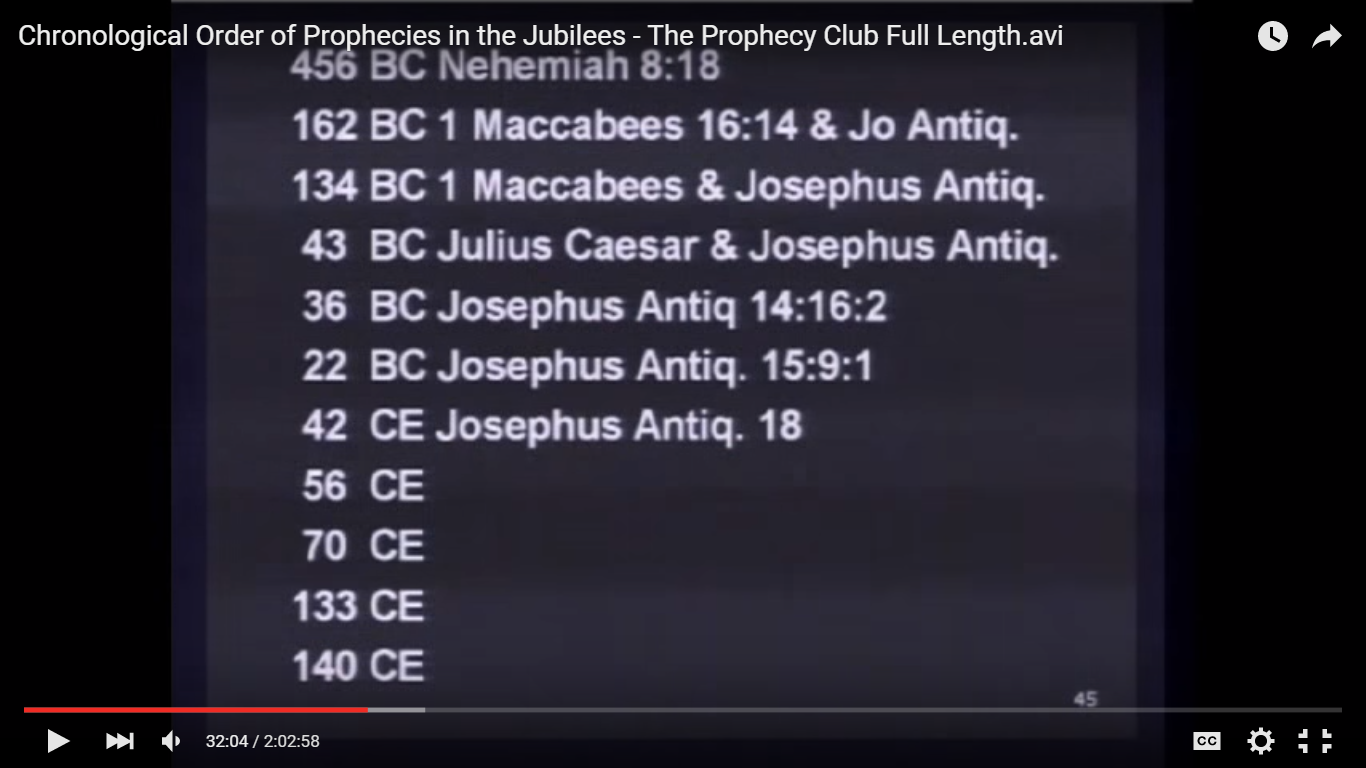
I watched awhile ago a Prophecy Club video called The Chronological Order of the Prophecies in The Jubilees. There is much of this person's views that are clearly wrong, from his supporting the Britam view of the Lost Tribes, to trying to make the 120 years of Genesis 6 point to 6000 years. But his evidence for a reckoning of the Jubilees that would have the next jubilee year starting in Spring of 2045 AD (with the Jubilee Trumpet then in fall of 2044) is compelling. Here is a still I took regarding the Sabbatical Years.
The view of the 70 Weeks I've been favoring had the Decree of Artaxerxes in Nissan 454 BC putting the 70th week in 30-37 AD. But many have, using much of the same evidence, argued for the Decree being Nissan of 455 BC, and a 70th Week that is 29-36 AD. I need to look into that more, but if so that would make both the beginning and ending of the 70 weeks the start of Jubilee years in the above Jubilee model, which makes sense.
I've seen people argue for both 29 and 36 AD Crucifixion models. For the latter that includes Nikos Kokkinos who's theories I may talk about more in a future post. My personal bias remains 30 AD for the moment however. But The Resurrection and Acts 2 Pentecost being Jubilee years has a certain symmetry to it.
This makes the latest Jubilee year to happen Spring 1996-Spring 1997. And before that 1947-1948 which many see as Biblically significant. Before that 1898-1899, and before that 1849-1850.
This model could place the beginning of the 21 year Time of Jacob's Trouble in Spring of 2024 AD.
Or maybe if someone could argue the above proposed Jubilee cycle is off by a year, to make my original 70s Weeks views match up to Jubilees, things would fit better. Then it would be during a Jubilee year modern Israel was founded.
If I switched to a Mid 7th Year or mid 49th Year Rapture view. How do I match up the time-frames? The ministry of the Witnesses and consecration of the Rebuilt Temple would be around the Nissan that would start year 4 of the relevant Sabbatical cycle. The 42 Months The Beast is allowed to continue would begin about 6 months later. And the 1260 days The Woman is in the Wilderness would continue 3 years into The Millennium. Why would that happen? Who knows, perhaps I'll think of a reason later.
But I will still never accept a Non Chronological view of Revelation.
Showing posts with label Shofar. Show all posts
Showing posts with label Shofar. Show all posts
Saturday, October 1, 2016

Saturday, April 9, 2016
The Arnion of Revelaion
I'm going to begin this post by repeating (with small adjustments) some of what I said in this now possibly defunct theory. Much of that post I already possibly retracted here.
The KJV of the Book of Revelation uses the word "Lamb" 29 times, all but once of Jesus. All of them are the same Greek word (Strongs number 721), but in 3 different forms. Arnion/Arniou/ArniO.
This word however appears only once in the NT outside Revelation, in John 21:15. There however it is a form distinct from any of the 3 used in Revelation, Arnia. I'm not sure but I think that could qualify as a feminine form, while the 3 in Revelation clearly do not. There it is used of Believers not of Jesus. But unlike in English translations the Greek text doesn't seem plural there, like Jesus is calling The Church as a whole His Arnia.
The suggestion has been made before that "Lamb" is not an accurate translation of this word, and even been suggested before that it should be "Ram". It's controversial because this word is rare even in Ancient Greek usage outside The Bible. Other Greek words are known to have existed for Lambs and Rams and Goats, the other words for Ram aren't used in the New Testament however (I give no credence to the Septuagint). The main one would be Krios, the Greek name for the constellation Aries, The Ram.
When John, this same Author, in his Gospel quotes in Greek John The Baptist calling Jesus "The Lamb of God" in 1:29&36 he uses Amnos (Strongs number 286). Likewise Acts 8:32 and 1 Peter 1:19 when alluding to Isaiah 53:7 and the Passover Lamb also use Amnos, though Peter spelled it Amnou. In Hebrew also Isaiah 53:7's "Lamb to the Slaughter" uses the same word used of the Passover Lamb in Exodus 12, Strongs number 7716, Seh.
Revelation 5 tells us the Arnion has seven horns. Revelation 13:11 tells us the Beast out of The Earth has 2 horns like an ArniO. While lambs do have horns they're very small and not too noticeable, and so outside Revelation no Biblical references to Lambs mention that they have horns. But they are mentioned in reference to other animals, including the Ayil, and Goats.
And the Shofar (one of two Hebrew words translated Trumpet) was specifically a Trumpet made from a Ram's horn. It's the Shofar sounded on the Yom Kippur proceeding the Jubilee Year in Leviticus 25:9. And traditionally Rams horns are sounded on Yom Teruah, though the Biblicalness of that is debated by Kariates and others.
In the Book of Joshua chapter 6 at the fall of Jericho seven Shofars were sounded. If Arnion means Ram then it would be natural to speculate a connection between the seven horns of the Arnion in Revelation 5, and the seven trumpets sounded by the seven angels later. Others have argued those seven angels are also the seven spirits refereed to, though I've disagreed with that in the past, but I've now updated that post. And Jesus is described as having a voice like a Trumpet.
The repeat is over now.
While I had argued very recently before for the idea of it meaning Ram, my considering that Ayil maybe doesn't mean Ram weakens much of that.
I also learned recently that Shofars are not always Ram's Horns, they can be among other things, Goat's Horns too. (The KJV using Ram's Horn in Joshua 6 is mistranslated, the word used there is actually Jubilee). So the Shofar part of the Ram theory about the Seven Horns in Revelation 5 can also apply to Goats.
Arnion meaning Goat has not been argued for before from what I can find. But as I said Arnion was very rarely used. In Revelation it's first use din Chapter 5 where the Arnion is next to God on His Throne being described as the Arnion as it had been slain. This could be connected to the Blood of the Yom Kippur Sin offering being sprinkled on the "Mercy Seat".
The End Times are viewed as being largely about the Fall Feasts rather then the Spring Feasts. While Numbers 28-29 called for a lot of sacrifices on nearly all the Leviticus 23 Holy Days. Only one Fall Holy Day day is affiliated with a specific special Sacrifice the way Passover is. And that's Yom Kippur, The Sin Offering which was a Goat, described in detail in Leviticus 16.
A Greek word for Goat is used 3 times in the New Testament, in 3 different forms (Strong number 2055 and 2056). EriphOn and Eriphia in Matthew 25:32-33 the Sheep and Goats judgment, and Eriphon in Luke 15:29. In Luke it's at the end of the Prodigal Son parable, used by the older brother to disparagingly describe the animal that hadn't been offered to him in comparison to what his brother is getting now.
So none of those are of a Goat as representing Jesus, and possibly all meant to be derogatory. And neither is by the same human author as Revelation.
While they begin with different letters Ar and Er could reflect a common etymological origin.
And the thing is Hebrew has two different words for Goat or Kid (the KJV translates both as both at different times).
Sayir (Strong number 8163) and Ez (Strong number 5795). The two words are often used in the same verse. Anytime you see "a kid of the goats", Kid is Sayir and Goat is Ez.
Ez first appears in Genesis 15:9, the first appearance of several words for the Sacrificial Animals. Saiyr first appears in Genesis 37:31 which also uses Ez. Both are used in Leviticus 16, but Saiyr much more frequently. And both are used of the Sin offerings called for in Numbers 28-29. And both are used of the He-Goat or Rough-Goat that represents Greece in Daniel 8.
Azazel, the name of the Yom Kippur Scapegoat, is a compound word combining Ez and Azal (Strongs 235) In a sense both Yom Kippur Goats represent Jesus, He both carries our Sins and Dies for them. But I've also argued for a sense in which the Azazel goat could represent Satan, the Antichrist/Falseprophet or the unbelievers in general. This could make sense with Goats representing those cast into Aionios fire (sheeps and Goats judgment). So maybe that has something to do with the second beast having horns "like an ArniO".
In both Leviticus 17:7 and 2 Chronicles 11:15, Saiyr appears and is translated "devils" in the KJV. The context is describing idols or false gods that are being worshiped. Perhaps similar to the Greek goat-god Pan, or the Egyptian Goat of Mendes. In Isaiah 13:21 and 34:14, Saiyr is translated Satyr. A Greek mythological term that originally just refereed to the male counterparts of the Meaneds of Dionysus, but in time came to be thought of as Faun like creatures, which I think is what the KJV translators had in mind.
Isaiah 34 is about Edom, which is interesting since Saiyr is spelled the same as Seir in Hebrew, which is taken to mean Hairy and used to describe Esau's hairiness in Genesis 27. Also in Genesis 27 Jacob uses Goat skins to mimic the feel of Esau's hairiness. Song of Solomon 4:1 and 6:5 use Ez to describe the thickness of Shulamith's hair.
Ez seems to have no feminine equivalent used in Scripture. But Saiyr has Saiyrah, used in Leviticus 4:28 and 5:6. (Correction, Uzzah is a feminine form of Ez, but it only ever appears as a name.)
I'm thinking maybe Eriphon should be viewed as the Greek equivalent to one of those Hebrew words and Arnion the other. Which is which I could go either way on, but I'm leaning towards Eriphon as Saiyr since Paul uses Esau as an idiom for the Gentiles in Romans 9-11. The Septuagint I already know uses Arnion for neither, fortunately I don't trust it. But it may be interesting to see how it uses Eriphon. I don't feel like doing that myself right now, maybe for a future follow up.
Josephus in Antiquities of The Jews Book 3:231 says "ho men gar kata agnoian eis touto propesôn arna kai eriphon thêleian tôn autoetôn prospherei". Which William Whiston translated, " But if a person fall into sin by ignorance, he offers an ewe lamb, or a female kid of the goats, of the same age;". Arna is another form of Arnion, of it's NT appearances most similar to Arnia.
Josephus was not doing a Greek Translation of Scripture. But he was here clearly alluding to one of the verses where the feminine Saiyrah was used. Both verses also use Ez. Leviticus 4:28 includes no animal names besides those, but 5:6 does. It sounds like Josephus intent here was to be talking about Sin offerings, which are defined as being for sins committed in ignorance, which makes 4:28 the better fit. But later the same account mentions Lambs, so it's still unclear even what Josephus meant Arna to mean.
Modern Satanism's use of Goat imagery has caused Christians to develop an unhealthy aversion to Goat imagery. Even Torah observant Christians will talk about goats positively only when it's about Torah verses that require them too. I've talked about the negative references to goats here, but let's not forget based on Leviticus 16, a Goat can represent Jesus just as much as a Lamb can.
Maybe Arnion isn't Greek in origin at all. Because for other subjects I've attempted to research the Etymology of Arnon, the name of a River mentioned in The Hebrew Bible. And found that name has been suspected to be related to Arabic, Aramaic and Syriac words for a type of Goat.
The KJV of the Book of Revelation uses the word "Lamb" 29 times, all but once of Jesus. All of them are the same Greek word (Strongs number 721), but in 3 different forms. Arnion/Arniou/ArniO.
This word however appears only once in the NT outside Revelation, in John 21:15. There however it is a form distinct from any of the 3 used in Revelation, Arnia. I'm not sure but I think that could qualify as a feminine form, while the 3 in Revelation clearly do not. There it is used of Believers not of Jesus. But unlike in English translations the Greek text doesn't seem plural there, like Jesus is calling The Church as a whole His Arnia.
The suggestion has been made before that "Lamb" is not an accurate translation of this word, and even been suggested before that it should be "Ram". It's controversial because this word is rare even in Ancient Greek usage outside The Bible. Other Greek words are known to have existed for Lambs and Rams and Goats, the other words for Ram aren't used in the New Testament however (I give no credence to the Septuagint). The main one would be Krios, the Greek name for the constellation Aries, The Ram.
When John, this same Author, in his Gospel quotes in Greek John The Baptist calling Jesus "The Lamb of God" in 1:29&36 he uses Amnos (Strongs number 286). Likewise Acts 8:32 and 1 Peter 1:19 when alluding to Isaiah 53:7 and the Passover Lamb also use Amnos, though Peter spelled it Amnou. In Hebrew also Isaiah 53:7's "Lamb to the Slaughter" uses the same word used of the Passover Lamb in Exodus 12, Strongs number 7716, Seh.
Revelation 5 tells us the Arnion has seven horns. Revelation 13:11 tells us the Beast out of The Earth has 2 horns like an ArniO. While lambs do have horns they're very small and not too noticeable, and so outside Revelation no Biblical references to Lambs mention that they have horns. But they are mentioned in reference to other animals, including the Ayil, and Goats.
And the Shofar (one of two Hebrew words translated Trumpet) was specifically a Trumpet made from a Ram's horn. It's the Shofar sounded on the Yom Kippur proceeding the Jubilee Year in Leviticus 25:9. And traditionally Rams horns are sounded on Yom Teruah, though the Biblicalness of that is debated by Kariates and others.
In the Book of Joshua chapter 6 at the fall of Jericho seven Shofars were sounded. If Arnion means Ram then it would be natural to speculate a connection between the seven horns of the Arnion in Revelation 5, and the seven trumpets sounded by the seven angels later. Others have argued those seven angels are also the seven spirits refereed to, though I've disagreed with that in the past, but I've now updated that post. And Jesus is described as having a voice like a Trumpet.
The repeat is over now.
While I had argued very recently before for the idea of it meaning Ram, my considering that Ayil maybe doesn't mean Ram weakens much of that.
I also learned recently that Shofars are not always Ram's Horns, they can be among other things, Goat's Horns too. (The KJV using Ram's Horn in Joshua 6 is mistranslated, the word used there is actually Jubilee). So the Shofar part of the Ram theory about the Seven Horns in Revelation 5 can also apply to Goats.
Arnion meaning Goat has not been argued for before from what I can find. But as I said Arnion was very rarely used. In Revelation it's first use din Chapter 5 where the Arnion is next to God on His Throne being described as the Arnion as it had been slain. This could be connected to the Blood of the Yom Kippur Sin offering being sprinkled on the "Mercy Seat".
The End Times are viewed as being largely about the Fall Feasts rather then the Spring Feasts. While Numbers 28-29 called for a lot of sacrifices on nearly all the Leviticus 23 Holy Days. Only one Fall Holy Day day is affiliated with a specific special Sacrifice the way Passover is. And that's Yom Kippur, The Sin Offering which was a Goat, described in detail in Leviticus 16.
A Greek word for Goat is used 3 times in the New Testament, in 3 different forms (Strong number 2055 and 2056). EriphOn and Eriphia in Matthew 25:32-33 the Sheep and Goats judgment, and Eriphon in Luke 15:29. In Luke it's at the end of the Prodigal Son parable, used by the older brother to disparagingly describe the animal that hadn't been offered to him in comparison to what his brother is getting now.
So none of those are of a Goat as representing Jesus, and possibly all meant to be derogatory. And neither is by the same human author as Revelation.
While they begin with different letters Ar and Er could reflect a common etymological origin.
And the thing is Hebrew has two different words for Goat or Kid (the KJV translates both as both at different times).
Sayir (Strong number 8163) and Ez (Strong number 5795). The two words are often used in the same verse. Anytime you see "a kid of the goats", Kid is Sayir and Goat is Ez.
Ez first appears in Genesis 15:9, the first appearance of several words for the Sacrificial Animals. Saiyr first appears in Genesis 37:31 which also uses Ez. Both are used in Leviticus 16, but Saiyr much more frequently. And both are used of the Sin offerings called for in Numbers 28-29. And both are used of the He-Goat or Rough-Goat that represents Greece in Daniel 8.
Azazel, the name of the Yom Kippur Scapegoat, is a compound word combining Ez and Azal (Strongs 235) In a sense both Yom Kippur Goats represent Jesus, He both carries our Sins and Dies for them. But I've also argued for a sense in which the Azazel goat could represent Satan, the Antichrist/Falseprophet or the unbelievers in general. This could make sense with Goats representing those cast into Aionios fire (sheeps and Goats judgment). So maybe that has something to do with the second beast having horns "like an ArniO".
In both Leviticus 17:7 and 2 Chronicles 11:15, Saiyr appears and is translated "devils" in the KJV. The context is describing idols or false gods that are being worshiped. Perhaps similar to the Greek goat-god Pan, or the Egyptian Goat of Mendes. In Isaiah 13:21 and 34:14, Saiyr is translated Satyr. A Greek mythological term that originally just refereed to the male counterparts of the Meaneds of Dionysus, but in time came to be thought of as Faun like creatures, which I think is what the KJV translators had in mind.
Isaiah 34 is about Edom, which is interesting since Saiyr is spelled the same as Seir in Hebrew, which is taken to mean Hairy and used to describe Esau's hairiness in Genesis 27. Also in Genesis 27 Jacob uses Goat skins to mimic the feel of Esau's hairiness. Song of Solomon 4:1 and 6:5 use Ez to describe the thickness of Shulamith's hair.
Ez seems to have no feminine equivalent used in Scripture. But Saiyr has Saiyrah, used in Leviticus 4:28 and 5:6. (Correction, Uzzah is a feminine form of Ez, but it only ever appears as a name.)
I'm thinking maybe Eriphon should be viewed as the Greek equivalent to one of those Hebrew words and Arnion the other. Which is which I could go either way on, but I'm leaning towards Eriphon as Saiyr since Paul uses Esau as an idiom for the Gentiles in Romans 9-11. The Septuagint I already know uses Arnion for neither, fortunately I don't trust it. But it may be interesting to see how it uses Eriphon. I don't feel like doing that myself right now, maybe for a future follow up.
Josephus in Antiquities of The Jews Book 3:231 says "ho men gar kata agnoian eis touto propesôn arna kai eriphon thêleian tôn autoetôn prospherei". Which William Whiston translated, " But if a person fall into sin by ignorance, he offers an ewe lamb, or a female kid of the goats, of the same age;". Arna is another form of Arnion, of it's NT appearances most similar to Arnia.
Josephus was not doing a Greek Translation of Scripture. But he was here clearly alluding to one of the verses where the feminine Saiyrah was used. Both verses also use Ez. Leviticus 4:28 includes no animal names besides those, but 5:6 does. It sounds like Josephus intent here was to be talking about Sin offerings, which are defined as being for sins committed in ignorance, which makes 4:28 the better fit. But later the same account mentions Lambs, so it's still unclear even what Josephus meant Arna to mean.
Modern Satanism's use of Goat imagery has caused Christians to develop an unhealthy aversion to Goat imagery. Even Torah observant Christians will talk about goats positively only when it's about Torah verses that require them too. I've talked about the negative references to goats here, but let's not forget based on Leviticus 16, a Goat can represent Jesus just as much as a Lamb can.
Maybe Arnion isn't Greek in origin at all. Because for other subjects I've attempted to research the Etymology of Arnon, the name of a River mentioned in The Hebrew Bible. And found that name has been suspected to be related to Arabic, Aramaic and Syriac words for a type of Goat.
Rethinking the Ram and Deer
I did my Biblical significance of The Ram study last week. And for the second time this month I may have to abandon a theory not long after posting it, (the other being my Historical Arthur post). That theory could still be right, but some things have come to my attention as I've tried to go deeper on this.
I do still feel pretty certain my theory is correct that Ayil (Ram in the KJV) and Ayal (Hart in the KJV) were originally the same word, and Ayalah (Hind in the KJV) it's feminine form. But I decided I really should consider the opposite conclusion one could draw from that. That Ayil means Hart and it's the Deer who's Biblical significance has been obscured by all this.
Deer do seem to be the only major kind of animal listed among those clean to eat in Deuteronomy 14 that are never mentioned in Sacrifices, Ayil meaning Deer would change that. Archaeologists have in fact found a large percentage of fallow deer among the remains of animals sacrificed at the altar on Mt Ebal.
I've been reading recently that Rams are not really a separate species of Animal from Lambs, Ram is a word used specifically of adult male Sheep. Which would mean Ayalah as a female Ram would not make sense. In Deuteronomy 14 Seh is used as a Prefix for both Kebes and Sayir (Goat). Like Seh is the broader term and Kebes and Sayir refer to more specific animals. Ewe Lamb gets used to translate the feminine form of Kebes.
In Numbers 28-29 the word Seh is never used, it's the Kebes that refers to the daily offerings, and the 7 or 14 Lambs offered on each New Moon and Holy Day.
The thing that has to be discussed on this are the horns. The Ayil is absolutely described as having Horns, but while what Horn has come to mean in modern English does not apply to Deer Antlers, the Hebrew Qeren (Strongs 7161) absolutely can. In fact you could argue getting caught in a thicket like in Genesis 22 does make more sense for Antlers then Ram's Horns. One Robert Graves book was originally titled The Roebuck in The Thicket, so it seems he considered that a Deer or Hart was originally the animal offered in Genesis 22.
The key issue is the Shofar however. I read recently that not all Shofars are Ram's Horns, they can be made from Goat's Horns too. But Antlers are made of actual Bone (that is often why they're not considered Horns in modern terminology, but I'd suspect to the ancients who hadn't put that much thought into it all Horns were thought of as Bone like), and Trumpets can't be made from them because they can't be hollowed out.
The thing is there is no passage in the Hebrew Bible defining the Shofar as coming from an Ayil, Kebes, Sayir, Ez, Seh or anything else, it's just refereed to without really explaining where it came from in depth. New Torah students are often surprised how many of it's concepts the Torah doesn't fully explain.
In the KJV you see the term "Ram's Horns" in Joshua 6 and nowhere else. The Hebrew word translated that however is actually Jubliee, same word translated that in Leviticus 25-27 and Numbers 36:4. (It seems some were confused by the idea of that word being used for more then just the Jubilee year.) No animal is mentioned, and only verse 5 uses the word for Horn, Qeren.
Bonus note, In Daniel the KJV translated Qeren as Cornet when used specifically of a Trumpet, likewise when Shofar and the word for the Silver Trumpets appear in the same verse the KJV renders one of them Cornet. Cornet does look like it's derived from Qeren, the Hebrew Qoph sometimes becomes a K in transliteration which in turn can become a C when it makes the same sound.
So in Joshua 6 verses 4, 6, 8 and 13 "The Seven Trumpets of Ram's Horns" should be "The Seven Shofars of Jubilee". And in verse 5 "Ram's Horn" should be "Jubilee Cornet".
Deuteronomy 14 does not put Seh before Ayal like it does both Kebes and Sayir. And it's listed right alongside two other words for Deer type animals, seemingly in their category more so then the Sheep category.
If Deer or a type of Deer is what Ayil is meant to refer to, that even more vindicates the theory about that Japanese Suwa Taisha festival.
What if the Greek myth linked to the constellation Aries is the origin of the Ram being misidentified as the Genesis 22 animal? If it is an outcome of Hellenization, then the Lost Tribes who broke off before then wouldn't be influenced by it.
Genesis 22:7&8 use Seh when Isaac is asking about the animal before hand, so that could justify a Lamb or Ram being affiliated with the story. But we Christians know the future Lamb to be provided was Jesus.
This still has Naphtali in Genesis 49 identified with the same animal as Medo-Persia in Daniel 8. Using a Deer rather then Ram to represent Persia isn't without precedent, today the Fallow Deer is a National Symbol of Iran.
I'm also rethinking what Arnion could mean, but I'll make that a separate post.
I do still feel pretty certain my theory is correct that Ayil (Ram in the KJV) and Ayal (Hart in the KJV) were originally the same word, and Ayalah (Hind in the KJV) it's feminine form. But I decided I really should consider the opposite conclusion one could draw from that. That Ayil means Hart and it's the Deer who's Biblical significance has been obscured by all this.
Deer do seem to be the only major kind of animal listed among those clean to eat in Deuteronomy 14 that are never mentioned in Sacrifices, Ayil meaning Deer would change that. Archaeologists have in fact found a large percentage of fallow deer among the remains of animals sacrificed at the altar on Mt Ebal.
I've been reading recently that Rams are not really a separate species of Animal from Lambs, Ram is a word used specifically of adult male Sheep. Which would mean Ayalah as a female Ram would not make sense. In Deuteronomy 14 Seh is used as a Prefix for both Kebes and Sayir (Goat). Like Seh is the broader term and Kebes and Sayir refer to more specific animals. Ewe Lamb gets used to translate the feminine form of Kebes.
In Numbers 28-29 the word Seh is never used, it's the Kebes that refers to the daily offerings, and the 7 or 14 Lambs offered on each New Moon and Holy Day.
The thing that has to be discussed on this are the horns. The Ayil is absolutely described as having Horns, but while what Horn has come to mean in modern English does not apply to Deer Antlers, the Hebrew Qeren (Strongs 7161) absolutely can. In fact you could argue getting caught in a thicket like in Genesis 22 does make more sense for Antlers then Ram's Horns. One Robert Graves book was originally titled The Roebuck in The Thicket, so it seems he considered that a Deer or Hart was originally the animal offered in Genesis 22.
The key issue is the Shofar however. I read recently that not all Shofars are Ram's Horns, they can be made from Goat's Horns too. But Antlers are made of actual Bone (that is often why they're not considered Horns in modern terminology, but I'd suspect to the ancients who hadn't put that much thought into it all Horns were thought of as Bone like), and Trumpets can't be made from them because they can't be hollowed out.
The thing is there is no passage in the Hebrew Bible defining the Shofar as coming from an Ayil, Kebes, Sayir, Ez, Seh or anything else, it's just refereed to without really explaining where it came from in depth. New Torah students are often surprised how many of it's concepts the Torah doesn't fully explain.
In the KJV you see the term "Ram's Horns" in Joshua 6 and nowhere else. The Hebrew word translated that however is actually Jubliee, same word translated that in Leviticus 25-27 and Numbers 36:4. (It seems some were confused by the idea of that word being used for more then just the Jubilee year.) No animal is mentioned, and only verse 5 uses the word for Horn, Qeren.
Bonus note, In Daniel the KJV translated Qeren as Cornet when used specifically of a Trumpet, likewise when Shofar and the word for the Silver Trumpets appear in the same verse the KJV renders one of them Cornet. Cornet does look like it's derived from Qeren, the Hebrew Qoph sometimes becomes a K in transliteration which in turn can become a C when it makes the same sound.
So in Joshua 6 verses 4, 6, 8 and 13 "The Seven Trumpets of Ram's Horns" should be "The Seven Shofars of Jubilee". And in verse 5 "Ram's Horn" should be "Jubilee Cornet".
Deuteronomy 14 does not put Seh before Ayal like it does both Kebes and Sayir. And it's listed right alongside two other words for Deer type animals, seemingly in their category more so then the Sheep category.
If Deer or a type of Deer is what Ayil is meant to refer to, that even more vindicates the theory about that Japanese Suwa Taisha festival.
What if the Greek myth linked to the constellation Aries is the origin of the Ram being misidentified as the Genesis 22 animal? If it is an outcome of Hellenization, then the Lost Tribes who broke off before then wouldn't be influenced by it.
Genesis 22:7&8 use Seh when Isaac is asking about the animal before hand, so that could justify a Lamb or Ram being affiliated with the story. But we Christians know the future Lamb to be provided was Jesus.
This still has Naphtali in Genesis 49 identified with the same animal as Medo-Persia in Daniel 8. Using a Deer rather then Ram to represent Persia isn't without precedent, today the Fallow Deer is a National Symbol of Iran.
I'm also rethinking what Arnion could mean, but I'll make that a separate post.
Monday, April 4, 2016
The Biblical Significance of The Ram, are Rams mentioned more often then we think?
Deuteronomy 14 is one of a couple of chapters of The Torah dealing with what animals are and aren't considered okay to eat. In the KJV almost all animals cited elsewhere as animals offered in sacrifices to Yahuah are included here, Lambs, Goats, Bulls, Oxen, Pigeons and Doves. And many additional animals too including multiple words taken as referring to Deer and similar animals, and multiple types of Poultry that leave me with little doubt a traditional Thanksgiving meal is Kosher.
But one of the known sacrificial animals seems absent, the Ram. We know they would be okay to eat because of the broader instructions given here and in Leviticus 11 that tell how to tell the Levitical Cleanses even of Land Mammals the Bible never mentions at all. But I still find it odd that as a clearly well known animal in The Bible, Rams are seemingly not mentioned. In facts Rams seem to be mentioned only once in all of Deuteronomy, and that's in the Song of Moses in chapter 32.
The Hebrew word for Ram is Strongs number 352, Ayil. The word first appears in Genesis 15:9, it's the word for Ram used in Genesis 22 of the one offered in place of Isaac, and in Exodus 29 which I'll bring up again later. It's used throughout Leviticus where Rams are refereed to. And in Numbers 28-29 where they are specified to be offered on most of the Leviticus 23 Holy Days. And in Daniel 8 of the Ram that represents the Medo-Persian Empire. And almost every time you see "ram" in the Old Testament of the KJV.
What's interesting is that according to the Strongs there are two Hebrew words spelled the exact same way as this word, AYL, but are pronounced differently thanks to the Aramaic derived vowel indicators that developed after the captivity.
One is Strongs number 353, Eyal. Which is used only once, in Psalm 88 verse 4 where the KJV translates it "strength". Not the only time "strength" is used to translate a rarely used and thus harder to define word.
The other is Strongs number 354, Ayal. This is consistently translated by the KJV as "Hart" (or Harts when plural) and is in fact the word used every time you see "Hart". It first occurs in Deuteronomy 12, but is also listed as an okay to eat Animal in Deuteronomy 14:5. Indisputably the animal we call in English harts are Levitically clean, but plenty other animals listed here are basically the same kind, deer.
So what I'm thinking is maybe Ayal was not a separate word originally, but some confusion began probably during the captivity. A Hart is a type of Dear, the idea of a Hebrew word for Ram becoming later misunderstood as a word for Dear could be relevant to my Japan and the Lost Tribes post.
Also strong number 355, Ayalah, is the feminine form of Ayal. The KJV always translates this "Hind" or "Hinds". It is used to describe Naphtali in Genesis 49:21 which I've argued could have significance for the Ram of Daniel 8. That there is a lack of a feminine equivalent for Ayil I think could be further evidence it was meant to be the same word as Ayal.
Both "Hind" and "Hart" are used in the Song of Songs by Shulamith and the Beloved to refer to each other. The Song also uses (sometimes in the same verses) "Roe" in both masculine and feminine form, a word elsewhere translated Roe, Buck and Roebuck, and also used in Deuteronomy 12&14. I think they make sense as referring to different animals rather then two words for basically the same animal, but the other reading could work too. Maybe these words for Ram and Deer being used together like this in the song is the origin of the confusion. I think a lot of things about the Song of Solomon have confused people.
Now I shall move to The New Testament.
The KJV of the Book of Revelation uses the word "Lamb" 29 times, all but once of Jesus. All of them are the same Greek word (Strongs number 721), but in 3 different forms. Arnion/Arniou/ArniO.
This word however appears only once in the NT outside Revelation, in John 21:15. There however it is a form distinct from any of the 3 used in Revelation, Arnia. I'm not sure but I think that could qualify as a feminine form, while the 3 in Revelation clearly do not. There it is used of Believers not of Jesus. But unlike in English translations the Greek text doesn't seem plural there, like Jesus is calling The Church as a whole His Arnia.
The suggestion has been made before that "Lamb" is not an accurate translation of this word, and even been suggested before that it should be "Ram". It's controversial because this word is rare even in Ancient Greek usage outside Revelation. Other Greek words are known to have existed for both Lambs and Rams, the other words for Ram aren't used in the New Testament however (I give no credence to the Septuagint). The main one would be Krios, the Greek name for the constellation Aries, The Ram.
When John, this same Author, in his Gospel quotes in Greek John The Baptist calling Jesus "The Lamb of God" in 1:29&36 he uses Amnos (Strongs number 286). Likewise Acts 8:32 and 1 Peter 1:19 when alluding to Isaiah 53:7 and the Passover Lamb also use Amnos, though Peter spelled it Amnou. In Hebrew also Isaiah 53:7's "Lamb to the Slaughter" uses the same word used of the Passover Lamb in Exodus 12, Strongs number 7716, Seh.
Aries, the name of the Ram constellation, is it's Latin rather then Greek name, but Latin and Greek have some similar words due to their common Indo-European origin. That Aries and Arnios begin with the same sound is interesting.
If you are curious how Arnion is used in the Septuagint, it's iffy. It's in 4 verses, none of which use Seh in the Hebrew. Psalm 114 in verses 4 and 6, and in Jeremiah in 11:19 and 50:45. In three of those you will see Lamb in the KJV but for the Psalm the Hebrew is using a word for flock, that is also used in Jeremiah 50:45 and translated "flock". Tsone, Strongs number 6629, in the Septuagint that is the word rendered Arnia, it uses the John 21 version which fits the context.
In Jeremiah 11:19 it's Kebes which the KJV always renders Lamb or Sheep but the Strongs (where it's number is 3532) defines it as being a Ram of a certain age, and it's also used in Exodus 29 as possibly a synonym for Ayil, Seh isn't used in Exodus 29. In the Septuagint of Jeremiah (It's chapter 29 there, some are numbered differently in the LXX) that is clearly the word translated Arnion.
Ayil is used in both Psalm 114 verses but not in the Jeremiah ones. In the Septuagint it's Psalm 113 and Ayil is Krios while Tsone is Arnia in both verses. I feel like all four of those examples together point to this word never being used not for Ayil but for other words used as synonyms for Ayil.
Upon further study of the usage of Kebes it is used in many verses where Ayil or Ayal is used clearly as distinct, and in Deuteronomy 14 Seh is used as a prefix of both Kebes and Goat. So interpreting Arnion as Ram not Lamb is still dependent on the Septuagint being wrong (as I feel it often is) in at least the Jeremiah 11 verse..
Replacing Lamb with Ram when you see it in Revelation arguably takes nothing away from the significance, both were sacrificial animals. The most unique attribute of the Lamb was as the Passover Sacrifice, Revelation is more about the fulfillment of the Fall Feasts. But it can potentially add a lot when you study the significance of the Ram. A Lamb was mentioned in Genesis 22 but it was a Ram that was provided, both Isaac and the Ram represent Jesus, The Lamb of God.
One reason to support seeing the Arnion of Revelation as a Ram rather then a Lamb is that Lambs are usually gentile animals while Rams are more aggressive in nature, hence Aries is similar to Ares the name of the Greek god of War. Revelation 6 refers to the Wrath of the Arnion.
The Arnion of Revelation can arguably be viewed as Jesus serving as The High Priest. Exodus 29 specifies that Ram's Blood is to be shed to consecrate a new High Priest.
Revelation 5 tells us the Arnion has seven horns. Revelation 13:11 tells us the Beast out of The Earth has 2 horns like an ArniO. While lambs do have horns they're very small and not too noticeable, and so outside Revelation no Biblical references to Lambs mention that they have horns.
But their Horns are a big part of the Ram's Biblical significance. Starting in Genesis 22 where it was the Ram's horns caught in the thicket. And the Shofar (one of two Hebrew words translated Trumpet) was specifically a Trumpet made from a Ram's horn. It's the Shofar sounded on the Yom Kippur proceeding the Jubilee Year in Leviticus 25:9. And traditionally Rams horns are sounded on Yom Teruah, though the Biblicalness of that is debated by Kariates and others.
In the Book of Joshua chapter 6 at the fall of Jericho seven Shofars were sounded. If Arnion means Ram then it would be natural to speculate a connection between the seven horns of the Arnion in Revelation 5, and the seven trumpets sounded by the seven angels later. Other have argued those seven angels are also the seven spirits refereed to, though I've disagreed with that in the past, but I've now updated that post. And Jesus is described as having a voice like a Trumpet.
I've talked before about the significance of the fact that the Second Beast/False Prophet has two "Horns like a Lamb". My argument there is no less valid, it's still the same word and still an animal linked to Jesus right from The Torah. What can be added to that is a potential connection to Daniel 8, we all know the first Beast is connected to the beasts of Daniel 7. If ArniO means Ram then the second beast could be connected to Daniel 8.
But the Earth Beast isn't a real Ram, it has horns "like a Ram". Alexander The Great, the notable Horn of the He-Goat, after he defeated Darius III started ruling like a Persian King. Because of this there are coins depicting him as a two horned Ram. And that imagery is why in the Arabic world he became known as Dhul-Qarnain, which means Two-Horned. Maybe none of that is relevant, I certainly don't think Alexander is the False Prophet, but there could be a new Rabbit hole there to chase down.
I've also hear that some of the Herodian Monarchs like Herod Agirppa (of Acts 12) used a Ram as one of their Royal Symbols. I've yet to actual verify this though so I'm reserving judgment on it.
Now what could my above Hart/Hind theory add to Arnion speculation?
This is why I considered their usage in the Song of Songs notable. Among other things the Song of Songs has a typological application about Christ and his Bride. In Revelation 19:7-9 the Marriage Supper is of the Arniou, not any other title of Christ that Revelation uses. And in 21:9 New Jerusalem is called the Arniou's Wife. And I already suggested that in his Gospel this same author used the word's feminine form of The Bride, John 21. What if Ayalah is what Jesus actually said in Hebrew?
The Song of Solomon calls The Beloved an Ayal in the very last verse.
The Mazaroth and the Gospel in The Stars
I've grown more skeptical of that theory then I used to be. But I've talked about it in the past, and many people I converse with still hold to it. And I already mentioned Aries in this study anyway.
The Book of Jubilies (17:15 and 18:3) and some other traditions imply that around Passover was when the offering of Isaac happened, the Samaritans also commemorate it during Unleavened Bread.. According to Stelarium on the day I believe Jesus was Crucified, April 6th 30 AD, the Sun was in Aries. Josephus also linked the beginning of the Hebrew Year to the month the Greeks called Aries.
Over the last two thousand years the ecliptic have moved about a month. So where the Sun was at Passover in the days of Christ it wold be at for Second Passover now. Which could be interesting for theories of an eschatological significance for Second Passover.
The Greek myth affiliated with Aries does seem like a corruption of the story of Genesis 22, possibly another influence of Edomites and Danites who traveled to Greece/Javan (Ezekiel 27).
Adding a twin sister who dies is the darkest corruption of it. But theologically what matters most is how the Monotheism is removed.
Traditions have speculated that the first two Shofars were the horns of the Genesis 22 Ram and continued to be used all the way down to the Temple of Solomon, so the idea of remains of this Ram becoming a sacred relic also maybe has a basis.
I should note that there is also speculation that some of the ancient inhabitants of Cholchis may have been descendants of Calcol son of Zerah son of Judah and Tamar. According to some ancient secular pagan pre-christian Greek writers like Herodotus and Diodorus Sicilus they apparently practiced circumcision, and some even used that to speculate they had a common origin with the Jews and Dannus as descendants of foreigners kicked out of Egypt.
There were other Israelites named Calcol. The British Israelites are in denial that the Chalcol son of Mahol who's Wisdom was compared to Solomon's can't be the same person. So I don't doubt that the Cholchins were Danites.
Or maybe it's possible descends of Laban's son moved the Cholchis region at some point? Since Aeetes is kind of taking the Laban role, Laban in Genesis 24 plays the role that is traditionally the role of the Father of the Bride, though he's actually Rebekah's brother. And we're told gifts were given to Laban and to their mother.
[Update: I may have to retract this, the Ayil part explained here and the Arnion part explained here.]
But one of the known sacrificial animals seems absent, the Ram. We know they would be okay to eat because of the broader instructions given here and in Leviticus 11 that tell how to tell the Levitical Cleanses even of Land Mammals the Bible never mentions at all. But I still find it odd that as a clearly well known animal in The Bible, Rams are seemingly not mentioned. In facts Rams seem to be mentioned only once in all of Deuteronomy, and that's in the Song of Moses in chapter 32.
The Hebrew word for Ram is Strongs number 352, Ayil. The word first appears in Genesis 15:9, it's the word for Ram used in Genesis 22 of the one offered in place of Isaac, and in Exodus 29 which I'll bring up again later. It's used throughout Leviticus where Rams are refereed to. And in Numbers 28-29 where they are specified to be offered on most of the Leviticus 23 Holy Days. And in Daniel 8 of the Ram that represents the Medo-Persian Empire. And almost every time you see "ram" in the Old Testament of the KJV.
What's interesting is that according to the Strongs there are two Hebrew words spelled the exact same way as this word, AYL, but are pronounced differently thanks to the Aramaic derived vowel indicators that developed after the captivity.
One is Strongs number 353, Eyal. Which is used only once, in Psalm 88 verse 4 where the KJV translates it "strength". Not the only time "strength" is used to translate a rarely used and thus harder to define word.
The other is Strongs number 354, Ayal. This is consistently translated by the KJV as "Hart" (or Harts when plural) and is in fact the word used every time you see "Hart". It first occurs in Deuteronomy 12, but is also listed as an okay to eat Animal in Deuteronomy 14:5. Indisputably the animal we call in English harts are Levitically clean, but plenty other animals listed here are basically the same kind, deer.
So what I'm thinking is maybe Ayal was not a separate word originally, but some confusion began probably during the captivity. A Hart is a type of Dear, the idea of a Hebrew word for Ram becoming later misunderstood as a word for Dear could be relevant to my Japan and the Lost Tribes post.
Also strong number 355, Ayalah, is the feminine form of Ayal. The KJV always translates this "Hind" or "Hinds". It is used to describe Naphtali in Genesis 49:21 which I've argued could have significance for the Ram of Daniel 8. That there is a lack of a feminine equivalent for Ayil I think could be further evidence it was meant to be the same word as Ayal.
Both "Hind" and "Hart" are used in the Song of Songs by Shulamith and the Beloved to refer to each other. The Song also uses (sometimes in the same verses) "Roe" in both masculine and feminine form, a word elsewhere translated Roe, Buck and Roebuck, and also used in Deuteronomy 12&14. I think they make sense as referring to different animals rather then two words for basically the same animal, but the other reading could work too. Maybe these words for Ram and Deer being used together like this in the song is the origin of the confusion. I think a lot of things about the Song of Solomon have confused people.
Now I shall move to The New Testament.
The KJV of the Book of Revelation uses the word "Lamb" 29 times, all but once of Jesus. All of them are the same Greek word (Strongs number 721), but in 3 different forms. Arnion/Arniou/ArniO.
This word however appears only once in the NT outside Revelation, in John 21:15. There however it is a form distinct from any of the 3 used in Revelation, Arnia. I'm not sure but I think that could qualify as a feminine form, while the 3 in Revelation clearly do not. There it is used of Believers not of Jesus. But unlike in English translations the Greek text doesn't seem plural there, like Jesus is calling The Church as a whole His Arnia.
The suggestion has been made before that "Lamb" is not an accurate translation of this word, and even been suggested before that it should be "Ram". It's controversial because this word is rare even in Ancient Greek usage outside Revelation. Other Greek words are known to have existed for both Lambs and Rams, the other words for Ram aren't used in the New Testament however (I give no credence to the Septuagint). The main one would be Krios, the Greek name for the constellation Aries, The Ram.
When John, this same Author, in his Gospel quotes in Greek John The Baptist calling Jesus "The Lamb of God" in 1:29&36 he uses Amnos (Strongs number 286). Likewise Acts 8:32 and 1 Peter 1:19 when alluding to Isaiah 53:7 and the Passover Lamb also use Amnos, though Peter spelled it Amnou. In Hebrew also Isaiah 53:7's "Lamb to the Slaughter" uses the same word used of the Passover Lamb in Exodus 12, Strongs number 7716, Seh.
Aries, the name of the Ram constellation, is it's Latin rather then Greek name, but Latin and Greek have some similar words due to their common Indo-European origin. That Aries and Arnios begin with the same sound is interesting.
If you are curious how Arnion is used in the Septuagint, it's iffy. It's in 4 verses, none of which use Seh in the Hebrew. Psalm 114 in verses 4 and 6, and in Jeremiah in 11:19 and 50:45. In three of those you will see Lamb in the KJV but for the Psalm the Hebrew is using a word for flock, that is also used in Jeremiah 50:45 and translated "flock". Tsone, Strongs number 6629, in the Septuagint that is the word rendered Arnia, it uses the John 21 version which fits the context.
In Jeremiah 11:19 it's Kebes which the KJV always renders Lamb or Sheep but the Strongs (where it's number is 3532) defines it as being a Ram of a certain age, and it's also used in Exodus 29 as possibly a synonym for Ayil, Seh isn't used in Exodus 29. In the Septuagint of Jeremiah (It's chapter 29 there, some are numbered differently in the LXX) that is clearly the word translated Arnion.
Ayil is used in both Psalm 114 verses but not in the Jeremiah ones. In the Septuagint it's Psalm 113 and Ayil is Krios while Tsone is Arnia in both verses. I feel like all four of those examples together point to this word never being used not for Ayil but for other words used as synonyms for Ayil.
Upon further study of the usage of Kebes it is used in many verses where Ayil or Ayal is used clearly as distinct, and in Deuteronomy 14 Seh is used as a prefix of both Kebes and Goat. So interpreting Arnion as Ram not Lamb is still dependent on the Septuagint being wrong (as I feel it often is) in at least the Jeremiah 11 verse..
Replacing Lamb with Ram when you see it in Revelation arguably takes nothing away from the significance, both were sacrificial animals. The most unique attribute of the Lamb was as the Passover Sacrifice, Revelation is more about the fulfillment of the Fall Feasts. But it can potentially add a lot when you study the significance of the Ram. A Lamb was mentioned in Genesis 22 but it was a Ram that was provided, both Isaac and the Ram represent Jesus, The Lamb of God.
One reason to support seeing the Arnion of Revelation as a Ram rather then a Lamb is that Lambs are usually gentile animals while Rams are more aggressive in nature, hence Aries is similar to Ares the name of the Greek god of War. Revelation 6 refers to the Wrath of the Arnion.
The Arnion of Revelation can arguably be viewed as Jesus serving as The High Priest. Exodus 29 specifies that Ram's Blood is to be shed to consecrate a new High Priest.
Revelation 5 tells us the Arnion has seven horns. Revelation 13:11 tells us the Beast out of The Earth has 2 horns like an ArniO. While lambs do have horns they're very small and not too noticeable, and so outside Revelation no Biblical references to Lambs mention that they have horns.
But their Horns are a big part of the Ram's Biblical significance. Starting in Genesis 22 where it was the Ram's horns caught in the thicket. And the Shofar (one of two Hebrew words translated Trumpet) was specifically a Trumpet made from a Ram's horn. It's the Shofar sounded on the Yom Kippur proceeding the Jubilee Year in Leviticus 25:9. And traditionally Rams horns are sounded on Yom Teruah, though the Biblicalness of that is debated by Kariates and others.
In the Book of Joshua chapter 6 at the fall of Jericho seven Shofars were sounded. If Arnion means Ram then it would be natural to speculate a connection between the seven horns of the Arnion in Revelation 5, and the seven trumpets sounded by the seven angels later. Other have argued those seven angels are also the seven spirits refereed to, though I've disagreed with that in the past, but I've now updated that post. And Jesus is described as having a voice like a Trumpet.
I've talked before about the significance of the fact that the Second Beast/False Prophet has two "Horns like a Lamb". My argument there is no less valid, it's still the same word and still an animal linked to Jesus right from The Torah. What can be added to that is a potential connection to Daniel 8, we all know the first Beast is connected to the beasts of Daniel 7. If ArniO means Ram then the second beast could be connected to Daniel 8.
But the Earth Beast isn't a real Ram, it has horns "like a Ram". Alexander The Great, the notable Horn of the He-Goat, after he defeated Darius III started ruling like a Persian King. Because of this there are coins depicting him as a two horned Ram. And that imagery is why in the Arabic world he became known as Dhul-Qarnain, which means Two-Horned. Maybe none of that is relevant, I certainly don't think Alexander is the False Prophet, but there could be a new Rabbit hole there to chase down.
I've also hear that some of the Herodian Monarchs like Herod Agirppa (of Acts 12) used a Ram as one of their Royal Symbols. I've yet to actual verify this though so I'm reserving judgment on it.
Now what could my above Hart/Hind theory add to Arnion speculation?
This is why I considered their usage in the Song of Songs notable. Among other things the Song of Songs has a typological application about Christ and his Bride. In Revelation 19:7-9 the Marriage Supper is of the Arniou, not any other title of Christ that Revelation uses. And in 21:9 New Jerusalem is called the Arniou's Wife. And I already suggested that in his Gospel this same author used the word's feminine form of The Bride, John 21. What if Ayalah is what Jesus actually said in Hebrew?
The Song of Solomon calls The Beloved an Ayal in the very last verse.
The Mazaroth and the Gospel in The Stars
I've grown more skeptical of that theory then I used to be. But I've talked about it in the past, and many people I converse with still hold to it. And I already mentioned Aries in this study anyway.
The Book of Jubilies (17:15 and 18:3) and some other traditions imply that around Passover was when the offering of Isaac happened, the Samaritans also commemorate it during Unleavened Bread.. According to Stelarium on the day I believe Jesus was Crucified, April 6th 30 AD, the Sun was in Aries. Josephus also linked the beginning of the Hebrew Year to the month the Greeks called Aries.
Over the last two thousand years the ecliptic have moved about a month. So where the Sun was at Passover in the days of Christ it wold be at for Second Passover now. Which could be interesting for theories of an eschatological significance for Second Passover.
The Greek myth affiliated with Aries does seem like a corruption of the story of Genesis 22, possibly another influence of Edomites and Danites who traveled to Greece/Javan (Ezekiel 27).
In Greek mythology, Athamas (/ˈæθəməs/; Ancient Greek: Ἀθάμας) was a Boeotian king.
Phrixus and Helle (his twin son and daughter) were hated by their stepmother, Ino. Ino hatched a devious plot to get rid of the twins, roasting all the town's crop seeds so they would not grow. The local farmers, frightened of famine, asked a nearby oracle for assistance. Ino bribed the men sent to the oracle to lie and tell the others that the oracle required the sacrifice of Phrixus. Athamas reluctantly agreed. Before he was killed, though, Phrixus and Helle were rescued by a flying golden ram sent by Nephele, their natural mother. Helle fell off the ram into the Hellespont (which was named after her) and died, but Phrixus survived all the way to Colchis, where King Aeëtes took him in and treated him kindly, giving Phrixus his daughter Chalciope in marriage. In gratitude, Phrixus gave the king the golden fleece of the ram, which Aeëtes hung in a tree in his kingdom.What could I say that isn't obvious? The parallel possibly carries over into Genesis 24, with Chalcioe as Rebekah.
Adding a twin sister who dies is the darkest corruption of it. But theologically what matters most is how the Monotheism is removed.
Traditions have speculated that the first two Shofars were the horns of the Genesis 22 Ram and continued to be used all the way down to the Temple of Solomon, so the idea of remains of this Ram becoming a sacred relic also maybe has a basis.
I should note that there is also speculation that some of the ancient inhabitants of Cholchis may have been descendants of Calcol son of Zerah son of Judah and Tamar. According to some ancient secular pagan pre-christian Greek writers like Herodotus and Diodorus Sicilus they apparently practiced circumcision, and some even used that to speculate they had a common origin with the Jews and Dannus as descendants of foreigners kicked out of Egypt.
There were other Israelites named Calcol. The British Israelites are in denial that the Chalcol son of Mahol who's Wisdom was compared to Solomon's can't be the same person. So I don't doubt that the Cholchins were Danites.
Or maybe it's possible descends of Laban's son moved the Cholchis region at some point? Since Aeetes is kind of taking the Laban role, Laban in Genesis 24 plays the role that is traditionally the role of the Father of the Bride, though he's actually Rebekah's brother. And we're told gifts were given to Laban and to their mother.
[Update: I may have to retract this, the Ayil part explained here and the Arnion part explained here.]
Thursday, January 21, 2016
Yom Teruah and Trumpets
I talked about the controversy of affiliating Yom Teruah with Trumpets in my initial Seventh Trumpet post. I went back and forth on Psalm 81 more recently.
On one of the Karaite websites I follow I noticed that they object to affiliating Trumpets with Yom Teruah. Even Karaites can be fallible.
The Hebrew word for neither kind of Trumpet is used in Leviticus 23:24 or Numbers 29, that is correct. To me as I argued before whether it's the Shofar or the Silver Trumpet is irrelevant, Revelation's Trumpets I believe draw on both as does The Rapture Trumpet.
The Karaites like Chris White feel Teruah without a clear Trumpet reference refers to the people making noise, not a Trumpet. Thing I've noticed though is that many Bible verses that use Teruah grammatically of the people shouting also reference Trumpets, if not in the same verse very near by.
Revelation 11 also has voices shouting and making Alarm in Heaven after the Seventh Trumpet sounds.
Jeremiah 4:19 and Zephaniah 1:16 both use Teruah in reference to the Shofar, with the KJV translating it Alarm. Joshua 6 uses it while also talking about the Trumpets at the battle of Jericho. Psalm 150, the last Psalm (and a short one), uses it in verse 5 in reference to Cymbals but Trumpets were mentioned earlier. Also 2 Chronicles 13:12, 15:14 and Psalm 47:5. And Amos 2:2 uses it and the Shofar.
2 Samuel 6 15 and 1 Chronicles 15:28 use it and also mention Trumpets while talking about when David brought The Ark to Jerusalem. Revelation 11 tells use after the Seventh Trumpet is sounded that the Ark will be seen in the Temple in Heaven.
Some verses that use the word without mentioning Trumpets directly, are referring to "The Alarm of War". Numbers 10 and Joshua 6 both tell me we can infer the Alarm of War involves Trumpets.
Still, in The Torah this is the Holy Day we're told the least about. It's not mentioned in Deuteronomy 16 or Ezekiel 45. Yom Kippur is also absent from those chapters but it has Leviticus 16 dedicated to it.
Nehemiah 7:23-8:12 is all on this day, and it makes that day pretty important, though no Trumpets are referenced.
Before that however was Ezra 3, in verses 1-2 and 6-7 talking about the first year of the return from captivity (though some argue a time jump between verses 6 and 7). Verses 8-9 jump to the Second Month of the Second year to talk about Zerubbabel and Jeshua starting their work. I can't help but wonder if it can be conjectured while not clearly stated, that verse 10 has jumped forward to the anniversary of what was recorded before, that that day is supposed to be the day for consecrating the foundations during this period.
If so it's interesting that Ezra 3:10 refers to Trumpets, and says "after the ordinance of King David", and then verses 11 and 13 use Teruah 3 times with the KJV translating it Shout.
What can be interesting in terms of a Tishri Rapture in general is 2 Chronicles 31, talking about Hezekiah's reforms. Verses 5 and 6 talks about offering made for The Temple at Hezekiah's command, including First Fruits offerings. Then verse 7 says.
"In the third month they began to lay the foundation of the heaps, and finished them in the seventh month."
Early in the third month is when Pentecost happens, could this time frame be a type of the time frame of The Church? Our foundation laid at Pentecost and finished in Tishri? Because after this these offerings were gathered up and stored in the "chambers in the house of the LORD" in verses 10 and 11.
While I don't like to build doctrine on Extra Biblical Jewish Traditions, especially ones not attested before The Talmud in the 2nd Century. The customs that went on during the first Century Second Temple period were an influence on the imagery of the New Testament. I've already done a post on how Yom Teruah customs tie into the Two Witnesses.
Numbers 10 is about the Silver Trumpets sounding every Holy Day and New Moon. What is interesting about Yom Teruah is it is the 7th New Moon of the year.
On one of the Karaite websites I follow I noticed that they object to affiliating Trumpets with Yom Teruah. Even Karaites can be fallible.
The Hebrew word for neither kind of Trumpet is used in Leviticus 23:24 or Numbers 29, that is correct. To me as I argued before whether it's the Shofar or the Silver Trumpet is irrelevant, Revelation's Trumpets I believe draw on both as does The Rapture Trumpet.
The Karaites like Chris White feel Teruah without a clear Trumpet reference refers to the people making noise, not a Trumpet. Thing I've noticed though is that many Bible verses that use Teruah grammatically of the people shouting also reference Trumpets, if not in the same verse very near by.
Revelation 11 also has voices shouting and making Alarm in Heaven after the Seventh Trumpet sounds.
Jeremiah 4:19 and Zephaniah 1:16 both use Teruah in reference to the Shofar, with the KJV translating it Alarm. Joshua 6 uses it while also talking about the Trumpets at the battle of Jericho. Psalm 150, the last Psalm (and a short one), uses it in verse 5 in reference to Cymbals but Trumpets were mentioned earlier. Also 2 Chronicles 13:12, 15:14 and Psalm 47:5. And Amos 2:2 uses it and the Shofar.
2 Samuel 6 15 and 1 Chronicles 15:28 use it and also mention Trumpets while talking about when David brought The Ark to Jerusalem. Revelation 11 tells use after the Seventh Trumpet is sounded that the Ark will be seen in the Temple in Heaven.
Some verses that use the word without mentioning Trumpets directly, are referring to "The Alarm of War". Numbers 10 and Joshua 6 both tell me we can infer the Alarm of War involves Trumpets.
Still, in The Torah this is the Holy Day we're told the least about. It's not mentioned in Deuteronomy 16 or Ezekiel 45. Yom Kippur is also absent from those chapters but it has Leviticus 16 dedicated to it.
Nehemiah 7:23-8:12 is all on this day, and it makes that day pretty important, though no Trumpets are referenced.
Before that however was Ezra 3, in verses 1-2 and 6-7 talking about the first year of the return from captivity (though some argue a time jump between verses 6 and 7). Verses 8-9 jump to the Second Month of the Second year to talk about Zerubbabel and Jeshua starting their work. I can't help but wonder if it can be conjectured while not clearly stated, that verse 10 has jumped forward to the anniversary of what was recorded before, that that day is supposed to be the day for consecrating the foundations during this period.
If so it's interesting that Ezra 3:10 refers to Trumpets, and says "after the ordinance of King David", and then verses 11 and 13 use Teruah 3 times with the KJV translating it Shout.
What can be interesting in terms of a Tishri Rapture in general is 2 Chronicles 31, talking about Hezekiah's reforms. Verses 5 and 6 talks about offering made for The Temple at Hezekiah's command, including First Fruits offerings. Then verse 7 says.
"In the third month they began to lay the foundation of the heaps, and finished them in the seventh month."
Early in the third month is when Pentecost happens, could this time frame be a type of the time frame of The Church? Our foundation laid at Pentecost and finished in Tishri? Because after this these offerings were gathered up and stored in the "chambers in the house of the LORD" in verses 10 and 11.
While I don't like to build doctrine on Extra Biblical Jewish Traditions, especially ones not attested before The Talmud in the 2nd Century. The customs that went on during the first Century Second Temple period were an influence on the imagery of the New Testament. I've already done a post on how Yom Teruah customs tie into the Two Witnesses.
Numbers 10 is about the Silver Trumpets sounding every Holy Day and New Moon. What is interesting about Yom Teruah is it is the 7th New Moon of the year.
Sunday, September 27, 2015
Possible Psalm 81 Retraction
In my main Seventh Trumpet post I had cited Psalm 81 as evidence for affiliating Yom Teruah with Trumpet sounding. And my overall point in that post remains regardless of the relevance of this Psalm. But it turns out there are possible translation issues with that verse.
I had cited the KJV rendering, as is usually my default, of verse 3.
There are a few issues I have since discovered. Which I found looking into why many modern Bibles replace "in the time appointed" with Full Moon.
1. The Hebrew doesn't use the usual Hebrew phrase for Appointed Time, Mowed, but rather Keceh, which the Strongs says means full or fullness.
2. The usual word for the "new" part of New Moon, Rosh, isn't the Hebrew in the verse. Just the word Codesh which is affiliated with the Moon as well as with Months. But not the standard Hebrew word for Moon which is Yerah.
3. The reference to "solem feast day" isn't Mowed either, but chag, which unlike other words translated Feast is assumed to specifically mean a feast or festival. I've been told recently that only the pilgrimage days are feasts/festivals. Two of those happen on or right after Full Moons, and none on a New Moon.
According to Numbers 10 the Silver Trumpets are sounded on all the Appointed Times. The Hebrew here references the Shofar however. It's possible the types of Trumpets are not meant to be as distinguished from others as some insist they should be.
Modern Bibles are clearly wrong to reference the New and Full Moon both, this is a single day being refereed to according to the grammar. If it's a Solemn Feast Day that's Full Moon linked, it's either Passover of Tabernacles.
The word in question for "fullness" is only used once elsewhere in Scripture. Proverbs 7:20. There again the KJV renders it Appointed.
It is strong number 3677, but it's root is 3680. That word is taken as meaning things like cover, hide, conceal. So that sounds more like the New Moon or a solar Eclipse (the eve of the Hebrew New Moon which is the crescent) were the Moon isn't visible at all.
Numbers 10 does say to sound the Silver Trumpets on all the Holy Days, but it's usually only Yom Teruah (or Yom Kippur but only for the Jubilee) specifically associated with Trumpets. Especially the Shofar.
I still think my original view on this may be right, but that makes those who insist Yom Teruah and Yom Kippur are not Feasts mistaken. Solomon's 14 day Festival went through Yom Kippur, which doesn't work if Yom Kippur is a Fast Day as tradition as convinced people.
The Septuagint agrees with the KJV on this verse, I have major issues with the Septuagint, but those come down to how it's used against the KJV, and the Masoretic text in general, here I'm simply wondering how to interpret what the Masoretic text says. And I do think now the KJV and LXX are both mistaken in exactly how to express the verse, but possibly closer to the correct intent then the Full Moon view.
Thing is this would be the only verse in The Bible making the Full Moon significant, (with only one other mentioning it at all, based on the same word). Certain Feast Days happen to occur near the Full Moon, but it's how long after the New Moon they are counted. And saying the 15th of each month is the Full Moon is a mistake based on a wrong understanding of the Biblical New Moon. The Full Moon is actually the 14th more often then not.
I always find it significant when God does the opposite of The Pagans. The Full Moon is constantly significant to Pagans, but The Bible seems to be more focused on New Moons.
This PDF argued in-favor of the Full Moon interpretation. But in doing so reveals how that interpretation has it's roots in the opinions of the Pharasitic Rabbis of the first and second centuries, who went on to influence Jerome. I give Jerome credit for being the first "Church Father" to use Hebrew rather then the Septuagint for the Old Testament, but he should have sought his advice from Kariates rather then Rabbis.
And that PDF's argument against the "covering" interpretation seems overly technical for a word that is used only twice.
My hunch now is that this refers to when the Moon comes out of hiding, the Biblical New Moon.
This is an issue I'm gonna to dig deeper on.
On a side note, tonight is the Blood Moon (but in Kariate Biblical reckoning it's not Tabernacles after all, Tabernacles starts tomorrow night). Here is Chris White's refutation of that again.
He could have added that it's barely visible in Israel, this last one being the only one visible there at all.
I'm gonna put Rob Skiba's recent longer video here too, though he says plenty I don't agree with (like on the Flat Earth).
I had cited the KJV rendering, as is usually my default, of verse 3.
Blow up the trumpet in the new moon, in the time appointed, on our solemn feast day.Yom Teruah is the only day that is both a New Moon and one of the Leviticus 23 Feast Days.
There are a few issues I have since discovered. Which I found looking into why many modern Bibles replace "in the time appointed" with Full Moon.
1. The Hebrew doesn't use the usual Hebrew phrase for Appointed Time, Mowed, but rather Keceh, which the Strongs says means full or fullness.
2. The usual word for the "new" part of New Moon, Rosh, isn't the Hebrew in the verse. Just the word Codesh which is affiliated with the Moon as well as with Months. But not the standard Hebrew word for Moon which is Yerah.
3. The reference to "solem feast day" isn't Mowed either, but chag, which unlike other words translated Feast is assumed to specifically mean a feast or festival. I've been told recently that only the pilgrimage days are feasts/festivals. Two of those happen on or right after Full Moons, and none on a New Moon.
According to Numbers 10 the Silver Trumpets are sounded on all the Appointed Times. The Hebrew here references the Shofar however. It's possible the types of Trumpets are not meant to be as distinguished from others as some insist they should be.
Modern Bibles are clearly wrong to reference the New and Full Moon both, this is a single day being refereed to according to the grammar. If it's a Solemn Feast Day that's Full Moon linked, it's either Passover of Tabernacles.
The word in question for "fullness" is only used once elsewhere in Scripture. Proverbs 7:20. There again the KJV renders it Appointed.
He hath taken a bag of money with him, and will come home at the day appointed.Other translations also say "full moon" instead of "day appointed' here.
It is strong number 3677, but it's root is 3680. That word is taken as meaning things like cover, hide, conceal. So that sounds more like the New Moon or a solar Eclipse (the eve of the Hebrew New Moon which is the crescent) were the Moon isn't visible at all.
Numbers 10 does say to sound the Silver Trumpets on all the Holy Days, but it's usually only Yom Teruah (or Yom Kippur but only for the Jubilee) specifically associated with Trumpets. Especially the Shofar.
I still think my original view on this may be right, but that makes those who insist Yom Teruah and Yom Kippur are not Feasts mistaken. Solomon's 14 day Festival went through Yom Kippur, which doesn't work if Yom Kippur is a Fast Day as tradition as convinced people.
The Septuagint agrees with the KJV on this verse, I have major issues with the Septuagint, but those come down to how it's used against the KJV, and the Masoretic text in general, here I'm simply wondering how to interpret what the Masoretic text says. And I do think now the KJV and LXX are both mistaken in exactly how to express the verse, but possibly closer to the correct intent then the Full Moon view.
Thing is this would be the only verse in The Bible making the Full Moon significant, (with only one other mentioning it at all, based on the same word). Certain Feast Days happen to occur near the Full Moon, but it's how long after the New Moon they are counted. And saying the 15th of each month is the Full Moon is a mistake based on a wrong understanding of the Biblical New Moon. The Full Moon is actually the 14th more often then not.
I always find it significant when God does the opposite of The Pagans. The Full Moon is constantly significant to Pagans, but The Bible seems to be more focused on New Moons.
This PDF argued in-favor of the Full Moon interpretation. But in doing so reveals how that interpretation has it's roots in the opinions of the Pharasitic Rabbis of the first and second centuries, who went on to influence Jerome. I give Jerome credit for being the first "Church Father" to use Hebrew rather then the Septuagint for the Old Testament, but he should have sought his advice from Kariates rather then Rabbis.
And that PDF's argument against the "covering" interpretation seems overly technical for a word that is used only twice.
My hunch now is that this refers to when the Moon comes out of hiding, the Biblical New Moon.
This is an issue I'm gonna to dig deeper on.
On a side note, tonight is the Blood Moon (but in Kariate Biblical reckoning it's not Tabernacles after all, Tabernacles starts tomorrow night). Here is Chris White's refutation of that again.
He could have added that it's barely visible in Israel, this last one being the only one visible there at all.
I'm gonna put Rob Skiba's recent longer video here too, though he says plenty I don't agree with (like on the Flat Earth).
Monday, September 7, 2015
Witnesses and The Seventh Trumpet
This is copied from a Pre-Trib Website arguing against linking the Seventh Trumpet of Revelation 11 to the Rapture's Last Trumpet of Yom Teruah.
After the witnesses are interviewed, to confirm that they are indeed two agreeing witnesses, the High Priest was informed. Then The High Priest stood at the top of the Temple Mount (because the witnesses brought this news to the bottom of the mount) and tells the two witnesses to "Come up" and they ascend the Temple Mount to the High Priest, and then they sound the Last Trump.
This site's argument against tying this to the Seventh Trumpet was.
This site also talks about how Jewish thought also has a First Trumpet, and the First Trumpet is sounded on Pentecost.
Well I've argued on this Blog extensively why I see the Sixth Seal and Revelation 7 as the second fulfillment of Joel 2:28-32. And the sealing of the 144,000 is the latter rain, the final great outpouring of the Holy Spirit. So the First Trumpet being sounded right after that fits perfectly.
This site assumes the Great Trumpet and Last Trumpet can't be the same simply because Rabbinic Tradition distinguishes them I guess.
I believe when The Witnesses are Resurrected will be when the sliver of the New Moon of Tishri is seen. The World will witnesses their rising, they'll preach some more, The Gospel will spread and then God will call them up to Heaven and they will Ascend to Heaven.
Then the people of Jerusalem (who we know from the beginning of chapter 11 are mostly Gentiles at this time) will Believe and Repent and Praise God. That will be when the fullness of the Gentiles is come in. Then the Seventh Trumpet is sounded.
Jesus said in Luke 21 that Jerusalem will be "Trodden under foot of the Gentiles till the Times of the Gentiles are fulfilled". And that is when he will return.
They leave out another important detail however.Yom Teruah is the only festival that no man knows when exactly it will occur. This is due to the fact that it begins on the new moon. The new moon was sanctified when two witnesses see the new moon and attest to it before the Sanhedrin in the Temple.This sanctification could happen during either of two days, depending on when the witnesses come. Since no one knew when the witnesses would come, no one knew when the Feast of Trumpets would start.On the 30th of each month, the members of the High Court assembled in a courtyard in Jerusalem, where they waited to receive the testimony of two reliable witnesses. They then sanctified the new moon. The new moon is very difficult to see on the first day because it can be seen only about sunset, close to the sun, when the sun is traveling north. So, looking for a very slim faint crescent moon, which is very close to the sun, is a very difficult thing to do. If the moon’s crescent was not seen on the 30th day, the new moon was automatically celebrated on the 31st day.
After the witnesses are interviewed, to confirm that they are indeed two agreeing witnesses, the High Priest was informed. Then The High Priest stood at the top of the Temple Mount (because the witnesses brought this news to the bottom of the mount) and tells the two witnesses to "Come up" and they ascend the Temple Mount to the High Priest, and then they sound the Last Trump.
This site's argument against tying this to the Seventh Trumpet was.
We cannot go to the Book of Revelation and say that the voice of the seventh angel (Revelation 11:15) is the last trump. In the first century, the last trump (shofar) meant a specific day in the year.It's not an argument, people are just under the assumption Yom Teruah and the 7th Trumpet can't be the same cause we are conditioned to think the Fall Feast begin/end years even though Biblically they mark the middle. So we're not prepared to see them in the middle of Revelation unless you're a post-tirbber who garbles the chronology.
This site also talks about how Jewish thought also has a First Trumpet, and the First Trumpet is sounded on Pentecost.
Well I've argued on this Blog extensively why I see the Sixth Seal and Revelation 7 as the second fulfillment of Joel 2:28-32. And the sealing of the 144,000 is the latter rain, the final great outpouring of the Holy Spirit. So the First Trumpet being sounded right after that fits perfectly.
This site assumes the Great Trumpet and Last Trumpet can't be the same simply because Rabbinic Tradition distinguishes them I guess.
I believe when The Witnesses are Resurrected will be when the sliver of the New Moon of Tishri is seen. The World will witnesses their rising, they'll preach some more, The Gospel will spread and then God will call them up to Heaven and they will Ascend to Heaven.
Then the people of Jerusalem (who we know from the beginning of chapter 11 are mostly Gentiles at this time) will Believe and Repent and Praise God. That will be when the fullness of the Gentiles is come in. Then the Seventh Trumpet is sounded.
Jesus said in Luke 21 that Jerusalem will be "Trodden under foot of the Gentiles till the Times of the Gentiles are fulfilled". And that is when he will return.
Saturday, July 26, 2014
The Seventh and Last Trumpet
First I want to address those who refute the Seventh Trumpet view by claiming the "Last Trump" (1 Corinthians 15:52) being called the "Trump of God" (1 Thessalonians 4:16) means it can't be sounded by an Angel. Everything in Heaven is of God, and the Seventh Trumpet being clearly separated from the rest in it's sounding makes it unique. In Revelation 15 and 16 the Seven bowls of Gods Wrath are poured out by Angels, even though we all know the Wrath in question is Of God, the Trumpets are the same.
A debate exists over whether or not the "Last Trump" that signals the Rapture in Thessalonians, and Corinthians and Matthew 24 is the Seventh Trumpet of Revelation 11 or the Last Trumpet sounded on the Feast of Trumpets.
Chris White argues it's neither and that we should look at the Silver Trumpets of Numbers 10.
It is true that the Biblical Hebrew text does not explicitly link Trumpets to the First of Tishri feast in Leviticus 23:24, that's an assumption we make based on Trumpets being added in translation, and extra Biblical traditions about that day. Chris White however seems to assume the Trumpets affiliated with the First of Tishri are the Ram's Horns. But a book I have on Hebrew customs (by Ethan Allen) says Silver Trumpets and Shofar were both sounded on that day.
Numbers 10:10 does say the Silver Trumpets are to be sounded "Also in the day of your gladness, and in your solemn days, and in the beginnings of your months". Now "solemn days" in the Hebrew texts refers to the "appointed times' or High Holy Days, meaning all of them outlined in Leviticus 23. And the beginning of each month would also include the First of Tishri.
The single word translated "blowing of trumpets" in Leviticus 23:24 is T@ruw`ah (ter-oo-aw'); Noun Feminine, Strong #: 8643. Is used in Numbers 10:5&6 where it is translated "Alarm".
"When ye blow an alarm, then the camps that lie on the east parts shall go forward.
When ye blow an alarm the second time, then the camps that lie on the south side shall take their journey: they shall blow an alarm for their journeys."
In verse 7 it's a different word translated alarm, but one that is probably the root of the final syllable of Taruwah.
At any rate I'd agree we can't build solid doctrine on any extra Biblical assumptions about Rosh Hoshana. But this one may have more of a Biblical basis then he realized. The First of Tishri is the one day there is double the reason to sound those Trumpets. And the only thing we are told about it in Leviticus is a key word also used in Numbers 10 about blowing Trumpets.
Actually Psalm 81 I feel kind of refutes the claim that there is no Biblical basis for linking Trumpets to the First of Tishri. In verse 3 Asaph wrote "Blow up the trumpet in the new moon, in the time appointed, on our solemn feast day." The only day that is both a New Moon and one of the Leviticus 23 ordained major Feast Days is the First of Tishri. Here though Shofar is used rather then the word for the Silver Trumpets.
I don't think we should distinguish between the Rams Horns and Silver Trumpets in terms of how they may symbolically point to Heavenly/Eschatology Trumpets. Whether it's the verses indisputably about The Rapture or the Seven Trumpets in Revelation. Earthly Trumpets needed to be made from separate materials for Earthly reasons, but the Heavenly Trumpets are probably not really made from any Earthly substance at all. Silver is Levitcully a symbol of Redemption, and Ram's Horns are taken from Sacrificial offerings. So symbolically both point to Jesus as our Sin Offering, who's voice is sometimes described as "like a Trumpet". And the New Testament only uses one Greek word for Trumpet.
Hosea 5:8 Poetically uses both words for Trumpet as if their synonyms. But the KJV renders one of them Cornet to avoid sounding redundant.
He's also wrong that the Trumpet themes through out the Prophets are always the Silver Trumpets. Hosea 5:8 is the only time the Silver Trumpets are mentioend in the Porphetic Books. And Psalm 98 the only time they're in the Psalms. Both have the Shofar also in the same verse. Every other Trumpet reference in the Psalms or Prophets it is the Shofar. And Plenty seem linked to The Rapture/Day of The LORD.
I believe that the references to the Trumpets in Revelation are meant to draw on all the earlier Trumpet themes of Scripture. Both the Silver and the Rams Horns. Because I view Revelation as explaining the rest of Scripture, and unveiling all things that were before mysteries. Meaning if the Trumpet that signals the Rapture isn't in Revelation, then Revelation has arguably failed to serve part of it's purpose.
Post-Tirbbers often agree with seeing the Rapture in the same Revelation passages Mid-Tirbbers do, but make it compatible with their view by garbling the chronology of Revelation in ways that are ridiculous. Those would also agree with my on the Seventh Trumpet being sounded on he First of Tishri, I would point out that there is no Biblical basis for God post Exodus ever returning to Tishri rather then Nisan years.
Of the passages outside Revelation viewed as being the most indisputably about The Rapture, a Trumpet sounding is the most nearly universal detail. Matthew 24:31, 1 Thessalonians 4:16 and 1 Corinthians 15:52, and I feel the most solid Old Testament reference in Joel. Yet Pre-Trib and Pre-Wrath people refuse to look for a Trumpet in their placement in Revelation, and Pre-Wrathers feel their position is proved by Rapture signs only used in the Olivite Discourse yet never by Paul.
Both Post-Tribbers and Mid-Trib/Pre-Wrath supporters love to refute the Pre-Trib argument that Matthew 24 isn't referring to the same coming/gathering as Paul by pointing out all the parallels between that account and Paul's from Thessalonians and Corinthians. There are at least 20. But what many either miss or ignore is that a number of those same parallels apply to the Seventh Trumpet in Revelation 11.
We have a Trumpet sounding followed by great voices in Heaven. The use of the word "Archangel" in Corinthians is a different from then when Jude uses it of Michael. It ends with an "n" making it technically plural in Greek.
We have The Four Cherubim declaring God's Wrath is come, in a way that makes clear it hadn't come before the 7th Trumpet.
We have talk about it now being the "Time of the Dead" and time to judge and reward the saints. That sounds like the Bema Judgment to me.
I also think "And the temple of God was opened in heaven, and there was seen in his temple the ark of his testament" could correlate to "The sign of the Son of Man" being seen in the Heavens. One can argue the Ark of the New Testament is the Cross on which The Lamb's Blood was shed for our Sins.
There is lighting and another Earthquake. The Seventh Trumpet account lacks reference to the Sun or Moon being darkened. But this could be left over effect for the Fourth Trumpet, and/or when the Smoke form the Abyss covered The Earth following the Fifth.
Also there were no Chapter breaks originally, to Revelation 12's beginning is still the Seventh Trumpet. The word Harpatzo is used, and stars fall from heaven. And possibly a layer of meaning here is astronomical clues pointing to the New Moon of Tishri.
Then after the rest of 12 and 14 continue laying out the Mid-Trib drama, we come to 14.
The 144 Thousand are seen on Mt. Zion, and it sounds to me like they're in their Resurrected state, with talk of being "Redeemed from the Earth" and being the "First Fruits". I do not allegorize the 144 Thousand, they're a specific group of believer. But I do think their part of the Church and Resurrected already here. A better argument certainly then the weak one that the Multitude in Chapter 7 are Resurrected already.
And latter we have "And I looked, and behold a white cloud, and upon the cloud one sat like unto the Son of Man" in verse 14. And with it's Harvest imagery.
And further reading shows the pouring out of God's Wrath is still only about to happen.
And then supplemental to what follows the Seventh Trumpet, is what proceeds it. It seems to immediately follow the Resurrection and Rapture of the Two Witnesses. Again, I do not allegorize the Witnesses, they're Enoch and Elijah to me. But I do think it's possible their Rapture could have a connection to ours. Their being taken out of the Earth alive before are each seen as types of The Rapture after all.
I think there is more then enough connection between the Seventh Trumpet and the Last Trump to see them as connected.
Revelation 9:20 shows the Image of the Beast hasn't been set up yet. Because the Idols these people are being judged for worshiping "neither can see, nor hear, nor walk:". So the life like Image of the beast isn't here yet.
Actually, Revelation 9 is a major Death nail for the Pre-Wrath position. No damned individual should be able to Ascend out of the Bottomless Pit before it is unlocked. But the Pre-Wrath position needs this to be well after the Abomination of Desolation, which can't happen until after The Beast ascends out of the Bottomless Pit. We're told he's ascended out of it already when he kills The Two Witnesses.
I believe Revelation 9 is the Removal of The Restrainer. As I explained in this blog's first post.
Pre-Wrath people usually insist the ministry of The Witnesses is the second half of the 70th week. But Malachi clearly says Elijah returns BEFORE the great and terrible Day of the LORD.
I've also decided I see Joel 2:1 as the Sixth Trumpet, what happens after it sounds has some clear parallels to what happens in Revelation 9:13 and up, with a bizarre Supernatural army of Fiery Horsemen.
And so Joel 2:15 I see as the Seventh Trumpet, where the people are Gathered and the Groom collects his Bride. Between them in verse 10 the Sun and Moon are described as being darkened.
I did a Google search on the subject, and it seems no one else has noticed this yet, Which surprises me. Many I've seen, like in J.R. Church's book on the Minor Prophets, link Joel Chapter 2 to the Fifth Trumpet, though to me that doesn't work quite as well. I don't like Allegorizeing the Locust of Revelation 9 into an Army, when the next Judgment is explicitly defined as an Army. To me the creatures let out of the Abyss are Demons taking temporary physical forms, like the ones they sometimes take from TransYughothian Ceremonial Magick rituals. That's the significance of The Smoke.
The Invading Army in Joel 2 is usually either taken as the Gog and Magog Invasion, or Armageddon. But to me it seems to be placed before The Rapture, which doesn't fit the latter. And I've become convinced that the former happens after the Millennium.
It seems people identifying as Pre-Wrath think a lot still happens between the Abomination of Desolation and the Rapture. Enough to account for months or even years. Basically, to them the Persecution of The Church the Matthew 24 Olivite Discourse describes happening before the Abomination of Desolation, and as correlating to the Fifth Seal, actually happens after the Abomination.
Paul in 2 Thessalonians 2 clears places the "Falling Away" before the Abomination of Desolation. This falling Away is seen by Pre-Wrather as correlating to the Matthew 24 persecution.
There are two coming end times Persecutions I believe. As I explain in the "Great Tribulation" post.
I believe the sounding of the Seventh Trumpet is on the Feast of Trumpets. So it's not either/or between those two options.
A debate exists over whether or not the "Last Trump" that signals the Rapture in Thessalonians, and Corinthians and Matthew 24 is the Seventh Trumpet of Revelation 11 or the Last Trumpet sounded on the Feast of Trumpets.
Chris White argues it's neither and that we should look at the Silver Trumpets of Numbers 10.
It is true that the Biblical Hebrew text does not explicitly link Trumpets to the First of Tishri feast in Leviticus 23:24, that's an assumption we make based on Trumpets being added in translation, and extra Biblical traditions about that day. Chris White however seems to assume the Trumpets affiliated with the First of Tishri are the Ram's Horns. But a book I have on Hebrew customs (by Ethan Allen) says Silver Trumpets and Shofar were both sounded on that day.
Numbers 10:10 does say the Silver Trumpets are to be sounded "Also in the day of your gladness, and in your solemn days, and in the beginnings of your months". Now "solemn days" in the Hebrew texts refers to the "appointed times' or High Holy Days, meaning all of them outlined in Leviticus 23. And the beginning of each month would also include the First of Tishri.
The single word translated "blowing of trumpets" in Leviticus 23:24 is T@ruw`ah (ter-oo-aw'); Noun Feminine, Strong #: 8643. Is used in Numbers 10:5&6 where it is translated "Alarm".
"When ye blow an alarm, then the camps that lie on the east parts shall go forward.
When ye blow an alarm the second time, then the camps that lie on the south side shall take their journey: they shall blow an alarm for their journeys."
In verse 7 it's a different word translated alarm, but one that is probably the root of the final syllable of Taruwah.
At any rate I'd agree we can't build solid doctrine on any extra Biblical assumptions about Rosh Hoshana. But this one may have more of a Biblical basis then he realized. The First of Tishri is the one day there is double the reason to sound those Trumpets. And the only thing we are told about it in Leviticus is a key word also used in Numbers 10 about blowing Trumpets.
Actually Psalm 81 I feel kind of refutes the claim that there is no Biblical basis for linking Trumpets to the First of Tishri. In verse 3 Asaph wrote "Blow up the trumpet in the new moon, in the time appointed, on our solemn feast day." The only day that is both a New Moon and one of the Leviticus 23 ordained major Feast Days is the First of Tishri. Here though Shofar is used rather then the word for the Silver Trumpets.
I don't think we should distinguish between the Rams Horns and Silver Trumpets in terms of how they may symbolically point to Heavenly/Eschatology Trumpets. Whether it's the verses indisputably about The Rapture or the Seven Trumpets in Revelation. Earthly Trumpets needed to be made from separate materials for Earthly reasons, but the Heavenly Trumpets are probably not really made from any Earthly substance at all. Silver is Levitcully a symbol of Redemption, and Ram's Horns are taken from Sacrificial offerings. So symbolically both point to Jesus as our Sin Offering, who's voice is sometimes described as "like a Trumpet". And the New Testament only uses one Greek word for Trumpet.
Hosea 5:8 Poetically uses both words for Trumpet as if their synonyms. But the KJV renders one of them Cornet to avoid sounding redundant.
He's also wrong that the Trumpet themes through out the Prophets are always the Silver Trumpets. Hosea 5:8 is the only time the Silver Trumpets are mentioend in the Porphetic Books. And Psalm 98 the only time they're in the Psalms. Both have the Shofar also in the same verse. Every other Trumpet reference in the Psalms or Prophets it is the Shofar. And Plenty seem linked to The Rapture/Day of The LORD.
I believe that the references to the Trumpets in Revelation are meant to draw on all the earlier Trumpet themes of Scripture. Both the Silver and the Rams Horns. Because I view Revelation as explaining the rest of Scripture, and unveiling all things that were before mysteries. Meaning if the Trumpet that signals the Rapture isn't in Revelation, then Revelation has arguably failed to serve part of it's purpose.
Post-Tirbbers often agree with seeing the Rapture in the same Revelation passages Mid-Tirbbers do, but make it compatible with their view by garbling the chronology of Revelation in ways that are ridiculous. Those would also agree with my on the Seventh Trumpet being sounded on he First of Tishri, I would point out that there is no Biblical basis for God post Exodus ever returning to Tishri rather then Nisan years.
Of the passages outside Revelation viewed as being the most indisputably about The Rapture, a Trumpet sounding is the most nearly universal detail. Matthew 24:31, 1 Thessalonians 4:16 and 1 Corinthians 15:52, and I feel the most solid Old Testament reference in Joel. Yet Pre-Trib and Pre-Wrath people refuse to look for a Trumpet in their placement in Revelation, and Pre-Wrathers feel their position is proved by Rapture signs only used in the Olivite Discourse yet never by Paul.
Both Post-Tribbers and Mid-Trib/Pre-Wrath supporters love to refute the Pre-Trib argument that Matthew 24 isn't referring to the same coming/gathering as Paul by pointing out all the parallels between that account and Paul's from Thessalonians and Corinthians. There are at least 20. But what many either miss or ignore is that a number of those same parallels apply to the Seventh Trumpet in Revelation 11.
We have a Trumpet sounding followed by great voices in Heaven. The use of the word "Archangel" in Corinthians is a different from then when Jude uses it of Michael. It ends with an "n" making it technically plural in Greek.
We have The Four Cherubim declaring God's Wrath is come, in a way that makes clear it hadn't come before the 7th Trumpet.
We have talk about it now being the "Time of the Dead" and time to judge and reward the saints. That sounds like the Bema Judgment to me.
I also think "And the temple of God was opened in heaven, and there was seen in his temple the ark of his testament" could correlate to "The sign of the Son of Man" being seen in the Heavens. One can argue the Ark of the New Testament is the Cross on which The Lamb's Blood was shed for our Sins.
There is lighting and another Earthquake. The Seventh Trumpet account lacks reference to the Sun or Moon being darkened. But this could be left over effect for the Fourth Trumpet, and/or when the Smoke form the Abyss covered The Earth following the Fifth.
Also there were no Chapter breaks originally, to Revelation 12's beginning is still the Seventh Trumpet. The word Harpatzo is used, and stars fall from heaven. And possibly a layer of meaning here is astronomical clues pointing to the New Moon of Tishri.
Then after the rest of 12 and 14 continue laying out the Mid-Trib drama, we come to 14.
The 144 Thousand are seen on Mt. Zion, and it sounds to me like they're in their Resurrected state, with talk of being "Redeemed from the Earth" and being the "First Fruits". I do not allegorize the 144 Thousand, they're a specific group of believer. But I do think their part of the Church and Resurrected already here. A better argument certainly then the weak one that the Multitude in Chapter 7 are Resurrected already.
And latter we have "And I looked, and behold a white cloud, and upon the cloud one sat like unto the Son of Man" in verse 14. And with it's Harvest imagery.
And further reading shows the pouring out of God's Wrath is still only about to happen.
And then supplemental to what follows the Seventh Trumpet, is what proceeds it. It seems to immediately follow the Resurrection and Rapture of the Two Witnesses. Again, I do not allegorize the Witnesses, they're Enoch and Elijah to me. But I do think it's possible their Rapture could have a connection to ours. Their being taken out of the Earth alive before are each seen as types of The Rapture after all.
I think there is more then enough connection between the Seventh Trumpet and the Last Trump to see them as connected.
Revelation 9:20 shows the Image of the Beast hasn't been set up yet. Because the Idols these people are being judged for worshiping "neither can see, nor hear, nor walk:". So the life like Image of the beast isn't here yet.
Actually, Revelation 9 is a major Death nail for the Pre-Wrath position. No damned individual should be able to Ascend out of the Bottomless Pit before it is unlocked. But the Pre-Wrath position needs this to be well after the Abomination of Desolation, which can't happen until after The Beast ascends out of the Bottomless Pit. We're told he's ascended out of it already when he kills The Two Witnesses.
I believe Revelation 9 is the Removal of The Restrainer. As I explained in this blog's first post.
Pre-Wrath people usually insist the ministry of The Witnesses is the second half of the 70th week. But Malachi clearly says Elijah returns BEFORE the great and terrible Day of the LORD.
I've also decided I see Joel 2:1 as the Sixth Trumpet, what happens after it sounds has some clear parallels to what happens in Revelation 9:13 and up, with a bizarre Supernatural army of Fiery Horsemen.
And so Joel 2:15 I see as the Seventh Trumpet, where the people are Gathered and the Groom collects his Bride. Between them in verse 10 the Sun and Moon are described as being darkened.
I did a Google search on the subject, and it seems no one else has noticed this yet, Which surprises me. Many I've seen, like in J.R. Church's book on the Minor Prophets, link Joel Chapter 2 to the Fifth Trumpet, though to me that doesn't work quite as well. I don't like Allegorizeing the Locust of Revelation 9 into an Army, when the next Judgment is explicitly defined as an Army. To me the creatures let out of the Abyss are Demons taking temporary physical forms, like the ones they sometimes take from TransYughothian Ceremonial Magick rituals. That's the significance of The Smoke.
The Invading Army in Joel 2 is usually either taken as the Gog and Magog Invasion, or Armageddon. But to me it seems to be placed before The Rapture, which doesn't fit the latter. And I've become convinced that the former happens after the Millennium.
It seems people identifying as Pre-Wrath think a lot still happens between the Abomination of Desolation and the Rapture. Enough to account for months or even years. Basically, to them the Persecution of The Church the Matthew 24 Olivite Discourse describes happening before the Abomination of Desolation, and as correlating to the Fifth Seal, actually happens after the Abomination.
Paul in 2 Thessalonians 2 clears places the "Falling Away" before the Abomination of Desolation. This falling Away is seen by Pre-Wrather as correlating to the Matthew 24 persecution.
There are two coming end times Persecutions I believe. As I explain in the "Great Tribulation" post.
I believe the sounding of the Seventh Trumpet is on the Feast of Trumpets. So it's not either/or between those two options.
Subscribe to:
Posts (Atom)