Showing posts with label Solomon. Show all posts

Friday, March 9, 2018

Solomon is never mentioned very Positively in The New Testament.

Matthew 12:42 and Luke 11:31 are both about Jesus proclaiming himself greater than Solomon.  Of  course the next verse does the same with Jonah, and elsewhere Jesus also refers to Jonah in a sense clearly making him a type of Christ, but there is no equivalent to that for Solomon.

Matthew 6:28-29 and Luke 12:27 are outright dismissive of Solomon’s glory, declaring it inferior to the Lilies of the Field.

Matthew's genealogy of Jesus in chapter 1 verses 6 and 7 mentions Solomon.  But it also mentions Manasseh and Amon and Ahaz, even though Matthew made a point to skip some of the bad kings of Judah, he didn't skip them all.  There is disagreement about if Jeconiah was skipped.  2 Chronicles tells us Manasseh repented, but 2 Kings doesn't mention that.

Three verses that use the name of Solomon are just referencing Solomon's Porch as a location, those include the only time you see it in John, and the other two are in Acts 3 and 5.

Solomon isn't mentioned in Hebrews 11, or by James in his parallel passage.  He's never mentioned by Paul, not even in Acts 13 where he mentions Saul and David.

But the key reference to Solomon in the New Testament I want to draw attention to is Stephen’s in Acts 7:47, in his summary of Israel's history.

Acts 7:44-50
Our fathers had the tabernacle of witness in the wilderness, as he had appointed, speaking unto Moses, that he should make it according to the fashion that he had seen.  Which also our fathers that came after brought in with Joshua into the possession of the Gentiles, whom God drave out before the face of our fathers, unto the days of David; Who found favour before God, and desired to find a tabernacle for the God of Jacob.

But Solomon built him an house.  Howbeit the most High dwelleth not in temples made with hands; as saith the prophet, "Heaven is my throne, and earth is my footstool: what house will ye build me? saith the Lord: or what is the place of my rest? Hath not my hand made all these things?"
According to this, what Solomon did in building his Temple was NOT what David intended.  Why would he say that?  (BTW, the Prophet Stephen was quoting was Isaiah, chapter 66 verses 1 and 2.)

II Samuel 7 is the origin of David's desire to build a House of some type for Yahuah.  And even if he didn't change his mind on that based on what Nathan said, what David wanted to build was a House of Cedar, of Wood.  Cedar Trees were involved in the construction of Solomon's Temple, but it wasn't mainly a Wooden structure, it was a Stone building.  1 Kings 5:18 and 6:7, and 7 :9-12.

Now David mentioned Stone in his instructions to Solomon in 1 Chronicles 22, but it's possible their intended involvement was minimal compared to what Solomon did.  In fact 1 Chronicles 22 account of David preparing much of the material in advance is interesting given how in 1 Kings especially Solomon didn't use those but got his own.

It's possible that Solomon even used the wrong location.  2 Chronicles 3:1 tells us Solomon's Temple was built on Mount Moriah, the threshing floor of Ornan the Jebusite (also called Araunah) that David purchased.  But the earlier accounts of David buying that land in 2 Samuel 24 and 1 Chronicles 21, are not said to be where The Temple would be, just an Altar for a special Sacrifice to atone the Sin of the Census.

Well that's the case with Samuel, without the modern Chapter divisions 1 Chronicles 22 can be assumed to be referring to that same location from 1 Chronicles 21.  But Samuel has no equivalent to 1 Chronicles 22.

Psalm 132 tells us where David found the place for his Tabernacle, Ephratah which is also Zion The City of David.  Most people think the Tabernacle of David was never called a Mishkan, but that's because they're leaving Psalm 132 out of that subject.  The New Testament quotes Davidic Psalms a lot, but never the actual narrative of Samuel, Kings or Chronicles.

I've expressed support before for the Tabernacle being a Dome as some have argued.  In the past I'd felt that maybe that was true of Solomon's Temple also.  Now I'm thinking maybe not, maybe Solomon was influenced by the design of Pagan temples like the one at Ain Dara.

The Hebrew word Dbiyr (Translated Oracle in the KJV) could be a clue to Solomon’s Temple not following the intended design.  It’s never used in The Torah or of The Tabernacle, or in David’s instructions for Solomon in 1 Chronicles 22.  It’s used mainly in descriptions of Solomon’s Temple in 1 Kings and 2 Chronicles, seemingly as a synonym for the Holy of Holies.  It is used in one Davidic Psalm, but that’s poetic language.  The references referring to the Oracle do seemingly make the Holy of Holies a separate room, in contrast to what I observed about The Mosaic Tabernacle in my Vail of the Tabernacle post.

Those are conjectures for why.  Maybe they’re wrong but the point is Stephen said Solomon didn’t do as David intended.

Solomon has been argued to be a type of The Antichrist based on 1 Kings 10:14 and 2 Chronicles 9:13 saying the amount of Gold that came to him in one year was Six Hundred and Sixty Six talents.

My argument that the Second Temple might not have been built over Solomon’s Temple but over part of Solomon’s Royal Palace, could have interesting implications for the Abomination of Desolation.  The Antonia Fortress was also over it in that view, with Solomon’s Judgment Seat possibly being where Pilate’s was.

Now this goes against my own personal biases a bit since one of the books attributed to Solomon, The Song of Songs that is Solomon's, has been important to arguments I've made on my Sola Scriptura Christian Liberty Blog.  However The Holy Spirit spoke genuine Prophecies through the mouth of Balaam, and even Caiaphas in John 11:49-52.  So this negative painting of Solomon need not require rejecting the Canonicity of the Scriptures that Solomon wrote.  2 Peter 2:22 does quote Proverbs 26:11, and Romans 12:20 quotes Proverbs 25:21-22, and Hebrews 12:5-6 quotes Proverbs 3:11-21.

Update March 20th 2018: I've posted a follow up of sorts here.

Saturday, February 10, 2018

The Name of the Beast could be a Yah Theophoric Name

This theory I'm proposing is compatible with my prior Iapetos theory, since in that post I'd suggested how the name Iapetos could be re-interpreted as a Yah Theophoric name by a Jewish Messiah claimant using it.  But it could be compatible with other theories too.  In fact it could be just a form of the name YHWH manipulated to have a Greek Numerical value of 666, but I have not yet discovered a form that would work for that.

Revelation 13 at the end mentions the Name of the Beast that has a Numerical value of 666.  But earlier the chapter also mentioned the "Name of Blasphemy" that is on each head of the Beast.  I have a hunch that could be the same name.

Throughout The Bible however, the primary name that is associated with Blasphemy is The Holy Name, which I prefer to pronounce Yahuah, like in Leviticus 24.  It's also one of The Ten Commandments to not use that Name in vain.  Blasphemy does include the name being claimed by one to whom it doesn't belong.

There are aspects of the Image of the Beast narrative in Revelation 13 that could lead one to see it as a sort of repeat of the Golden Calf incident.  Well remember they sort of called that Calf by the name of YHWH in Exodus 32 verses 4 through 6.

This potentially goes along with what I've suggested before that The Beast may in fact be enforcing a Torah based system.

A Torah basis for the Mark of the Beast system possibly exists in the same verses that are the basis of the Tefillin tradition.  Exodus 13:9 and 16, Deuteronomy 6:8 and 11:18.  But I could add to that the Crown of the High Priest which Exodus 28:36 and 39:30 says will have "Holiness to Yahuah" engraved on it.  And that verse also uses the word "Signet".

There are a few Biblical Figures viewed as Types of The Antichrist who also have Yah Theophoric names.

Adonijah who attempted to usurp the throne from Solomon.

Solomon himself has been viewed as a Type of the Antichrist when he backslid into Idolatry.  In which case it's useful to remember that the name Nathan gave Solomon was Jedediah in 2 Samuel 12:25, which means Beloved of Yah.

All three named children of Ahab and Jezebel had Yah Theophoric names, Ahaziah, Jehoram and Athaliah.

But perhaps most interestingly is Jehu who I've spoken about on this Blog a lot already.  Jehu is the closest any Human in the Bible comes to simply being named YHWH, his name is also four letters in the Hebrew, the only difference is the second Heh is instead an Aleph making it YHWA, YHWO or YHWU.  And it means "Yahu is He", which could be manipulated to mean "He is Yahu".

The Septuagint spelling of Jehu is Iota-Omicron-Upsilion, which is Iou, which often gets transliterated into English as just Ju.  And in Latin it's usually IehuIou has a numerical value of 480, so it's just a matter of somehow adding 186 to it.  But it's also a spelling you can get from dropping half the letters out of Iesous/Jesus.

Sunday, December 3, 2017

The Crucifixion at the site of Solomon's Temple?


Christians have long wanted to view Genesis 22:14 as saying the place where Isaac was offered is the same spot as where Jesus was Crucified.  The problem has been Mt Moriah being clearly identified as where Solomon's Temple was (The name Moriah appears in The Bible only twice, Genesis 22:2 and 2 Chronicles 3:1), and we know Jesus wasn't Crucified inside The Temple.

The Garden Tomb theory is based in part on saying that location is also on the same mountain as the Temple Mount, and was originally it's peak.  But the Garden Tomb in question is too old, and I have long felt that location for The Crucifixion was least likely to be true.

However now that I've opened the door to the possibility that the Second Temple wasn't where the First Temple was.  Where was Solomon’s Temple site in the time of Christ?  Could it be where the Passover was fulfilled in 30 AD?

What if Jesus was Crucified where Animals would have been killed in Solomon's Temple?   And maybe the Tomb where he was buried and rose from the dead was beneath the Holy Place or Holy of Holies, his Body laid beneath where The Ark once rested?

Now needless to say if this is true it rules out the Mount of Olives model that I had favored at one point, since that's to the East and probably where Solomon placed his Idols.

Placing Solomon's Temple to the West would happen to fit The Church of The Holy Sepulcher.  In my post about Venus maybe being the Star of Bethlehem, I was interested in the implications of Hadrian building a Temple to Venus on that site.  In the apocryphal Prophecy attributed to the Tiburtine Sybil, The Church of the Holy Sepulcher seems to play the role modern Futurist Christians tend to give The Temple in Bible Prophecy.  The actual presumed Tomb of Jesus there is directly under its largest Dome, which is interesting.  

That would place the Brazen Altar in the Katholikon, perhaps about where the Omphalos is.  I recall seeing in a documentary I watched years ago, a woman saying she thinks the Crucifixion site was within The Church of the Holy Sepulcher, but not at the traditional spot.  This part I may be remembering wrong, but I think she placed it in the Katholikon.

However I have seen models of the Tabernacle and Temple that interpret the Brazen Altar as being as being not directly east of the entrance to the Holy Place, but a little further south.

Also it could be that if the Tomb is the Holy of Holies and the Brazen Altar to the East of it.  That the traditional Rock of Golgotha could equate to where the Red Heifer was killed, to the east of the Gate of the Tabernacle. Fitting the desire to connect Numbers 19 to Hebrews 13:11-13.

But I'm not quite willing to support The Church of The Holy Sepulcher being the site of either  Solomon's Temple or Calvary just yet.  It may be too far West (and North) given where I think Jebus proper was.

What if the real site of Jesus Crucifixion and Resurrection was where the Nea Ekklesia was built?  Which in my main post on thinking Solomon’s Temple wasn’t where the second Temple was I came to favor for it’s location.

The Garden that exists by that site now happens to by sheer coincidence be called The Garden of The Resurrection, the intent being to refer to Israel's modern Resurrection as a nation.  And that Armenian Church is called The Church of the Archangels, I have suggested before that Michael's actions in Daniel 12 could be tied to the events of the Crucifixion and Resurrection.

Some people have theorized Jesus was Crucified on a still standing Tree, with only part of the Cross being what he carried.  Which makes me curious about the Olive Tree believed to mark the Holy of Holies in that model.

However I have come to realize that if that Armenian Church is where Ananias lived as it’s actual tradition claims, then it was within the City at Christ’s time and thus not where the Crucifixion would have been.  

The people who before me argued it was the site of The Temple were basing most of their arguments on it being the Second Temple.

One more compelling argument for the possibility of Jesus burial being where the Holy of Holies was where the Ark of The Covenant rested,  is in the word for Ark itself.

The Hebrew word translated Ark when referring to the Ark of the Covenant is not the same Hebrew word used for Noah’s Ark or the basket the carried Moses.  It’s ‘arown Strong Number 727.  This word is used almost exclusively in direct reference to the Ark of the Covenant, including I think every time the KJV translates it Ark.  Of course I lean towards the theory that there were two Ark of the Covenants and this word is used of both.  But still it’s almost always of an Ark containing Tablets of The Law.

Six of the exceptions to this are places where the KJV translated it “chest”, in two accounts of the same events.  2 Kings 12:9-10 and 2 Chronicles 24:8-11.  This chest was also placed in The Temple, it was a chest for depositing funds for The Temple.

Coincidentally the name given to Ornan who originally owned the Threshing Floor the Temple was built on in 2 Samuel 24 is Araunah, basically this word with a Heh added at the end.  Interesting but still not the exact same word, but the most similar any other word in Scripture is.

But the exact word in question does appear one other time in Scripture, in the very last verse of the Book of Genesis.  Where the KJV translates it “coffin” because it describes where Joseph’s body was laid to rest.  Joseph is viewed as a type of Christ, and the Tomb Jesus was buried in was originally built for another man named Joseph.

The references to Jacob and Joseph being “embalmed” in Genesis 50:2-3 and 26 are often assumed to refer to Mummification because of who/where people assume Mizraim was.  But the actual etymology of the word just means to spice or anoint a body, exactly as was done with Jesus.

So perhaps the last verse of the first book of The Bible is providing us a type picture of the Burial of Jesus while at the same time providing the first usage in Scripture of a word used almost exclusively of The Ark of The Covenant?

And for further connection between Genesis 50 and this subject.  Genesis 50:10-11 says the children of Jacob stopped to mourn at the Thresshingfloor of Atad on the way to burying Jacob. Now this is often assumed to be east of the Jordan, but if Mizraim was in Arabia rather then Africa, then Beyond Jordan in this context could mean west of the Jordan.  Canaanites being there could be a reason to see this as west of the Jordan, as well as that they aren't described as crossing the Jordan to get from here to Hebron/Mamre.  Atad isn't used as a place name anywhere else, it means "thorn", so could it be a reference to the same thorns that the Crown of Thorns was made from?  And could this Thresshingfloor have later become the Thresshinglfoor of Ornan the Jebusite?

And then there is John 20:12 where after the Tomb is found empty Mary Magdalene sees two angels standing where the body of Jesus had laid, one at the Head and the other at the Feet.  Could they correspond to the two Cherubim on the Atonement Covering?

Update March 20th 2018: I've abandoned this view as explained here.

Saturday, October 14, 2017

Was the Second Temple even built on the same location as The First?

As I've repeatedly engaged in the ongoing debate of where The Temple was located, usually favoring the Southern Conjecture.  This question has been in my mind, and I think I even alluded to it on this Blog before, but I've held off on going too deep into that issue.

The Book of Ezra's account of the Second Temple's construction never named Mt Moriah, or refereed to a threshing floor, nor said anything else to indicate they made sure it was the right spot. In fact the only books of The Bible they seem to have consulted were The Torah.  And it had been over 50 years.  Ezra also seems to imply they didn't even know the proper Hebrew language anymore.

And since The Tabernacle had been set up at multiple locations before The Temple, Yahuah may have not cared if it was built on the same spot anyway. 

When Zerubabel's Temple was completed, it's said that the older generation wept because of how unlike the original Temple it was.  This is generally taken to just mean it was inferior in terms of size or magnificence.  But perhaps there is something deeper.

In my investigation into if The Tabernacle and perhaps also Solomon's Temple had a Dome design rather then the Box shape Josephus describes Herod's Temple having.  It has been suggested that perhaps this mourning was partly because the new Temple had the wrong shape and wasn't a Dome.  Perhaps the second Temple's construction was intentionally or subconsciously influenced by Pagan Temples like the one at Ain Dara, since they had spent so much time in exile among Pagans.

But perhaps they were also mourning it being built at the wrong location.  Maybe those two things correlate, if the Temple's shape was changed because it was built on a squared rather then circular foundation?

Solomon also built a magnificent Palace complex for himself, that took nearly twice as long to build as The Temple did.  1 Kings 7:1-12 focuses on this.  What if the site of Solomon's Palace was where the Second Temple was built by mistake?  They assumed the largest ruin in the city was where The Temple was?

The Second Temple I still believe was about where the Al-Kas fountain is, or maybe I could accept the Al Aqsa Mosque view.  But the Dome of The Rock was the Antonia Fortress, of that I'm certain.

Now when I first came to consider this I was working under an assumption many people have that Solomon's Palace was right by The Temple.  Josephus seems to have thought it was to The South of The Temple.  So that had me considering it being where the Al Aqsa Mosque was, and Solomon's Temple at the Al-Kas Fountain.   I'd also thought of looking typologically at Ezekiel's Temple, how the Nasi's house is just west of the Holy of Holies.  But Solomon's palace complex was larger and more complex then that one.

I notice however that Pharaoh's Daughter was moved to her house in II Chronicles 8:11 specifically to keep her at a distance from any place the Ark of the Covenant had been housed.  So now I'm thinking perhaps Solomon's Temple was not in any place we're used to looking for it.  This also refutes a suggestion I've seen that it's a misunderstanding Solomon built a house for himself and that 1 Kings 7 is just elaborating on The Temple complex, since 1 Kings 7 also clearly places the house for Pharaoh's Daughter here.

II Chronicles 3:1 is another important verse for refuting the Temple was in the City of David view.  And perhaps working against it being in Jerusalem proper of David's time at all.

In this verse Mt Moriah is considered part of Jerusalem at this time.  But it's clearly identified as the threshing floor of Ornan the Jebusite, also known as Araunah in II Samuel 24.  Verse 23 of that chapter calls Araunah a King in the Hebrew, Wikipedia accuses English translations of obscuring this fact, but I feel it's implied well enough in the KJV reading.

Both the Samuel and Chronicles accounts of the Plague and buying the Threshing floor clearly place it outside Jerusalem at that time.  David's purchase expanded what was considered part of Jerusalem, but when The Angel of Yahuah held off there, it's presented as approaching but not yet reaching Jerusalem.

Now my past assumptions about what Mount is Mt Moriah would say this must have been north of Jebus.  But the Plague had already afflicted Israel "from Dan to Beersheba" so both to the north and south.  So actually it may have approached from a different direction.  Since the hills east of Jerusalem are where Solomon placed his Idols in 1 Kings 11 (The Mount of Olives), I feel like deducing this was approaching from the West.

I have since taking the Augustus view of Daniel 11:36-45, concluded that the Appeden of Daniel 11:45 is the Antonia fortress.  Appeden is a Persian term that means "Audience Hall", and I've seen people describe one of the buildings mentioned in 1 Kings 7 as part of Solomon's palace as an Audience Hall.  So what if the Antonia Fortress was built over Solomon's Temple?  Maybe Solomon's Judgment Seat in 1 Kings 7:7 is about where Pilate's judgment seat was when he sentenced Jesus?  Which would thus mean it included the Dome of The Rock, but maybe covered the entire Temple Mount.

So, if I'm going to look West for Solomon's Temple, where should we begin?

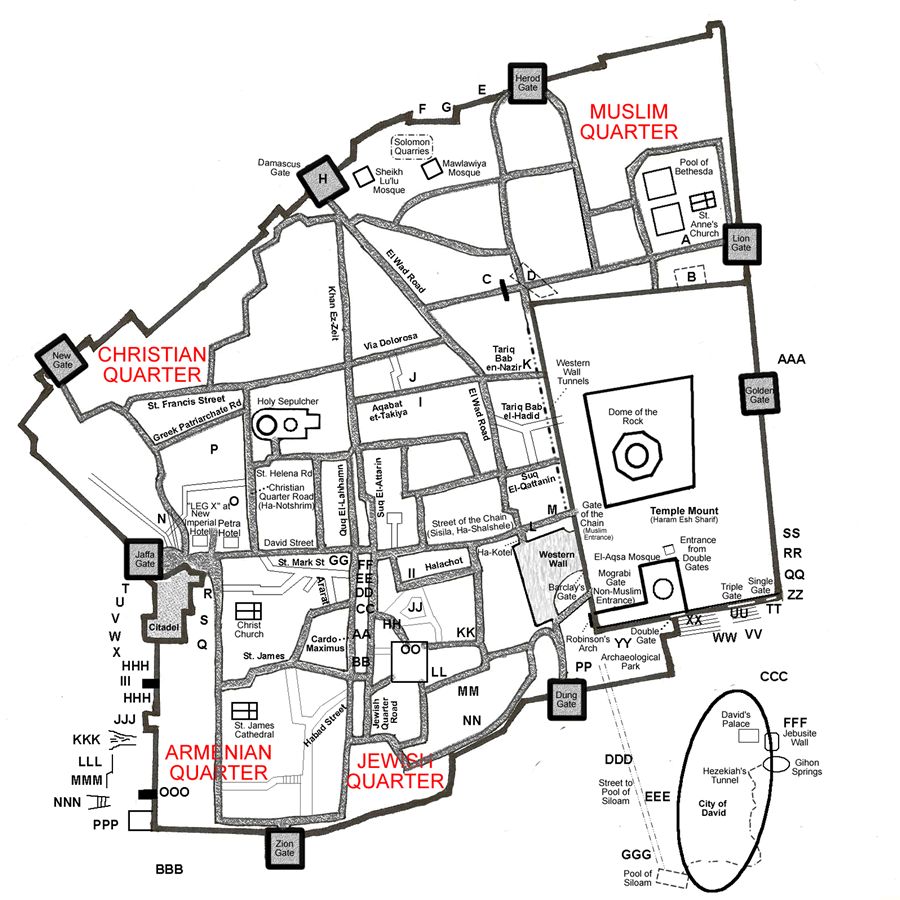
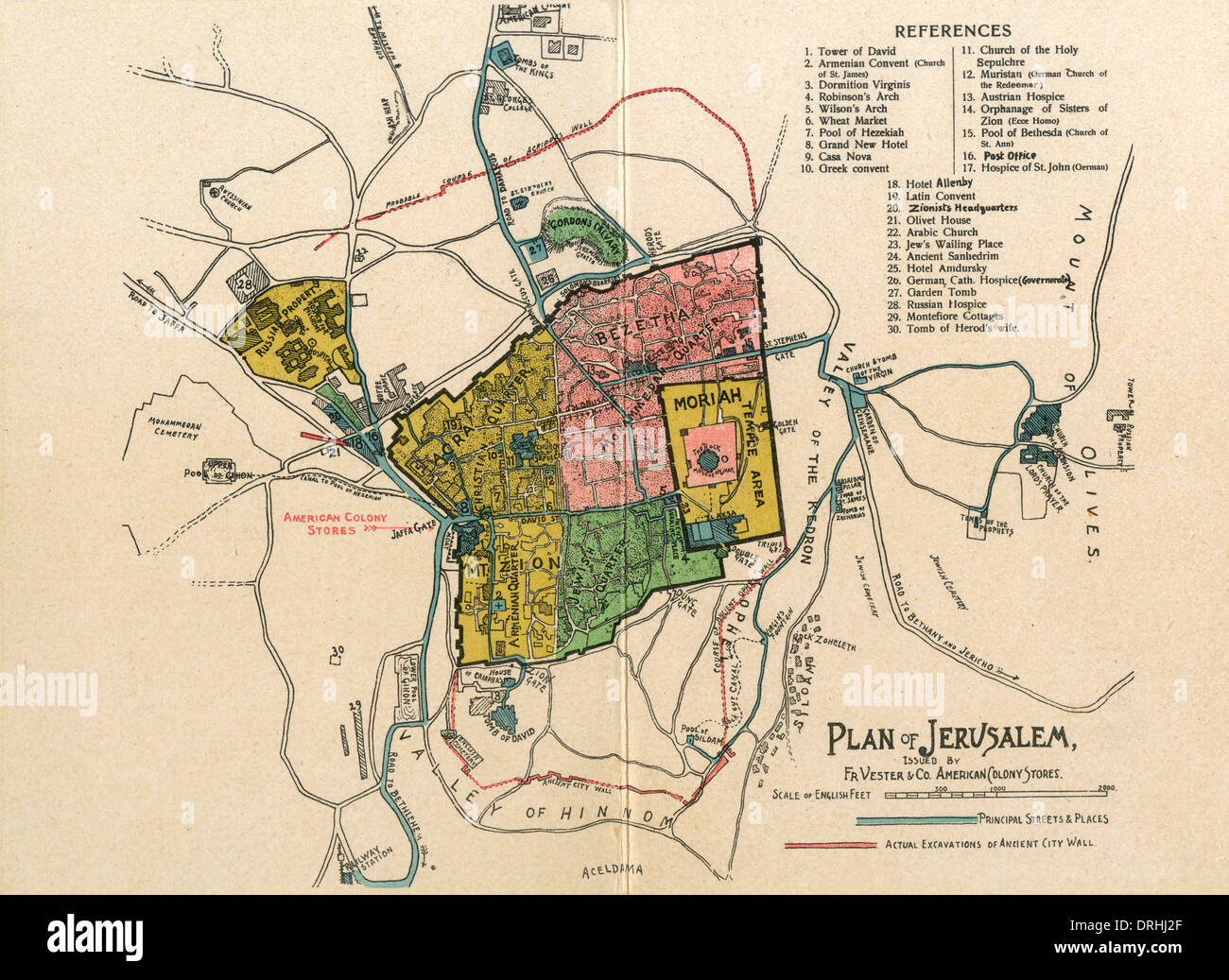
I decided to look at Maps of modern Jerusalem.

http://www.generationword.com/jerusalem101-photos/2010/jerusalem-map-for-site-location-1500.gif
 http://c8.alamy.com/comp/DRHJ2F/the-plan-of-jerusalem-town-map-layout-DRHJ2F.jpg

South of the Temple Mount is a Circle that is basically what Tradition now calls the City of David, where Bob Cornuke thinks The Temple was.  I have argued the City of David is Bethlehem but do think that site was the Core of the Jebus David originally captured.  David had palaces in both cities.  And I place neither Temple in either.

Wikipedia acknowledges three traditional candidates for the Hill that is Mt Zion.  I think Zion is none of those but in Bethlehem.

The one within the supposed "City of David" is what Bob Cornuke thinks The Temple was built on.  The second is simply applying the term to the main Temple Mount, the traditional Mt Moriah.

The third, the Western hill, which is South of the Armenian Quarter. is a site Christian Tradition has called Mt Zion, and that has it's own claimed site for King David's Tomb (in the same compound as the traditional site of the Upper Room of the Last Supper and Pentecost), but that Jewish tradition knows most certainly was not Zion and probably not part of David's Jerusalem at all. 

Justinian built an important Church on this "Zion", the Nea Ekklesia of The Theotokos, which Porcopius describes in a way that is designed to parallel the account of Solomon's Temple.  It was originally thought to be where the Al Aqsa Mosque is, but we now know it was on the Western Hill.

Earlier was built there the Church of the Holy Apostles (not to be confused with many more famous churches of that name) and the Hagia Sion which is now the Abbey of the Dormition.

Perhaps the Western Hill is the real Mount Moriah and one of these Churches was built where Solomon's Temple was? Since I firmly believe Solomon's Temple would not have been built on the full top of the Hill, I think the Nea possibly fits best.

So, I hope that was enlightening.  This is mostly speculative so I can't be sure of anything yet.

Update October 15th: And the day after posting this, I found that at least someone before me has argued the Nea Ekklesia is where Solomon's Temple was.   Their reasons for coming to this conclusion may be different from mine, I haven't read all of what they've argued yet.  (They mistakenly think The Mercy Seat was a Throne like many.)  They seem to believe the Second Temple was also at this site, which I'm open to.
https://haheykal.wordpress.com/.

I was also off a little on where I thought the Nea was.  It's more where the Jewish and Armenian Quarter meet, between the Zion and Dung gates, and includes the HaTkuma Garden.  This blog places the Holy of Holies under the current Deir al Zeitune Armenian Church, which is an interesting coincidence given it's a Church with a Dome.  According to tradition that Church was the house of High Priest Ananias, which could easily have been near The Temple.  Perhaps High Priests often lived just west of the Holy of Holies to try and fit the imagery of Ezekiel's Temple.

But again, given the starting premise of this post, it could be Ananias house was built over where Solomon's Temple was.

Update October 23rd 2017:

On a website about this Church, it says the Church's traditions also linked it to  2 Samuel 24:16-17 and I Chronicles 21:15-16, which is about the Threshing Floor of Ornan. Seemingly not noticing that that is the site of Solomon's Temple.

The Armenians' traditions also associate Queen Helena and King Abgar with founding the Church at this location, figures who've interested me for a few reasons.  And the Armenian traditional history of the site seems to skip the period when Justinian's Nea Ekklesia would have been here.

I also found a YouTube Video on the Theory.

The Olive Tree associated with this site is also interesting, when you study references to Olive Trees in The Bible. Both literally and symbolically.

Update March 25th 2018: Based on this recent post of mine, I've now sorta switched. I think the Nea Eklessia was where the Second Temple was, and maybe Bob Cornuke's location was Solomon's Temple he's just wrong on how he makes much of that argument.

Thursday, May 18, 2017

Iapetos could be The Name of The Beast

Iapetos was the name of a Titan from Greek Mythology, often called today Iapetus or Japetus because of Latinization, but Ἰαπετός Iapetos was the original proper Greek spelling.

Disclaimer up front, I'm not arguing Greek Mythology is true and The Antichrist will be a Titan from it.  Or even how many Christians usually tie the Titan Mythology into Genesis 6.  Nor would it require him being anyone who lived in the past returning.  By the end it will make sense why a (completely biologically Homo-Sapien) Jewish Messiah claimant, or maybe even someone claiming to be Jesus, would use this name. Just bear with me.

The spelling has a Greek Gemetria value of Six Hundred and Sixty Six.
Iota=10, Alpha=1, Pi=80, Epsilon=5, Tau=300, Omicron=70, Sigma=200.
10+1+80+5+300+70+200=666.

[Update May 2023: Since my overall Eschatological views have become more flexible since I first wrote this I want to clarify that I view this interpretation of 666 as also potentially  Compatible with Preterist Post-Millennial and Historicist views on Revelation even though everything below was primarily argued for in the context of Pre-Mil Futurism.]

This spelling is also 7 letters with no repeats, 7 different Greek letters.  Why do I find that significant?  At the start of Chapter 13 John says the Name of Blasphemy was written on the seven heads of the Beast.  I've long had a hunch this is the same name being dealt with at the end, just not sure what to make of it.  Here I think it possible that each Head had one letter.  Perhaps I could go deeper with that, but not today.

A few Greek names are known to have had this value.  Irenaeus and Hippolytos and other Early Church Fathers speculated on some but didn't notice this one.  Though Tietan, a bizarre I don't think attested anywhere else spelling of Titan, is included, and a Titan is what Iapetos was in Greek Mythology.  I'm not quite the first to notice this however, a google search for Iapetos 666 will mainly turn up stuff about a Metal band (I haven't listened to them).  But no Bible Study seriously looking into it.  At first I myself while excited to have stumbled on this didn't think too much of it.

But then I read how the name is usually interpreted to mean The Piercer.  It's thought to come from the word iapto which means wound or pierce, and usually refers to a spear.  Most scholars think this meaning is meant to apply the idea of mortality to him.

All that is stuff right from Wikipedia.  I myself think it could also be possible to interpret it's derivation from that word as meaning Pierced or Wounded.  Which can make us think of Revelation 13 even if we didn't already have the Gemetria connection.  But maybe The Beast would want both the Piercer and Pierced meanings to apply to him, he was Pierced, but after being healed intends to Peirce his enemies.

I will return to Etymology later.

Homer mentions Iapetos in the Iliad (8.478–81) as being in Tartaros with Kronos. He is a brother of Kronos, who ruled the world during the Golden Age.  2 Peter 2:4 uses Tartaros as a name for The Abyss, The Beast ascends out of The Abyss.  The beginning of Hesiod's theogony also associates Tartaros with the Deep.

The importance of that Homer reference has to do with how the idea of all the Titans being in Tartaros comes later, at first it was just these two.  Given how little we know of Iapetos, and how Homer and Hesiod come after Greek Mythology had already changed in many ways.  It could be Iapetos and Kronos were originally the same.

Egyptian mythology also has more then one Underworld god.  Anubis like Hades is seemingly existing only to rule there.  The other is Osiris who similar to the Titans originally ruled the world of the living but then was killed.  The Pharaoh was Horus in life and Osiris in death.

It is believed there was an underworld god among the Semites named Shalman, the god of the Theophoric Assyrian name Shalmanezzer.  Possibly related to the Hebrew name Shalim meaning Dusk.  In Egyptian Mythology the land of the Dead was also called The West, Amentis, because it was where they believe the Sun traveled from West to East during the Night.  It's not difficult to connect these names to the name of Solomon, as Shalim and Shalem are very similar if not identical in spelling.  And I've argued elsewhere adding an N to the name of Shalmo to get Solomon isn't just a result of the Greek.  And they are also speculated to be related to the Greek Salmoneus, another King imprisoned in Tartaros.  In the Septuagint Solomon is spelled Salomon.

Solomon is linked to the number 666 in 1 Kings 10:14 and 2 Chronicles 9:13.  He was a type of Christ early on when he was doing well, but later he fell into Idolatry.  Even the fact that he built a palace for himself that took 4 years longer to build then The Temple is perhaps a sign of this.  That will be a subject in the future.  But this connection is still only as a type.

I've also talked on this Blog about how The Beast may seek to be an Adam figure.  That one of the titles of Christ he may claim for himself is The Last Adam.  How part of the reason his name adding up to 666 means something may be a connection to the 6th day of Creation being the day Adam was made.  And understanding The Image of The Beast begins with Adam being made in The Image of God.  And that maybe his deception will draw on false teachings that say Genesis 1 and 2 are about two different Adams.

Iapetos in Greek Mythology is made an ancestor of the entire Human Race, or at least the Hellenes and those the Hellenes felt kinship with.  Two of his sons are Prometheus and Epimetheus.  Prometheus is the father of Deucalion, the Noah figure of one of Greek Mythology's Flood Legends.  And Epimetheus married Pandora (arguably an Eve figure) and had Pyrrha, the wife of Deucalion.

It may be interesting to note that being the Grandfather of the Flood Survivor gives basis to identify Iapetos with Methuselah, who's name means "His death shall bring" making an interesting connection for the mortality association.

The Flood connection is a good place to get into how many Creationists (including myself), and even some purely Secular scholars doing comparative mythology like Robert Graves see this name as being derived from Yaphet/Japheth.  Greek mythology is very garbled and so a son of the Flood survivor became an ancestor.  Not unlike Rammah son of Kush becoming Rama with a son named Kusha in Hindu mythology. 

The secular scholars however tend to do so from a desire to late date as much of Genesis as they can and say Genesis took the name from the Greeks.  While Iapetos makes sense as an archaic Greek transliteration of Japheth, if it went the other way I wouldn't expect Japheth to be spelled with only three letters.

This can be a good time to look at how Japheth fits into typological themes of The Bible.

In Genesis 9:27.
 God shall enlarge Japheth, and he shall dwell in the tents of Shem; and Canaan shall be his servant.
The word for Tents here is Ohel and is definitely used of the Mishkan/Holy Tabernacle elsewhere, but also of the Sukkots of the Feast of Tabernacles.   This can be seen as anticipating Romans 9-11 and Galatians talk of Gentiles being grafted unto Israel.  (I've seen a KJV only pastor use Genesis 10 to say "Gentiles" Biblically refers only to descendants of Japheth)  That is good, I love the Adoption theme of The Bible.

The Problem is how many, including some in the Hebrew Roots movement tie that into British Israelism and Two House Theology.  Seeing Ephraim and the Northern Kingdom become intermingled beyond distinction with the descendants of Japheth.  Cimmerians linked to both Gomer and Omri, Scythians linked to both Magog and Israel, The Irish linked to Magog and Judah's son Zarah and later the House of David.  And all of Britam's identifications.  I do see some truth in plenty of that kind of stuff, but it also gets tied into Racist and Nationalist political agendas.

And many of these are expecting a Messiah Ben-Joseph.  Christ White has argued for The Antichrist claiming to be Messiah Ben-Joseph independent of the Lost Tribes aspect.  And I disagree with many aspects of his argument especially Jerusalem as Mystery Babylon, but have explored how that could tie into the Lost Tribes issue.

I have a growing hunch The Antichrist will be using much rhetoric taken from the Hebrew Roots movement.  That he'll talk about Nimrod the same way Rob Skiba does.  And that includes their reverence for The Book of Jasher, which paints Nimrod as Evil and says he fought a War with the Japhethites.  There may be other sources for this Japheth vs Nimrod mythology, I'm unsure.

I've said before I think there may be Decoy Antichrists, including the Terrible of The Nations who will rule Babylonia.  And that The Terrible of The Nations will be an enemy of The Antichrist, and probably who wounds him.

Of all the people who are types of Christ in The Hebrew Bible, it's interesting how it was Joshua of all of them who shares his actual name.  The Shia Muslim reverence of Ali draws a lot on seeing Ali as the Joshua to Muhammad's Moses (even though logically Umar fits that role better).  Well in this un-Biblical Jasher mythology, Japheth becomes arguably the Joshua to Noah's Moses.

Now some Creationists talking about Iapetos as Japheth have claimed Iapetos makes no sense in Greek etymology at all.  And in fairness there are real Greek scholars who have questioned the etymology I discussed above.  But what I want to talk about is how that commonly accepted Etymolgoy for Iapetos can be more consistent with Japheth's Hebrew etymology then you might think.

Going back to Genesis 9:27, the use of Enlarge there is a known pun, as Japheth's name is derived from that Hebrew word, phathah.  But this verse is the only time the KJV translates it Enlarge.  It's also sometimes words like Entice or Beguile, where sometimes a sexual connotation is implied in the context.  And the Strongs definition suggests it could mean "to open".  So the idea of Piercing could come from it, especially as things get clouded through a change in language.

A Yot added at the beginning of a name is often a sign of being Yah theophoric but then contracted, like Jehoram becoming Joram. Yeshua itself is an example of a Yah theophoric being contracted to the point where the letter Yot is all that represents the Holy Name.  Now I don't think Japheth was a Yah theophoric name originally, but I think a future false Messiah deifying himself while going by that name could seek to re-imagine it as one.  Actually the word play in Genesis 9:27 can be interpreted as making Japheth a Yah thephoric now that I think about it.

Those who out of ignorance of how First Century Greek worked try to claim Iesous is really a pagan name.  May add that they feel a transliteration of a Yah theophoric name should have an Alpha after the Iota.  But in Greco-Rroman times all Semitic names beginning with Yot began with Iota-Eta.  And that included Japheth in the Septuagint. But this rule wasn't a factor in more archaic times when the spelling of Iapetos was standardized.  And given the many Semtic via Phonecian influences on Greek, I wonder if Iasus might derive from a more ancient Greek form of Yeshua?

So I can easily imagine a false Messiah Ben-Joseph etymologically connecting himself to Japheth.  And interpreting the name Iapetos to mean either "Yah pierced" or "Yah Piercer".  And either of those proposed meanings could have opposite proposed interpretations depending on if he identifies himself with Yahuah or rejects the name of Yahuah.  "Pierced by Yah" or "Yah is pierced".  And "Yah the Piercer" or "the Piercer of Yah". 

And the Hebrew Gemetria value of the Hebrew spelling of Japheth being 490 he could argue a Biblical Numerical significance for, being 70 times 7.  I've suggested before that the Antichrist might claim to be the Messiah the 70 weeks points to.

And so I feel I have made my case.  What's below is just a supplemental epilogue and not part of the main thesis. 

Wednesday, May 17, 2017

The Beast of The Earth from the Koran.

My attitude towards Islamic Antichrist/Mahdi theories has been long and complicated.

One factor is I used to say that if the Beast out of the Sea does claim to be the Islamic Mahdi, that I doubted the second assumption of The False Prophet aka the Beast out of The Earth claiming to be the Islamic Isa/Jesus would be correct.

Then I changed my mind on that as I learned more.  I showed from Scripture that the False Prophet being a Counterfeit Jesus does make sense independent of reading Islamic eschatology into it.  But now, I've again noticed something others talking about Islamic Eschatology miss.

The Koran, which doesn't mention The Mahdi, does mention a Beast of The Earth, it actually calls it that, but doesn't depict this Beast as Evil, it's depicted as good.
And when the Word is fulfilled against them (the unjust), we shall produce from the earth a beast to (face) them: He will speak to them, for that mankind did not believe with assurance in Our Signs.
— Qur'an, sura 27 (An-Naml), ayat 82
 And from a Hadith, though it's considered weak.
Narrated Abu Hurairah: that the Messenger of Allah (ﷺ) said: "A beast will emerge from the earth. With it shall be the ring of Sulaiman (Solomon) and the staff of Musa (Moses). It will brighten the face of the believer, and stamp the nose of the disbeliever with the ring, such that when the people gather to eat, it will be said to this one: 'O believer! and to that one: 'O disbeliever!'"
— Jami' Al-Tirmidhi; English: Vol. 5, Book 44, Hadith 3187; Arabic: Book 47, Hadith 3490
Could this Brightening the Faces have some connection to the Mark of The Beast in the Forehead?

Many Christian commentators think The False Prophet will claim to be the Prophet like Unto Moses.  This beast claiming to have the Staff of Moses could fit that.  The New Testament tells us that Prophet is Jesus.  But many even claiming to be Christians want to give that title to someone else, like Muslims arguing it was Muhammad.  And those who want to make Moses one of the Two Witnesses say this Prophecy is about a second coming of Moses.  I haven't seen it yet but it wouldn't surprise me if some Jews think that will be fulfilled by Elijah.

Since The Mahdi was added to Islamic Eschatology later.  One could argue that the demonic forces behind The Koran originally just intended Isa to be the Antichrist and this Beast the False Prophet.

But maybe it's possible for a Muslin today to try and argue this Beast in this Sura was a symbol of Isa, just as the New Testament Apocalypse Symbolized Jesus as the Arnion (usually translated Lamb but could be Goat or Ram).  And indeed The Beast out of The Earth has Horns like an Arnion.  And Jesus did Descend into the Heart of The Earth.  Contrary to what most Muslims think The Koran doesn't contradict Jesus dying on The Cross but affirms it.

Having The Ring of Solomon could be a sign of being an Heir to Solomon and thus being Messiah Ben-David.  But in this extra Biblical Lore about Solomon (it's not unique to Islam) Solomon used this Ring/Seal to perform Magick and control Demons/Shedim/Jinn.  The Ring is also said to have the Divine Name in-graved on it.  And I would guess it's normally depicted as being worn on the Right Hand.

This is perhaps a good time to remember that the number 666 was linked to Solomon, and the Hexagram has been linked to the Seal of Solomon, which many have sought to connect to the Number of The Beast.  And in one Legend the Ring of Solomon is thrown into the Sea to be returned to Solomon later by a Sea Animal.

What if the Ring of Solomon here is going to be used like a Ring a King would give to a Regent?

More importantly, there is a reason the Ring of Solomon and Seal of Solomon are treated as synonyms when you study this lore.  Because a King's Seal was often on his Ring which he would use to place his Seal on documents and so forth, but he might also give the Ring to someone else to give them authority to seal things in his name.  Revelation is definitely drawing on this imagery in Chapter 7 with the 144,000.  And The Mark is frequently viewed as Satan's inferior copy of that.

The Hebrew word chowtham is often translated either Signet or Seal.  There is no Bible verse directly telling us Solomon had one.  But the first one mentioned is Judah's in Genesis 38:18.  Jeremiah 22:24 tells us it's often kept on the Right Hand.  1 Kings 21:18 tells us a royal one was used by the Northern Kingdom at least.  The use of this word in Exodus 28:36 and 39:30 I've considered passages a False Messiah could use to justify the Mark of The Beast system as being part of The Torah, (along with the Tefflin verses).  The Hebrew word translated "engravings" in those verses, pittuwach, is very likely the Hebrew equivalent of the word translated "Mark" in Revelation.  Though another candidate would be miqla'ath which is possibly used as a synonym for that word the only time it appears, in 1 Kings 6-7.

Again, my take on studying these False Prophecies is that I think Satan makes all of them as potential seeds for The Antichrist.  But that doesn't mean for certain that this false Prophecy is what The Antichrist will wind up using.