Showing posts with label Chronology. Show all posts

Monday, June 6, 2016

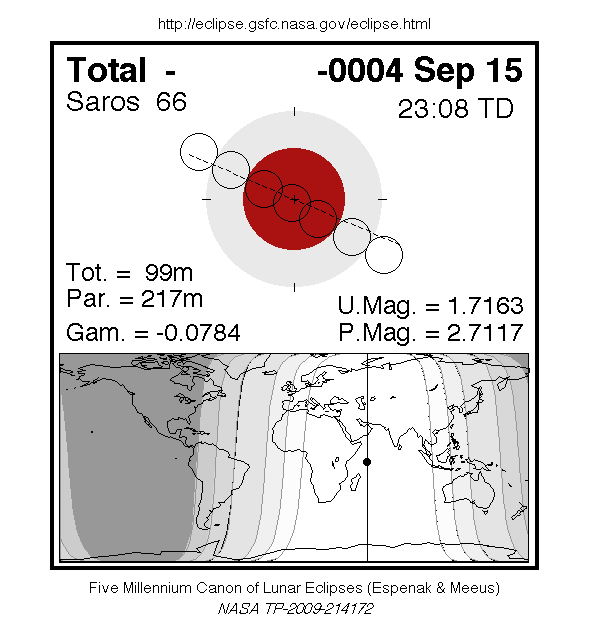
The Lunar Eclipse preceding the Death of Herod The Great

I have in the past long favored the January 1 BC Eclipse.  But I have recently come to feel the mainstream view of it being the March 4 BC Eclipse is more supportable then we thought.

This may change my view on the year Jesus was born but it won't significantly for when in the year.

Herod died when Passover was the next High Holy Day no matter what, and I still feel strongly convinced that comparing Matthew and Luke's accounts must place Herod's death before Jesus was presented in The Temple on the 40th Day.  Unless some really shocking chronological argument can be made.  Because I feel it doesn't make sense for the presentation to happen in Jerusalem before the Magi arrive.  So Jesus was most likely born in a winter month.

Taken from this exchange.
There are three principal reasons why the 4 B.C. date has prevailed over 1 B.C. These reasons were articulated by Emil Schürer in A History of the Jewish People in the Time of Jesus Christ, also published in the 19th century. First, Josephus informs us that Herod died shortly before a Passover (Antiquities 17.9.3, The Jewish War 2.1.3), making a lunar eclipse in March (the time of the 4 B.C. eclipse) much more likely than one in December.
Second, Josephus writes that Herod reigned for 37 years from the time of his appointment in 40 B.C. and 34 years from his conquest of Jerusalem in 37 B.C. (Antiquities 17.8.1, War1.33.8). Using so-called inclusive counting, this, too, places Herod’s death in 4 B.C.
Third, we know that the reign over Samaria and Judea of Herod’s son and successor Archelaus began in 4 B.C., based on the fact that he was deposed by Caesar in A.U.C. (Anno Urbis Conditae [in the year the city was founded]) 759, or A.D. 6, in the tenth year of his reign (Dio Cassius, Roman History 55.27.6; Josephus, Antiquities 17.13.2). Counting backward his reign began in 4 B.C. In addition, from Herod the Great’s son and successor Herod Antipas, who ruled over Galilee until 39 B.C., who ordered the execution of John the Baptist (Mark 6:14–29) and who had a supporting role in Jesus’ trial (Luke 23:7–12), we have coins that make reference to the 43rd year of his rule, placing its beginning in 4 B.C. at the latest (see Morten Hørning Jensen, “Antipas—The Herod Jesus Knew,” BAR, September/October 2012).
Thus, Schürer concluded that “Herod died at Jericho in B.C. 4, unwept by those of his own house, and hated by all the people.”
Jeroen H.C. Tempelman
New York, New York
While I know you can play games on how to reckon what Josephus said of the length of Herod's reign.  The argument we've made that the reigns of Antipas and Archelus must have included Co-Regencies simply doesn't work.  The death of Antipater is synchronized to the Death of Herod, Herod died 5 days later.  So you can't move Herod's death to a later year but keep Antipater's in 4 BC as I've seen some but not all 1 BC arguments do.  It was after Antipater died that Herod changed his will to the arrangement that wound up happening.

The reference connecting the Eclipse to a Fast has been used by 1 BC and September 5 BC advocates to support making it Yom Kippur.  This connects to a desire to see any unspecified Fast as Yom Kippur even though that day isn't stickily a Fast day though it's popular to Fast on it, and is not even the main fast day of it's own month. (that would be Yom Gedlaiah, the third of Tishri).

Here is the thing I've noticed that even most arguing for the March 4 BC Eclipse overlook.  What Josephus says is that the Eclipse of the Moon happened the night the Fast day ended, no gap.

First in case you didn't know, Jewish days begin and end at Sunset.

Second the Biblical New Moon/Rosh Codesh is the first visible crescent, not the day the Moon is invisible.  So Full Moons (the only day a Lunar Eclipse can happen) are the 14th day of each Hebrew Month, not the 15th as the Blood Moon theorists claimed.

In other words, this Fast must have been the Thirteenth day of it's Hebrew Month. So that doesn't fit Yom Kippur which is the 10th, or any of the 4 major Fast days linked to the fall of Jerusalem which are the 9th, 17th, 3rd and 10th days of their months.

The only Jewish Fast day we know of that was being kept at that time that would have been the 13th day of the Month, was the Fast of Esther, which is the 13th of Adar, the day before Purim.  Meaning this Full Moon was Purim, meaning of the 4 lunar eclipses considered likely, only March 4 BC fits.

Now I should mention that since I and others have seen "Blood Moons" on Full Moons that neither Stelarium or other Astronomers recognize as such (like in August of 2015).  I'm not confident the Eclipse Josephus mentioned can be identified by any modern means at all.  But either way it must be a 14th day of a Month and of known Fasts only Adar has one on the 13th.

Now the argument still remains that one month between the Eclipse and Passover doesn't quite seem enough for everything Josephus says happened.  It could be there was a Second Adar (Modern Rabbinic Judaism observes Purim in 2nd Adar but the Biblical reckoning favored by Kariates which may have still been the one used at this time clearly defines it as in the 12th Month which second Adar wouldn't be).  Or maybe all these events caused Passover to be pushed back to Second Passover.  Or maybe Joesphus who sometimes was less chronological then you'd expect wasn't putting as much in that time-frame as we think.

Some have calculated 20 or 21 days from the Death of Herod till Passover.  Which could put the Death of Herod on the 25th of Adar, same day traditionally viewed as the Death of Nebuchadnezzar (Jeremiah 52:31).

Is it possible Jesus was presented in The Temple on the first of Nisan?  Same day the Tabernacle was first set up according to Exodus 40?  Or that his birth was Shevet 24, the day Zechariah was given the Prophecy recorded in Chapter 1 verses 7-16?  Would not quite match the traditional date but be closer to it then others.

The main reason why many Christians regardless of what day of the year they favor feel the need to push Herod's death later is assumptions that I feel are mistaken about what we're told in Luke 3.

 Another factor is a desire to affiliate the Census of Luke 2 with a 3 or 2 BC Oath of Obedience to Augustus, which I've argued for myself in the past.  But I now just focus on that the main Imperial Censusus Augustus ordered he allowed 5 years to be carried out in the various regions, so you can go with the 8 BC Census and still have it carried out in Judea, Syria and Cyrene anywhere between then and 3 BC.

The first error of how we commonly view Luke 3 is saying it placed the Baptism of Jesus when he began to be about 30 in the 15th Year of Tiberius.  But it doesn't, the reference to the 15th Year of Tiberius at the start of the Chapter is totally unconnected to the Baptism account.  Paul in Acts 13 says John "Completed his course" before he Baptized Jesus. I'm not sure what that means exactly. but I think it's good evidence against assuming the Baptism was the same year John began his ministry or any other key event of Luke 3.  But doesn't rule it out entirely either.

BTW, I've become convinced of an argument that what Luke meant by the Greek phrase translated "Began to be about 30" was that Jesus was "almost" 30.

Luke 3 is clearly not being purely strictly Chronological since verse 20 has John put in Prison then verse 21 describes his Baptism of Jesus.

Luke 3:1-2 tells us that the "Word of God" came unto John in the wilderness in the 15th Year of Tiberius.  Then we get a basic account of who John was and what he was doing.  Then it talks about him preaching against Antipas and Heordias and getting imprisoned for it.

It could be the 15th Year of Tiberius is when he preached against Herod Antipas marriage to Heordias, (perhaps because that was the year he married her) and was imprisoned for it.  And that this doesn't tell us when John began his ministry at all.  And so both that and Jesus Baptism could have preceded the 15th year of Tiberius.

My argument above would have Jesus turn 30 before Passover in early 27 AD.

I'm not entirely willing to throw out the chronology of Jesus Birth I argued for before.  But I feel I must acknowledge that the 4 BC Death of Herod is fitting pretty well with my latest research.

I absolutely still believe Jesus ministry was less then a year.  And still heavily favor 30 AD as the Crucifixion. date.  What I'm now willing to consider is that there was more time then you'd expect between the Baptism and the beginning of His proper Ministry.

Luke 4 tells us his time in the Wilderness and Temptation was soon after his Baptism.  Then He returned to Galilee and had a local ministry of sorts for an unspecified amount of time (Luke 4:14-15).  Then Luke 4:16 begins the account of His proper main Ministry.

Returning to the Eclipse in question.  The argument for the Fast being Yom Kippur is the emphasis on the High Priest having duties that day.  As the Jewish Encyclopedia says.  While Yom Kippur is the busiest day of the year for the High Priest, it's not the only day he has responsibilities.  At any-rate if Josephus was exaggerating when he made it sound like the Eclipse was the very next day, which is what you'd have to argue for it to be Yom Kippur, then the statement mostly becomes chronologically useless.  If it was Yom Kippur then it still must have been the next full moon which makes only the September 15 5 BC fit in which case the next Passover is still the same Passover.

Wednesday, May 25, 2016

A Pre-Tribber on interpreting Revelation Chronologically

They and various forms of "Mid-Trib" like me seem to be the only ones inclined to take it Chronologically.

https://gracethrufaith.com/ask-a-bible-teacher/reading-revelation-chronologically/


Reading Revelation Chronologically


Q. John’s gospel is the least chronological of the four gospels. Events are out of order and a very unequal amount of verses are applied to certain events versus other events in Jesus’ life. So it would seem unlikely then that John’s book of Revelation would be completely in time order. Perhaps some parts of the Revelation are chronological, and others are placed thematically. This is a critical issue, since from reading your material it appears the primary basis of your belief in pre-Trib is because Rev 4 & 5 in chapter order precede the rest of the book. Can you please enlighten me as to how you see it and why?
A. I’ve read lots of opinions about whether the Revelation is chronological or not, and the only exceptions to a chronological reading that makes sense to me are;
1) John could only write about one thing at a time so there are places where multiple things are happening together and he could only describe them one at a time,
2) where he brought a particular subject to its conclusion before back tracking to pick up another train of thought, or
3) where he’s providing some background to help us understand something. These are all obvious. Otherwise, I don’t think it makes sense to depart from a chronological reading.
It’s not fair to compare the Revelation with John’s gospel. In the Revelation John was essentially “taking dictation” from the Lord, and the writing style is so different that some scholars debate whether he even wrote it.
Finally, there are several much stronger proofs for a pre-trib rapture that make a chronological reading of Revelation unnecessary to support the case for one.
My first objection is that taking it chronologically inherently helps Pre-Trib, Pre-Trib sees The Rapture not in Revelation at all so really it's chronology should be irrelevant to them.  I see it clearly in the middle of the book, from the latter part of Chapter 11 through chapter 14, with the key moment being The Rapture of the Man-Child.

1), His intent was clearly to try as much as possible to write things down as he saw them.

2), Certain subjects ARE clearly scattered about, the book is clearly not organized by subject, even The Beast gets a reference before his formal introduction.

3), This I assume is mainly about the mystery of the Seven heads, and maybe the various time statements.

The reason Revelation's Authorship confuses people is indeed because it was really written by Jesus with John as his stenographer.  It's actually wrong to say Jesus wrote none of The Bible.

Since Jack Kelly knows John's Gospel is the least Chronological, I wonder if he is wiling to admit Jesus ministry wasn't three years but only one tops.

Monday, June 22, 2015

Jesus ministry was only about a year

I argued for that when arguing for a 30 AD Crucifixion.  Other have btw argued for a 30 AD Crucifixion while keeping a 3-3.5 year ministry, but there are other chronological reasons I can't accept that.

Problem is others out there are arguing for an only 1 year ministry but doing so in a completely different way, that ignores the not so chronological nature of John and still thinks the John 2 Passover was a separate Passover from the Passion which is absurd as I argued before.

But worse then that, they argue that John 6 has a scribal error thus casting doubt on the preservation of God's Word.  Which is why I fear this is a Satanic ploy to discredit arguing for a 1 year ministry at all.

The verse in John 6 mentioning Passover is apparently missing from some manuscripts, but I'll bet as usual these are chiefly the Alexandrian Manuscripts.  I base my view of Scripture on the Received Text.

They say this can't actually be Passover because Jesus would have to be in Jerusalem if it's Passover.  The wording in John 6:4 doesn't say it is on Passover exactly, it says the Passover is nigh.  For the Passion week Jesus entered Jerusalem on the preceding Sunday, which I believe fell on the 10th of Nisan, the day the Passover Lamb is presented.

Passover could be nigh certainly if it's Nisan already, but in time Jewish tradition came to think of the Passover Season as beginning in a sense as soon as Purim ended around the 15-17th of Adar.  Not unlike how in modern America the Christmas season begins as soon as Thanksgiving ends.  Also the Samaritans had developed a tradition of having a build up to Passover that begins 10-11 weeks in advance, recounting the entire Exodus narrative from when Moses first came before Pharaoh.
For all these reasons I have decided, though I hadn't decided this firmly yet when I first made the 30 AD post, that I believe the Passover of John 6 is also the same Passover as the Crucifixion.  But I do think for reasons explained elsewhere Jesus Baptism was possibly near the Passover of the previous year.

I believe the break between chapter 6 and 7 should be moved up a verse, that 7:2 starts the Tabernacles narrative and 7:1 ends the John 6 narrative.  So I feel justified in speculating that John 7 took place 5 or 6 months before John 6.

They say the Synoptic accounts of the same Miracle that is the centerpiece of John 6 clearly place it at the end of Summer, I disagree, I don't see that.  The basis seems to be thinking the Synoptics account refers to the Feast approaching after this account correlates to John 7 depicting Tabernacles next.  As I feel the cleansing of The Temple issue proves, John isn't always chronological, even if a face value reading of his transitions seem that way.

The Synoptics unlike John are only concerned with that one Passover where he was Crucified, no other Feasts.  So any reference to a Feast or Festival approaching in the Synoptics I'm certain means  that Passover not any other.

I'll go ahead and repeat what I said before on the cleansing.
____________________________________________________________________
The biggest chronological mistake made when dealing with the Crucifixion is when people incorrectly state that John refers to three or four Passovers occurring during Jesus's ministry. (The discrepancy between three and four is a Feast being refereed to that isn't identified.) John 2 (It's second story), John 6 and 12 all refer to Passover clearly, the last the Passover season of the Crucifixion. John 5 refers to a Jewish feast but doesn't identify which, many then assume this is Passover. Since the Passover is largely the thematic heart of John's narrative I believe he would have identified it if it was Passover. I believe the one in John 5 is possibly Purim or Pentecost.

So John has three at most. The problem is the basic narrative of the Synoptic Gospels does not seem to allow more then a Year and a few months for Jesus' Ministry. The thing people overlook is that John's Gospel is the most Mystical of the Gospels, and because of that it's not always purely Chronological, sometimes events are described next to each other for symbolic reasons, not because they actually happened side by side.

John 2 describes two stories. The first is the miracle of turning water into wine at a wedding banquet. That story clearly seems to be at the beginning of Jesus' ministry, since it's presented as his first public miracle. The second story involves The Temple. I believe they're told side by side because together they make John 2 a Beth chapter. Beth is the second letter of the Hebrew Alphabet, and it also means house. So John 2 deals with both The House as in the Family and The House as in the House of God. Both also refer to a three day period of time.

What is so often and to me annoyingly overlooked is that John 2 gives clearly a more detailed account of the Cleansing of The Temple. Which the Synoptics clearly place in the same week as the Crucifixion. Some would suggest it happened twice, but in the Synoptics it's clearly the last straw that drives the Scribes and the Pharisees and the Priesthood to want Jesus dead, if he'd done the same thing 2 or 3 years before that wouldn't make much sense. It's also interesting that the Synoptic account alludes to what only John records Jesus saying here, (About destroying this Temple and rebuilding it in 3 days) in the form of false witnesses misrepresenting it.  But my point here is it's presented as something he recently said.

So in truth John gives a Ministry of only just over a year (many Atheists criticize the Gospels by saying the Synoptics clearly depict a ministry of only about a year and that John's three year model is then a contradiction. I've provided the means to refute that,) or maybe even less.  And since John 2 is recording the Passover season of the Crucifixion, that is very useful since John 2 dates itself."Forty and six years has this temple been in building". The renovation of the Temple Herod started wasn't finished till the 60s, so this is referring to them speaking 46 years after Herod's renovations began. 20/19 BC is when Herod first announced the project, but as a careful study of Josephus shows it really began in late 18 or early 17 B.C. So 46 years latter on Passover brings us to 30 A.D.  Ussher dated John 2's Temple incident to the same year, but repeated the error I explained above.
____________________________________________________________
Luke 4:19 refers to the acceptable year of The Lord.  Exodus 12 said the Passover Lamb should be of the first year.


What annoys me is how the 3 to 4 year ministry continues to be accepted by people who do not have a preterist view of the 70th Week.  Since it's origin (yes even among Early Church Fathers who taught it, Eusebius was the first) is in trying to justify a Preterist view of the 70th Week, that Jesus ministry was the first half.

But it's mistaken even as a Preterist view, I've decided a Preterist interpretation of the 70 Weeks isn't impossible (I see it as a dual fulfillment), but that when you clarify certain misunderstandings there is still no doubt that the Crucifixion was where the 69th ends and 70th begins, not the middle of a Week.  


The Crucifixion being in Nisan makes it being the middle of a year impossible.

Sunday, February 22, 2015

I think Jesus was born about December 25 and conceived about March 25

Or very near there at least.  The possibly that Jesus Circumcision was on the 25th is something I've been considering.

I held to the September 11th 3 BC theory for a long time, including in my last Christmas related post on this blog I made fairly recently.  My basic point of that post I still stand by, that there is nothing wrong with celebrating Jesus Birth on the wrong day.  And I'll say the same for those who even after reading my argument still here feel compelled to celebrate it during the Fall Feasts.

I still support the 3-2 BC range for the year of his Birth.  Africanus specifies the date in terms that can be understood as 3/2 BC. Both Irenaeus and Tertullian assign Jesus' birth to the forty-first year of Augustus. If this date presumes that the reign of Augustus began when he was elevated to consulship in August 43 BC, the year intended is 2 BC. Tertullian conveniently confirms this conclusion by adding that Christ's birth was 28 years after the death of Cleopatra and fifteen years before the death of Augustus. Cleopatra died in August 30 BC, and Augustus died in August AD 14. Konradin Ferrari d'Occhieppo has demonstrated that the date which Clement of Alexandria furnishes for the birth of Jesus is equivalent to 6 January 2 BC.

Nothing in Matthew 2 actually says the Star was seen by the Magi the day he was born.  Which means I can still support the same basic view I have before on the Star of Bethlehem, as well as viewing the visit of the Magi as being in December of of 2 BC.  There were three Jupiter-Regulus Conjunctions, I don't think they'd have fully understood their significance till all three happened.  Herod rounded up to two years because he wanted to make absolutely sure.

Likewise I still stand by my prior posts on the Census of Luke 2.  Josephus' reference we commonly cite and that I did there (Antiquities, XVII, 41-45 ),  however is probably not a specific Oath but to this sect in general rejecting Rome.

First I want to express my objection to him being born on either Passover or Tabernacles.  There is no way Rome would have enforced a Census requiring presence in their hometown in Judea on a day their religion demanded most people to pilgrimage to Jerusalem.  I feel this makes Trumpets and Tom Kippur unlikely too, that's still to close to the pilgrimage day.

Shepherds in Winter

The Biblical Argument against a winter birth for Jesus is a claim that Shepherds would not have had their flocks outdoors in winter.  These people are forgetting that Israel does not have the climate of Northern Europe or America.  The Weather can indeed be very bad in Winter there sometimes but not always, plenty of areas around the same latitude like the Southern US often have nice weather at this time.  I live in one of the Coldest part of the US, Wisconsin, and sometimes we don't get Snow till after Christmas has passed.

Genesis 31:38-40: "This twenty years have I been with thee; thy ewes and thy she goats have not cast their young, and the rams of thy flock have I not eaten.  That which was torn of beasts I brought not unto thee; I bare the loss of it; of my hand didst thou require it, whether stolen by day, or stolen by night.  That which was torn of beasts I brought not unto thee; I bare the loss of it; of my hand didst thou require it, whether stolen by day, or stolen by night. Thus I was; in the day the drought consumed me, and the frost by night; and my sleep departed from mine eyes. "

Jacob was at this time much further north then Bethlehem, yet he was engaged in Shepherding during the winter.  So using the no shepherds in winter argument calls Scripture a liar.  Research into Migdal Eder mentioned in Genesis 35:21 is what is more directly relevant to Bethlehem.

James Kelso, an archaeologist who spent a number of years living in Palestine and who has done extensive research there says this:
The best season for the shepherds of Bethlehem is the winter when heavy rains bring up a luscious crop of new grass. After the rains the once-barren, brown desert earth is suddenly a field of brilliant green. One year when excavating at New Testament Jericho, I lived in Jerusalem and drove through this area twice every day. At one single point along the road, I could see at times as many as five shepherds with their flocks on one hillside. One shepherd stayed with his flock at the same point for three weeks, so lush was the grass. But as soon as the rains stopped in the spring, the land quickly took on its normal desert look once again.
Since there seem to have been a number of shepherds who came to see the Christ child, December or January would be the most likely months (James Kelso, An Archaeologist Looks At The Gospels, p. 23-24).
 Also there is Canon H.B Tristram
“A little knoll of olive trees surrounding a group of ruins marks the traditional site of the angels’ appearance to the shepherds, Migdol Eder, ‘the tower of the flock’. But the place where the first ‘Gloria in excelsis’ was sung was probably further east, where the bare hills of the wilderness begin, and a large tract is claimed by the Bethlehemites as a common pasturage. Here the sheep would be too far off to be led into the town at night; and exposed to the attacks of wild beasts from the eastern ravines, where the wolf and the jackal still prowl, and where of old the yet more formidable lion and bear had their covert, they needed the shepherds’ watchful care during the winter and spring months, when alone pasturage is to be found on these bleak uplands“. Picturesque Palestine Vol 1 page 124 
 Also note this excerpt from Messianic Jewish Scholars Alfred Edersheim:
“That the Messiah was born in Bethlehem was a settled conviction. Equally so, was the belief that He was to be revealed from Migdal Eder , the tower of the flock.
This Migdal Eder, was not the watch tower for ordinary flocks which pastured on the barren sheep ground beyond Bethlehem, but lay close to town, on the road to Jerusalem. A passage in the Mishnah leads to the conclusion that the flocks which pastured there were destined for Temple Sacrifices, and accordingly that the Shepherds who watched over them were, no ordinary Shepherds. The latter were under the ban of Rabbinism on the account of their necessary isolation from religious ordinances, and their manner of life, which rendered strict legal observances unlikely, if not absolutely impossible.
The same Mishnic also leads us to infer, that these flocks lay out all year round , since they are spoken of as in the fields thirty days before Passover- that is, in the month of February, when in Palestine the average rainfall is nearly greatest. Thus Jewish traditions in some dim manner apprehended the first revelation of the Messiah from Migdal Eder, where Shepherds watched the Temple flocks all year round. Of the deep symbolic significance of such a coincidence, it is needless to speak -The Life and Times of Jesus the Messiah By Alfred Edersheim
I've also seen it claimed by Chuck Missler and others that Israel is "impassable" during winter, and Mary and Joseph couldn't have traveled south at this time.  But John 10:21-22 tells us Jesus traveled to Jerusalem to keep the feast of the Dedication/Hannukah.  Indeed I take from this passage that Hanukkah while not one of the required pilgrimage days became an unofficial additional one, since it was intimately about Jerusalem and The Temple.

The course of Abijah

Those arguing for Jesus being born in Tishri will claim the documentation places the course of Abijah operating in the Summer, around June/July.  However the agreement on this is far from universal.

Josef Heinrich Friedlieb’s Leben J. Christi des Erlösers. Münster, 1887, p. 312.  Strongly argues that Joarib was the course operating when the Temple was destroyed on the 9th of Av.  This would place the course of Abijah about the second week of Tishri, which happens to be when Yom Kippur happens.  The Dead Sea Scrolls seem to back up this chronology.

The apocryphal Infancy Gospel of James, is clearly not inspired, but it's an early witness being from the first half of the second century.  It promotes Zacharias to being The High Priest which is clearly wrong.  But the key thing is it says Yom Kippur is when Gabriel appeared to him.  John Crysostom also refers to Zachariahs being in The Temple during Tishri.

John The Baptist was conceived pretty much immediately after the course ended, which would place it possibly during Tabernacles or just before it, (in 3 BC the 15th of Tishri tell on September 25th, since it is well known September 11th that year was the First of Tishri).  Six months latter is when Jesus was conceived, which would be during the Feast of Unleavened Bread.  Nine months after that would be December or January.

John being convinced on Tabernacles or the Eve of it, and the Visitation happening during Passover/Unleavened Bread, could likely place John's birth on the 17th of Tammuz, which is an interesting date.  That agrees with the traditional date for his birth on our calendar being June 24th or 25th.

Early Church References

It is frequently claimed that it was a long time before Christians starting celebrating the Birth of Christ at all.  The very Early Christians indeed didn't have the time (dealing with persecution) to create new celebrations.  But there is evidence of a winter date for Christ's birth showing up fairly early.

Hippolytus of Rome (170-235 AD), who was a student of Ireaneus, who was a student of Polycarp, who was a student of John, to whom Jesus entrusted the care of his Mother.  Placed the Birth of Jesus on December 25th, and the Crucifixion on March 25th.  He was off by one on the year on the Crucifixion placing it in 29 AD.
For the first advent of our Lord in the flesh, when he was born in Bethlehem, eight days before the kalends of January [December 25th], the 4th day of the week [Wednesday], while Augustus was in his forty-second year, [2 or 3BC] but from Adam five thousand and five hundred years. He suffered in the thirty third year, 8 days before the kalends of April [March 25th], the Day of Preparation, the fifteenth year of Tiberius Caesar [29 or 30 AD], while Rufus and Roubellion and Gaius Caesar, for the 4th time, and Gaius Cestius Saturninus were Consuls.
From his Daniel commentary, he also spoke elsewhere on believing Jesus Conception and Death were the same day.  Clement of Alexandria, Jullius Africanus and Theophilus of Caesarea are also cited as early sources for these dates.  The Constitutions of the Apostles dated to 250 AD also refers to December 25th.

Irenaeus (130-202 AD) and Julius Sextus Africanus (160-240 AD) in his work Adversus Haereses, both gave March 25th as the day of Jesus Conception.

The Early Church belief in a winter birth seems to be related to a belief that Jesus was conceived about the same day of the Hebrew year as his Death or Resurrection.  The Western/Latin Church favored December 25th for Christmas and March 25th exactly 270 days earlier for the conception.  Whether they placed the Crucifixion or Resurrection on March 25th varies.  The Eastern/Greek church favored January 6th for Christmas and April 6 for the Crucifixion/Conception.  My argument for a 30 AD Crucifixion agrees with April 6th.

First Fruits did fall on March 25th in 37 AD, it seems some early Christians in Egypt got confused and gave 37 AD as the Crucifixion year.  Might be because that's when the 70 Weeks would have ended without a gap.

You may be thinking, "Wouldn't Mary have been in Jerusalem rather then Nazareth if the annunciation was during Passover/Unleavened bread?"  It's actually only males at least 12 years old the Law required to be in Jerusalem for the three pilgrimage Holy Days.  Now often husbands brought their wives and children with but that wasn't obligated,  Elizabeth may have stayed behind due to being six months pregnant.  Mary wasn't married yet, only betrothed.  The Bride is traditionally supposed to be separated from the groom during betrothal.  And I have reasons to think Mary was perhaps older then we assume and was at this time a single woman not in her father's house.  The men of the story are all absent during the Annunciation and Visitation narrative.

Cyril of Jerusalem in the late 4th century requested the date of Jesus birth be determined from the Census documents which apparently still existed in Rome.  He said they verified it to be December 25th.  Now that's late enough we should take it with a grain of salt, but it's there.

One of the first Protestants to oppose the 25th of December Christmas was Isaac Newton, who was a good scientist but also a Neo-Pagan and Alchemist.. Observations upon the Prophecies of Daniel, and the Apocalypse of St. John, Volume 1 (London: J. Darby, T. Browne & All, 1733), 144-65.

As far as the death and conception correlation goes.  Genesis 4 seems to hint at Seth being conceived very shortly after Abel died.  Abel is considered a type of Christ.

Leviticus 23

Lots of people in the Hebrew Roots movement and other Messianic fellowships that don't deny Grace, have an insistence that Jesus must have been born on one of the Appointed Times of Leviticus 23.

If Jesus birth was meant to be a fulfillment of one of those like his Death was Luke or Matthew would have made that clear, we wouldn't have to deduce it from elsewhere.  The fulfillment of the Fall Feast days lies in the middle of the 70th Week of Daniel.

As far as Revelation 12 goes.  There is a symbolic summery of history there but those signs being seen in Heaven is part of the events of the Seventh Trumpet, the chapter divisions weren't in the original text.  I deal with that here.

My main argument against Jesus being born on any of the Leviticus 23 Holy Days is it's absurd to think Rome would not have enforced a Census in Judea requiring people to be in different scattered towns close to any of the days where there local religion required people to be in Jerusalem.

Mary and Joseph happened to have been headed closer to Jerusalem then they were before so we don't think of that implication a lot.  But other people would have been just the opposite (there could hypothetically have been people living in Bethlehem who were required by this to go to Galilee). Jerusalem itself had lots of citizens who's family origin wasn't in it.  So you'd have people who usually didn't have to worry about the Pilgrimage requirement at all suddenly having that matter over complicated.

Now you can argue that Yom Teruah and Yom Kippur are not pilgrimage days themselves.  In fact I've seen Rob Skiba use Sukkot's pilgrimage day status against it arguing in favor of Yom Teruah.  But those two days are still way to close.  One is 5 days before and the other is 14 days before.  And Sukkot required being in Jerusalem an entire week.  My family has even with modern conveniences making travel a lot easier never gone on a week long trip without beginning the preparations more then three weeks in advance.

The time around the Winter Solstice was about as far away from the pilgrimage days as you can get.  And the date I've come to favor puts it like a month after Hanukkah and over a month away from Purim, so the Census would need not disrupt those less important Holy Days either.

Attempting to determine which year

Using Stellarium, it seems the 14th of Nisan of 3 BC could likely have fallen on April 1st.

However in 2 BC Passover and March lined up almost exactly the same as they did in 37 AD, with a discrepancy of less then 24 hours.  Maybe that is also a factor in the confusion.

And it was December 25th of 2 BC that Jupiter stopped in the night sky in exactly the right conditions to match Matthew 2.  I've seen an argument against the usual view that the Magi must have arrived a significant amount of time latter.

They have decent responses to most of the usual arguments, about the Greek word translated  "young Child" (Luke 2:17 uses the same term for a an infant Jesus) and moving to a house (Joseph could very well have done that the next day).  And insist the tone of Matthew 2:1 is clearly that they arrived in Jerusalem when Jesus was born.

We should consider the possibility that both the flight into Egypt and return (and in-between Herod's Death) happened before the presentation in The Temple.  May was supposed to be set aside for her Purification, Joseph could have found a way to do this even with them doing some traveling.  And it could explain why Mary is not a very active part of the story in Matthew 2, as she is in Matthew 1 and everything in Luke that's largely her POV.  Some have suggested January 28th 1 BC as the Day Herod died.  The presentation in The Temple would be about February 2.

Matthew 2:1 "now when Jesus was born", implies that the one event speedily followed the other. Directly after the presentation, Jesus went with His parents to Nazareth (Luke 2), therefore the presentation must have been preceded by their visit.  At the coming of the Magi, Herod first heard of the birth of Jesus, but if the presentation at the Temple had previously taken place, he must have heard of it, as it had been made public by Anna (Luke 2:38).

I feel placing the specific Oath of Allegiance 15-12 months before Herod's death may be flawed.  When Moses of Khorone refers to the same Oath, we learn it came with Imperial Idols.  Josephus in Antiquities 17.6 refers to a Golden Eagle Herod had erected that was torn down by upset Jews possibly very close to his death, when he was already ill.  If the tearing down of the Eagle happened immediately after it was set up (which I find highly likely), then it's interesting that this seems to have been fairly close to when Herod died..

The major problem for a 2 BC date is the length of Jesus ministry, which begins after he turns 30.  The notion that it's 3 or 3.5 years I refute in my 30 AD study, it's confusion based on not realizing John isn't chronological.  But it does seem to be nearly a whole year.  And we know from John 7-10 that a Tabernacles and Hanukkah happened during it.  And Jesus being born December 25th of 2 BC had Jesus turn 30 around December of 29/30 BC.

However maybe Luke 3 isn't saying what we assume.  I've often been curious about how it seems exact (saying began) and vague (saying about) at the same time.  Given the way Ancient Hebrews didn't even do Birthdays how we do, what if it really means the beginning of the year in which he turned 30?  Which would be Nisan of 29 AD if he was born around December 25th of 2 BC.  That could work quite well.

It was at Jesus Baptism that John proclaimed him "The Lamb of God who takes away the Sins of the World".  So it'd be fitting if this was around the Passover season the year before the ultimate Passover.  And maybe Jesus 40 days in the wilderness correlates a year in advance to the 40 days from the Resurrection to the Ascension.

Or another alternative is it could have meant the beginning of his 30th year.  Which would be when he turned 29.

If Jesus was 30 when he died in 30 AD, then He was Crowned with the Crown of Thrones the same age David was crowned in Hebron.  David had a second coronation 7 years latter, Jesus will have a second one too. Possibly 2007 years latter, but I'm not certain on that.

(Update: I've come to think it maybe more likely December 25th or after is when the Magi vistied Jesus, but they arrived in Jerusalem before.  The 25th of Tevet would have been the 23rd of 24th of December that year.)

Passover Conception 

What makes this model fascinating to me is the possibly of Jesus being Conceived on Passover or First Fruits, why?  Because of an insight made by Zola Levitt, about a possible correlation between the Gestation process and the High Holy Days of Leviticus 23.  One of the briefer websites describing it.
After the end of woman’s monthly cycle, the new cycle begins. On the fourteenth day of that first month, the egg appears. This matches Passover, which is the fourteenth day of the first month of God’s calendar. (Leviticus 23:5)
The egg must be fertilized within twenty-four hours, or it cannot be fertilized at all and will pass through her body. Twenty-four hours after Passover is the Feast of Unleavened Bread, which falls on the fifteenth day of the first month. (Leviticus 23:6)
If the egg does become fertilized, it attaches to the mother’s uterus within 2 – 6 days. This corresponds to the Feast of Firstfruits, which falls anywhere from 2 – 6 days after Passover. Passover and Unleavened Bread can fall on any day of the week, and then Firstfruits is the Sunday after the Feast of Unleavened Bread, which is why the timing is a flexible date. (Leviticus 23:11)
After another fifty days, the embryo begins to look like a human. You can clearly see the head with eyes, the arms with hands and fingers, and the legs with feet and toes. The fiftieth day after Firstfruits is Pentecost (which is the Greek word for fifty). (Leviticus 23:15-16) 
By the beginning of the seventh month, the baby’s hearing is developed. The first day of the seventh month of God’s calendar is the Feast of Trumpets, sometimes called the Day of Shouting. (Leviticus 23:24) It is the day in God’s calendar that includes a sound to alert his people of the last call to come out of false worship and sin, referred to as Babylon.
By the tenth day of the seventh month, the baby’s bone marrow is starting to produce red blood cells. The tenth day of the seventh month of God’s calendar is the Day of Atonement, the most holy day on the calendar. (Leviticus 23:27) This was the only day that the priest would take the blood sacrifice into the Holy Place of the Sanctuary, to place the blood on the mercy seat to obtain forgiveness of all confessed sins. We are told in Hebrews 9:22, that “Without shedding of blood, there is no remission.”
By the middle of the seventh month, the baby’s lungs have fully developed. This corresponds to the Feast of Tabernacles on the fifteenth of the seventh month (Leviticus 23:34), which is a day of celebrating our reunion with our spiritual Father and his Son. The Greek word for “spirit” is “pneuma” which relates to the lungs (as in the English word pneumonia).
The human gestation cycle is 280 days. Nine months of 30 days each is 270 days, so on the tenth day after the ninth month, the baby is born. Nine months and ten days after the Feast of Unleavened Bread is the Feast of Hanukkah, also called the Feast of Dedication in John 10:22. This festival lasts for eight days. The eighth day after birth is the day God commanded circumcision (Genesis 17:12).
The one thing wrong here is the Hanukkah tie in fudged the numbers a bit. Though maybe not as much as I at first thought.  This makes all the Leviticus 23 Holy Days potentially significant to the Nativity of Jesus.

The Birth of someone conceived around Passover is likely to be in Tevet (The Tenth Month), and December 25th can fall in Tevet almost as often as it can in Kislev.  If Jesus was born on the Fast of the Tenth Month, that'd be pretty interesting considering Zachariah 8:19.  Messianic Scholar Alfred Edersheim has suggested a theory that the 9th of Tevet was affiliated with Christmas by early Medieval Jewish tradition.
for this section: There is no adequate reason for questioning the historical accuracy of this date. The objections generally made rest on grounds which seem to me historically untenable. …but a curious piece of evidence comes to us from a Jewish source. In the addition to the Megilloth Taanith, the 9th Tebbeth is marked as a fast day, and it is added that the reason for this is not stated. Now, Jewish chronologist have fixed on that day as that of Christ’s birth and it is remarkable that, between the years 500 and 816 A.D. the 25th of December fell no less than twelve times on the 9th of Tebbeth. If the 9th Tebbeth, or 25th December, was regarded as the birthday of Christ, we can understand the concealment about it. — The Life and Times of Jesus the Messiah By Alfred Edersheim
Here is a Jewish website on Tevet (Update: that Link isn't working now and I don't know how to find the same information again), which may give insight into significance to The Messiah being around the 24th or 25th of Tevet.  But of course I don't want to build doctrine on Rabbinic sources.

According to Esther 2:16 the Tenth month is when Esther was made Queen.  But we're not told when in the month exactly.  Since the same books gives further significance to the time I place the Resurrection and thus now possibly Conception of Jesus (the 17th of Nisan) it is interesting.

It seems the 25th of Tevet was the day Alexander The Great met with the High Priest in Talmudic sources.  But Josephus disagrees with the Talmud on many details here, and he doesn't imply a date directly.  However he places Alexander coming to Jerusalem after he takes Tyre and and Gaza but before he went went to Egypt.  That wouldn't fit well with placing this event in Tevet(December-January) since Alexander was Crowned Pharaoh of Egypt November 14th.

Other inaccuracies in the Talmud account include who was High Priest at that time, and a claim Alexander let the Jews punish the Samaritans, the Samaritan got the same positive treatment from Alexander the Jews did.

Could be a reason for the confusion is the Rabbis wanted a reason for a holiday they'd forgotten the origin for.  Or perhaps confusing the history of Alexander with something else Simon the Just did.

Many people discussing the Magi arriving in Jerusalem or Bethlehem on the 25th of December 2 BC think that was at the end of Kislev (during Hanukkah).  But since I've decided Passover must have been around the 22nd of March 2 BC the 25th of December that year must have been near the end of Tevet.  1 BC probably had a second Adar.  Remember Judaism hadn't entirely settled on it's current leap year system yet so that could explain by some scholars are confused.

It should be noted that around the 22nd of Tevet is generally when the Moon is under Virgo's feet during it's Tevet cycle.  In 2 BC it was under the feet of Virgo on the 19th of December, 7 days before a Solar Eclipse on the 26th of December and 29th of Tevet.  The day after that was a New Moon (beginning of a Hebrew Month) and the 14 days later was the Full Moon/Lunar Eclipse described by Josephus as proceeding the death of Herod.  It could be Jesus was born on the 22nd and Circumcised on the 29th.

If Jesus was born around the 22-25th of Tevet he could have been presented in The Temple on the 2nd of Adar, the same day the Second Temple was originally completed.

Some out there like to believe Jesus was born on the 25th of Kislev and Circumscribed on last day of Hanukkah.  That model doesn't fit well with a Passover Conception unless he was slightly premature.  But if someone wants to try arguing for Jesus being convinced on Purim, that could be interesting.

It could be the Rabbis were observing them a month off from the accurate dates the year in question.  And that the Jews were observing Hanukkah during what was Biblically Tevet.  I should note that the theory Herod died on the 2nd of Shevat of 1 BC based on conjectures of the Scholion of Megillat Ta'anit, place the 25th of December 2 BC during Hanukkah rather then Tevet.  The January 10th Lunar Eclipse would have been the 14th of Shevat in my preferred model.

I will do a separate post on the Paganism of Secular Christmas, which I'm not at all trying to justify.

I will say here as one key thing

The Sun, Moon and stars move the way they do because God designed them to.  The Bible says the Sun, Moon and stars are for discerning times and seasons.

Malachi 4:2 calls Jesus "the Sun of righteousness".

So maybe when the Sun appears to move in a way that could be interpreted as it being "reborn", is exactly the time God intended The Sun of Righteousness to be born.  Likewise when Jess was crucified on April 6th 30 AD the Sun was in Aries The Ram (see Genesis 22).

That Pagans saw significance in those same movements doesn't mean they weren't part of God's design.

Thursday, September 25, 2014

A theory about the Death of James The Just, The brother of Jesus

According to a passage found in existing manuscripts of Josephus's Antiquities of the Jews, (xx.9) "the brother of Jesus, who was called Christ, whose name was James" met his death after the death of the procurator Porcius Festus, yet before Lucceius Albinus took office (Antiquities 20,9) — which has been dated to 62 A.D.. The High Priest Hanan ben Hanan (Anani Ananus in Latin) took advantage of this lack of imperial oversight to assemble a Sanhedrin (although the correct translation of the Greek synhedion kriton is "a council of judges"), who condemned James "on the charge of breaking the law," then had him executed by stoning. Josephus reports that Hanan's act was widely viewed as little more than judicial murder and offended a number of "those who were considered the most fair-minded people in the City, and strict in their observance of the Law," who went as far as meeting Albinus as he entered the province to petition him about the matter. In response, King Agrippa II replaced Ananus with Jesus son of Damneus.

But early Christian tradition (recounted in Hegesippus as related by Eusebius) says James was thrown off the Temple in 66-70 AD.  Simeon becoming the second Bishop of Jerusalem is consistently dated to that time. Later post Constantine Christian historians tried awkwardly to reconcile these accounts.

Also, some skeptics of the Historicity of Jesus insist that "who was called Christ" is a latter addition not in Jospehus's original.  But the majority of legitimate scholars reject that.

However, a poster on IMDB who's username is austenw (who doesn't view The Bible to be inerrant) has an interesting theory that it's the name of James that was added latter.
 it's a matter of Greek grammar; the sentence reads:

    "Ananus ...brought before them the brother of Jesus, who was named Christ - James his name - and some others;"

In this quotation, blue = nominative (subject); red = accusative (object), green = genitive (possessive), purple = dative (a difficult one to define, but can be a bit like possessive).

Crucially, the words "his name, James" in the nominative, does not fit into the architecture of the sentence; it could be removed without altering the grammar whatsoever, between the two accusatives "the brother" and "some others".

More importantly, however, the "traditional" theory - that the name James is original and the reference to Jesus is the interpolation - simply can't be correct, because were this to be so, then "James" would have had to have originally been in the accusative, or else he wouldn't have been knit into the architecture of the sentence at all, and the "[was] his name" would have been entirely redundant. This means that the supposed interpolator would have had to go to the trouble of changing a perfectly acceptable accusative case for "James" to the nominative case, and adding "his name", and for no reason whatsoever. Why bother to do this, when he could simply have added the clause "the brother (accusative).. etc", after the name?

However, if "James [was] his name" was originally a marginal note - written in the nominative, playing no grammatical part within the sentence - all makes sense. A later scribe included the marginal note, verbatim, in the only place he could - after the words "the brother of Jesus called Christ" - since nowhere else would have done.
 So basically that would mean it was possibly another Brother of Jesus (not named by Josephus) who was stoned in 62 A.D.  But someone leaving a marginal note later assumed it was the most famous of them.

Two of Jesus half brothers are known to have served as Bishop of Jerusalem. first James from the beginning of the Church until whenever he died. Then Simon from around 69 (Traditions agree he became Bishop just before the Destruction of the Second Temple) till 107 A.D.

We don't know much about Joses or Jude however.  Jude we know had later descendants, two grandchildren who were alive during the reign of Domitian, and Judah Kyriakos who was the last Jewish Bishop of Jerusalem. Though the start of his period as bishop of Jerusalem is not known, Judah is said to have lived beyond the Bar Kokhba revolt (132-136), up to about the eleventh year of Antoninus Pius (148 A.D.) though Marcus was appointed bishop of Aelia Capitolina in 135 by the Metropolitan of Caesarea.

Matthew 27:56 refers to some of the Women at the Cross when Jesus was crucified.  "Among which was Mary Magdalene, and Mary the mother of James and Joses, and the mother of Zebedee's children."  Mark 15:40-161 refers to the same first two women, but the third is simply a woman named Salome, (the only time that name is used in the New Testament).  Luke doesn't name the women at all.  John's Gospel in chapter 19 alone informs us clearly that Mary the Mother of Jesus was there.

Joses is a shortened form of Joseph.  The only other Joseph refereed to as Joses in The Gospels is the half-brother of Jesus (and an ancestor of Jesus in Luke's genealogy).  At face value John's Gospel is the only one that obviously tells us the Mother of Jesus was among those women.  John also seems to tell us she had a Sister.  I think it's possible that Sister, Salome from Mark's account, and the Mother of Zebedee's children are all the same individual.

I think in Matthew and Mark, the Mary mother of James and Joses is the same as the Mother of Jesus, but why is she not refereed to as such?  Maybe because of the events of Matthew 12-13 and Mark 6 the narrative voice ceases to refer to Jesus biological relatives as such after he effectively temporarily disowns them.

Why name only two of her four other Sons?  Who knows, but in Mark later references to clearly the same Woman refer to only one.  James and Joses are the two oldest in the list of Jesus brothers.

As far as the more popular view of making the mother of James and Joses the same as Mary the Wife of Cleophas/Clopas.  Cleophas/Clopas I feel is likely the disciple (probably one of the 70 but not one of the 12) Cleopas from Luke 14, the Road to Emmaus.  He's probably the same generation as the 12.

That view conflicts with making this person the same as the Alpheaus who is the father of the James and Jude among the 12.  Cleopas being a parent of any among the 12 is unlikely.  The tradition making Clopas the brother of Joseph has it's origin among those early fathers seeking to deny the siblings of Jesus were of Mary.

Certain authors devising alternative history theories have sought to say that Joseph of Arimathea was an uncle of Jesus, and one that he was the same person as James the half-brother of Jesus.  Logically it would make more sense if you want to make him a half-brother of Jesus to go with Joses.

Joseph of Arimathea is introduced in essentially the same narrative that deals with the Women at the Cross.  I think it would make sense to use the full name when referring to him and the shortened form when referring to someone else as a relative of him.  The last verse of Mark 15 refers to Mary only as the mother of Joses while finishing the narrative of Joseph of Airmathea arranging the burial of Jesus.

There is also the fact that this responsibility Joseph of Arimathea takes, burying the body, is one that in Jewish Custom belonged to the nearest living relatives.

The only problem with that theory is that the traditional assumption is none of Jesus brothers became Believers till after the Resurrection.  We know none were when John 7 occurs, half a year before the Crucifixion.  That fact refutes any theory reliant on making any of the 12 Disciples the same as any of the people refereed to as his siblings (a strategy used by some both for and against them being children of Mary).

But a lot can change in 6-7 months.

He could have moved from Nazareth to Arimathea (I agree with the theory that NT Arimathea is one of the OT Ramah or Ramaths, or perhaps Ramoth which was in Issachar in 1 Chronicles 6:73 and thus near the traditional site of Nazareth), sometime after their father died. But it's also possible Arimathea was an epithet not meant to identify a city, there is a lot of speculation involved here.

If Joses was Joseph of Airmathea then he was in the Sanhedrin.  Antiquities 20.9 does not explicitly say this half brother of Jesus was a Sanhedrin member, but the over all theme of Josephus in depicting these murders leading up to 70 AD is about people that were prominent but against doing a violent revolution against Rome.

Catholics like to argue the references to these four brothers and unnamed sisters are using the words loosely, referring to cousins or close friends or something.  The Greek words for brother and sister are sometimes used in similar senses, I've seen interesting theories about Lazarus, Martha and Mary of Bethany, but context tells us the difference.

Mark 6 is about contrasting a strict literal definition to one that widens it.  As I said above Jesus effectively disowns His biological family who didn't yet believe in Him, and said His true family are those who believe in Him.

And if the New Testament writers felt this word for brother could apply to a cousin, as is popularly suggested.  Why not use it of John The Baptist, who is more undisputedly then anyone else in The Gospel narrative a cousin of Jesus?  Maybe they'd say he's not a first cousin, he'd be second at the closest.

Another attempt to reconcile this with the perpetual virginity heresy is to say they are sons Joseph had by a different wife.  Because these same people are uncomfortable with acknowledging polygamy still went on in Judaism at this time, they insist a wife who died before he married Mary.  But if Jesus isn't the First-Born Son legally to both parents then He isn't the rightful Heir to David.  Yes a younger son superseding the actual First-Born is a common theme in Scripture, but if Jesus were an example of that the Gospel writers, especially Matthew, would have stressed it.  Those supercedings happen to help show how God doesn't really care about the formalities of The Law.  But Jesus himself had to be a perfect fulfillment of The Law.

The wording in Mark 6 of "the son of Mary, the brother of James, and Joses, and of Juda, and Simon? and are not his sisters here with us? And they were offended at him."  Starts with Mary and doesn't even mention Joseph (who is generally theorized to have died by then).  That tells me these siblings are siblings via being also sons and daughters of that same Mary.

Some will use that James the Brother of Jesus is called an Apostle by Paul in Galatians to prove he's one of the 12.  I already showed why these individuals can't be counted among the 12.  Apostle applied to any eye witness of the Resurrection.  Which is why Paul used it of himself calling himself the last Apostle.  And in Roman 16 identifies as among the Apostles a couple not even mentioned anywhere else in Scripture.

Matthew 1:25 says of Joseph.  "And knew her not till she had brought forth her firstborn son." This verse isn't just saying he didn't know her before, it also clearly tells us he did know her after.

Friday, September 19, 2014

Playing Devil's Advocate on the Seventieth Week

This is a follow up to my earlier post proving 7 years from Revelation.

In terms of those Futurists who view the 70th Week as past, I decided I want to give a fair open minded look at their view.  Problem is, they don't even view the first 69 Weeks the same as I do (from the ones I've encountered).  Now I am open minded to being proven wrong on that too, if you feel you have a sufficient fatal flaw to my argument feel free to leave one as a comment.

But for now, if you want to convince me of a Preterist view of the 70th Week, it's gonna need to be a view that has the 70th Week being from Nisan of 30 AD to Nisan of 37 AD.  And the Crucifixion in that Nisan of 30 AD.  Moving The Cross to the middle of The Week simply doesn't work.

I decided to look for myself at this Seven year period, to see if playing Devil's Advocate I could make that argument myself.  But also with the thought as someone who believers in types and near fulfillments, that the 7 years following the end of the 69th Week could be a minor prefiguring of the true final 70th Week.

My view on The Sixth Seal actually lends itself to that.  Based on the Sixth Seal parallels to Joel 2:28-32 and how Peter uses that same Joel passage in Acts 2.  I argue that the Earthquake and Darkening of The Sun that happened as Jesus was on The Cross was a prefiguring of the Terrestrial and Cosmic Signs of the Sixth Seal.  And with that I think the Sixth Seal will be opened on the 14th day of the Nisan that starts the 70th Week.  And that the Sealing of the 144,000 will be on the following Pentecost, it'll be another great outpouring of The Holy Spirit.

So in a sense it may be as if the initiation of the 70th Week is also God sort of resetting his Clock back to 30 AD.  But I would not build doctrine or date setting on anything I'm gonna suggest below.  This is just fun conjecture.

With a connection made to the beginning, I decided to look at the end.  It's not agreed universally which spring full moon correlated to Passover in 37 AD, it could've been March or April.  But the one in March was around the 21st-23rd and the Seventeenth fell on a Sunday again like it did in 30, this time it was March 25th.

The 16th of March that year was the day Tiberius died, awfully close.  And that Passover season close to Tiberius's death plays a key role in Josephus's account (Book 18 Chapter 4) of when Pilate was removed from his governorship.

Pilate is usually assumed to have been removed way back in the late summer or fall of 36.  But I can't help but feel reading Josephus like it was closer to when Tiberius actually died.  And others have as well, but the main such source I read does so arguing for a 37 AD Crucifixion, and then tying that into all kinds of other heresies.

It's not just Pilate and Tiberius.  It seems 36 and 37 AD saw the either deaths or removal from power of all the figures Luke 3:1-2 states were in power at that time.  Perhaps it prefigures how when the 70th Week begins, only one week is left for the current World Order.

But on the subject of Pilate's Removal.  The Josephus account includes a sort of False Messiah or False Prophet figure of the Samaritans who helped get them riled up, and who remains unnamed. 
"The man who excited them to it was one who thought lying a thing of little consequence, and who contrived every thing so that the multitude might be pleased; so he bid them to get together upon Mount Gerizzim, which is by them looked upon as the most holy of all mountains, and assured them, that when they were come thither, he would show them those sacred vessels which were laid under that place, because Moses put them there"
Acts 8:9-11 says of Simon Magus.  " But there was a certain man, called Simon, which beforetime in the same city used sorcery, and bewitched the people of Samaria, giving out that himself was some great one: To whom they all gave heed, from the least to the greatest, saying, This man is the great power of God.  And to him they had regard, because that of long time he had bewitched them with sorceries."

 The Samaritan chronicler Abul Fath mentions a sect headed by a R. Zadok which was tied to the heretic who claimed to be the “booth” or “booths” of the new Tabernacle. He speaks of “five brothers who from [the Samaritan holy mountain Gerizim] who were called [the Sons of Zadoq] and also another man called Zadoq the Elder from Bayt Far who deviated from “booths” and his companions, saying that Mount Gerizim is as holy as if the Samaritan temple were [still] standing upon it and that while one was obligated to do what was written [in the Law of Moses] he need not do what was not possible for him.” His community apparently “invoked him by the name mentioned [in the report of Booths] above, i.e. the Mediator, and agreed with [Booths] about abolishing … the rule of “Moses commanded for us a Law” [Deut 33:4]

I think, maybe these were the same individuals.  There are other reasons to view Acts 6-11 as being about 37 AD.  Wikipedia speculates that the martyrdom of Stephen must've been during the brief administration of Marcellus.  And Paul synchronizes the time of his Conversion to when Aretas controlled Damascus (2 Corinthians 11:32).  Which he didn't before Caligula became Emperor.

So that's the end of The Week, what about it's middle?  Tishri of 33 AD?

33 AD is a complicated year to study, web searches for it will have to shift through those referencing it thinking the Crucifixion was that year.  Nothing is known to be exactly dated to that year that resembles The Abomination of Desolation.  But the main thing that causes people to argue for the Crucifixion being that year, is itself interesting to look at.

That being a desire starting from some Early Church Fathers to identify an Eclipse and Earthquake mentioned by Thallus placed as occurring in Bythia and Asia Minor in 33 AD as the one that happen when Jesus was on the Cross.  He's quoted by Julius Africanus without much context.  Apologetic circles want to think Thallus himself was connecting this to Jesus, and Africanus accusing him of trying to naturalize the darkness as an eclipse.  But it seems more likely to me that Africanus simply assumed based on this being during the reign of Tiberius it was the same Darkness and Earthquake.  Problem is, it occurred in parts of Asia Minor, effecting some of the same cities that had the Churches of Revelation 2-3, not in Judea.

Revelation does also link Earthquakes to the Middle of the Seventieth Week, both the Rapture of The Witnesses and the Seventh Trumpet.

The Annals of Tacitus was year by year, so it's interesting to look at, but he was recording Roman History not Jewish.  Sadly nothing in Josephus seems to be linked to this year.  The events our copies of Jospehus place between the Testemonim Flavinium and the drama that removed Pilate, are events Tacitus places before Pilate became Prefect of Judea.

33 AD is the year of the consulship of Servius Galba and Lucius Sulla (the whole year is named for them even though they didn't serve the entire year.  Their consulship began at it's start).  This Galba it may interest you to know is the same one who latter overthrew Nero and began the year of the Four Caesars.  Tacitus recounts a probably urban legend that Tiberius said something which foretold him being Emperor some day during this Consulship.  Which Tiberius supposedly knew because of Thrasyllus.

I find it interesting that the first thing we're told of this year by Tacitus is that the same two men who were the Consuls for 30 AD, Tiberius decided that year to marry to the two still unmarried daughters of Germanicus, Julia Livilla and Drusilla.  Later these same two men are who Tiberius sent to help Asia Minor after the Earthquake mentioned above.  Vinicius married Livilla and Longinus married Drusilla.  A cousin of Longinus who was Consul later in 30 AD also married a descendant of Julia the Younger about this time.

A Financial Crisis happened in Rome this year, perhaps not unlike the one that will ravage the world when the Black Horseman rides.  Agrippina the Elder and her son Drusus died this year as well.  Also Nerva, a close friend of Tiberius.

I'm afraid Tacitus doesn't say much helping determine when in the year each event happened.

Another thing that makes people support a 32 or 33 AD Passover for the Death of Jesus is the Blood Moon Theory.  A Tetrad of Lunar Eclipses happened on the 15ths of Nisan and Tishri of both 32 and 33 A.D.

Problems with this are many.  The Blood Moon theory is bunk, I recommend Chris White's debunking of it.  And the one on Passover of 33 AD wasn't total or very visible in Jerusalem.  And at any-rate most of the events Blitz links to his Blood Moons happened a year or two before each Tetrad started, so even then they fit a 30 AD Crucifixion better.  Joel and Revelation's Blood Moons are simultaneous with Darkened Suns, they're not Eclipses.  They're either totally supernatural, or caused by volcanic eruptions.

What I will note just for the sake of reference is, this Tetrad ended with one on Tabernacles of 33 AD, which is estimated to have fallen on September 27th.  In light of my feeling that Revelation 12 could be describing when the Moon is under Virgo's feet on or soon after Rosh Hoshanah as the middle of The 70th Week roughly.  I decided to look at when this occurred about half a month before that Lunar Eclipse.  And Saturn was very close to Regulus in Leo, not quite a full conjunction, but very close.  I think that is interesting.

Now if I'm going to be serious about this, let's break down the last two verses of Daniel 9.

Daniel 9:26-27.  From the KJV

"And after threescore and two weeks shall Messiah be cut off, but not for himself:"
This is where we all agree, Jesus died in Nisan 30 AD.

"And the people of the prince that shall come shall destroy the city and the sanctuary".
This is why we tend to see 70 AD as during the Gap, or many Preterist models as when the 70 Weeks ends.  But the Hebrew word translated "destroy" here also means corrupt, ruin or decay.  It is used and translated corrupt in Daniel 11:17 "and he shall give him the daughter of women, corrupting her: but she shall not stand on his side, neither be for him."  It's Aramaic form is in Daniel 2:9 "ye have prepared lying and corrupt words to speak before me".  If the "Prince that shall Come" is in fact the same Prince from earlier in Daniel 9, then the People of the Prince refers to the Jewish people.

So Maybe the reason for the Cleansing of The Temple is what's in mind here.

"And the end thereof shall be with a flood, and unto the end of the war desolations are determined."
There were Wars going on at this time.  Directly relevant to Israel were a few revolts Pilate had to deal with.  And Herod Antipas had war with Aretas of Petra.

It could also be consistent with seeing the 70th week as 30-37 AD to also see here a somewhat preemptive statement about the wars that went on past then to 70 AD.

"And he shall confirm the covenant with many for one week: and in the midst of the week he shall cause the sacrifice and the oblation to cease".
The common Preterist view is this refers not to the literal taking away of Sacrifice, but them being rendered null and void after The Crucifixion.  And the Covenant here the New Covenant promised in Jeremiah 31.

This Preterist view is why people often want to make the Crucifixion the middle of The Week, not it's end.  But the word translated "Midst" is also translated "Half" sometimes.  Maybe it could be meant to read "for half of the week he shall cause the sacrifice and the oblation to cease".

What remains is simply what's taken as an allusion to The Abomination of Desolation, but it's not the exact phrase.

"and for the overspreading of abominations he shall make it desolate, even until the consummation, and that determined shall be poured upon the desolate."
Note, the occurrence of "he" after Abomination isn't in the Hebrew text, so there is no guarantee the same person is behind it..

The Preterist view of 70 AD can't work with what Jesus specifically said (probably in reference to the Daniel 12 use of the term) of it being In The Holy Place.

But the Terminology in Daniel 9:27 is much less specific about where, and it does seem to imply more then one Idol being set up.  And the word that is in some translations rendered "wing" can mean Wing, Corner, edge extremity, ect.  So Preterists make a strong argument that this can refer to Titus setting the "Imago" of his Father and other Roman Idols like the standards with the Imperial Eagle on them, or the Fasces, by the Gate of The Temple in 70 AD.

Same with the Last verse of Daniel 11, the word for "tabernacles" simply means tent, and so they argue it refers to the Tents the Roman legions Camped in.  Also as a supporter of the Southern Conjecture, I think the "Appeden" (Translated Palace) could be the Antonia Fortress which was where the Dome of The Rock currently is.

However, what most people haven't noticed is all those factors that could make those two things apply to Titus, can also apply to Pontius Pilate.  Go back and read when Josephus first introduces his readers to Pilate in Antiquities of The Jews Book 18 Chapter 3.
"BUT now Pilate, the procurator of Judea, removed the army from Cesarea to Jerusalem, to take their winter quarters there, in order to abolish the Jewish laws. So he introduced Caesar's effigies, which were upon the ensigns, and brought them into the city; whereas our law forbids us the very making of images; on which account the former procurators were wont to make their entry into the city with such ensigns as had not those ornaments. Pilate was the first who brought those images to Jerusalem, and set them up there; which was done without the knowledge of the people, because it was done in the night time; but as soon as they knew it, they came in multitudes to Cesarea, and interceded with Pilate many days that he would remove the images; and when he would not grant their requests, because it would tend to the injury of Caesar, while yet they persevered in their request, on the sixth day he ordered his soldiers to have their weapons privately, while he came and sat upon his judgment-seat, which seat was so prepared in the open place of the city, that it concealed the army that lay ready to oppress them; and when the Jews petitioned him again, he gave a signal to the soldiers to encompass them routed, and threatened that their punishment should be no less than immediate death, unless they would leave off disturbing him, and go their ways home. But they threw themselves upon the ground, and laid their necks bare, and said they would take their death very willingly, rather than the wisdom of their laws should be transgressed; upon which Pilate was deeply affected with their firm resolution to keep their laws inviolable, and presently commanded the images to be carried back from Jerusalem to Cesarea."
All the same factors are there.  The Roman garrisons, the plural Idols to Caesar.  And Josephus specifies Pilate was the First Roman to do this.   And his "Judgment Seat" probably the same seat he Tried Jesus from, was part of the Antonia Fortress.

So, a good argument can be made for a Preterist view of the 70 Weeks.  The problem is, if the Covenant is the real New Covenant, how is it confirmed for only one week and not forever?  Maybe the entire Church Age should be viewed as the 70th Week repeatably playing out in cycles until the true final fulfillment comes and we're Raptured in the Middle?

Or it could be notable that the parts of Acts I estimate to be seven years after The Cross corresponds to when The Gospel began to spread beyond just Jews and Judea.  So likewise with my view on the 144,000 and the Sixth Seal when the true 70th Week begins The Gospel is again focused on Israel and Israelites.

Also, it could be interesting to read Acts 3 and 4 under a premise that Peter and John there are serving as types of The Two Witnesses.

Sunday, July 27, 2014

The 69th Week ended in 30 AD

Now for the Seventy Weeks Prophecy as a separate study.  I studied when Jesus died here.

Daniel 9:24-27
Seventy weeks are determined upon thy people and upon thy holy city, to finish the transgression, and to make an end of sins, and to make reconciliation for iniquity, and to bring in everlasting righteousness, and to seal up the vision and prophecy, and to anoint the most Holy.  Know therefore and understand, that from the going forth of the commandment to restore and to build Jerusalem unto the Messiah the Prince shall be seven weeks, and threescore and two weeks: the street shall be built again, and the wall, even in troublous times.
And after threescore and two weeks shall Messiah be cut off, but not for himself: and the people of the prince that shall come shall destroy the city and the sanctuary; and the end thereof shall be with a flood, and unto the end of the war desolations are determined.  And he shall confirm the covenant with many for one week: and in the midst of the week he shall cause the sacrifice and the oblation to cease, and for the overspreading of abominations he shall make it desolate, even until the consummation, and that determined shall be poured upon the desolate.
Why the 7 and 62 weeks are distinct I don't know, I'm sure there is a reason, but distinct or not they're consecutive, the only gap is between the 69th and the 70th weeks, a gap that included the Destruction of the Temple is 70 AD. One possible theory I'm considering is that Nisan of 405 B.C. is when Malachi's book was published, closing the canon of the Hebrew Bible (what we often call The Old Testament).

Interpreting this as referring to 490 years is NOT the Day=Year theory because neither Day or Year is used. The Hebrew word translated "week" here simply means seven and can refer to seven of anything. Leviticus 25 refers to Sabbaths of years. The context of this prophecy was Daniel praying at the end of the 70 year captivity, so the context is years. 2 Chronicles 36:21 cites one of the reasons for a 70 years captivity is that for 490 years they'd failed to keep the sabbatical year.

Ezra and Nehemiah record about 4 different Decrees issued by Persian Kings. Cyrus's decree is the most famous and the first, but the text of the 70 weeks prophecy specifies the entire City including Wall be rebuilt. But the Biblical references make clear that is the 4th and final one at the beginning of Nehemiah. The text in Daniel 9 doesn't refer to The Temple's rebuilding at all.

People have tried to argue from Extra Biblical conjectures that the wall was included in Cyrus's decree anyway, but the texts of the Decree at the end of II Chronicles and the beginning of Ezra talk only about The Temple. Isaiah 44 and 45 do speak of the City, but NO mention is made of the Wall. In a poetic sense the rebuilding of The Temple begins the rebuilding of the City, but to ignore the significance that the Wall was not rebuilt until the time of Nehemiah is to miss the entire point of the narrative of Ezra, that the lack of the Wall kept hindering their attempts to rebuild the City.

The decree recorded in Nehemiah 2:1-8 was given in Nisan, the same month as Passover. One argument against the Nehemiah decree is we don't know the exact day, only the month. All the text of Daniel 9 deals with is years however and Nisan is Biblically the first Month of the Year, so I never word my interpretation of Daniel 9 as saying it was fulfilled to the exact day, only the year. The day the Messiah arrives as well as the day he is cut off is determined by understanding the Spring Feasts. Nehemiah also prayed the same Prayer Daniel prayed in Daniel 9, he's clearly linked to this prophecy.

So clearly the Nisan exactly 483 years latter must be when The Messiah was to be Cut Off. This decree is often erroneously dated to 445 or 444 B.C. Because Nehemiah dates it to the Nisan of the Twentieth year of Artaxerxes, and the beginning of Artaxerxes' reign and the death of Xerxes is dated to 465 B.C. because of Ptolemys' chronicle of Babylonian kings which ignores co-regencies.

Thucydides mentions that the accession of Artaxerxes had taken place before the flight of Themistocles. This places the start of his reign 473 or 474 B.C. And give the date of 454-455 B.C. as his twentieth year and the date of the decree.

Themistocles Seeks Protection from Artaxerxes.
This famous Greek grand-admiral, war hero of the Battle of Salamis, suffered a radical change of fortune. At the time of the betrayal of the Spartan hero, Pausanias, Themistocles, rightly or wrongly, was also implicated of treason toward the very nation-state that he protected. And, having learned of the death penalty meted out to Pausanius - he was actually walled in in the very temple where he sought refuge! - Themistocles decided to not wait for a similar fate. He journeyed to Persia for refuge. Having fought valiantly against the father, Xerxes, he sought protection of the son, Artaxerxes.

Themistocles Meets Artaxerxes, not Xerxes.
First, the passage from Thucydides. Themistocles escaped across the Aegean to Ephesus. The history continues...

"He then travelled inland with one of the Persians living on the coast and sent a letter Artaxerxes, the son of Xerxes, who had recently come to the throne."

An Eclipse helps to fix the date.
Although this relatively late period of Greek history (in which we have Themistocles's flight) is fairly accurately settled in history (that is, there is no serious controversy as to the dates), one more event transpires that is absolutely ironclad: a near-total eclipse of the sun on August 3rd, 431 BC, at the very beginning of the Peloponnesian War.

Why is this ironclad? There is no slop factor involved. Eclipses can be both predicted as future certainties and corroborated as historical events. Such is the case with the eclipse of 431 BC that Thucydides describes. The NASA website describes this account of Thucydides as the "[o]ldest European record of a verifiable solar eclipse (annular)"

How does this relate to the first event, the flight of Themistocles? They are both reported in the famous History of the Peloponnesian War of Thucydides, a carefully calibrated account that relates all events described (except the very early history of the first chapters) according to a unified chronological frame of reference.

To know the date of the solar eclipse, 431 BC (modernly verified by NASA, for those who require such proof) is to know, by reading the History, the date of the flight of Themistocles, 473 BC. To know that date is to know also the beginning of the reign of Artaxerxes, which happened just a short while before this, 474 or 473 BC.

Numerous Egyptian records also corroborate that Artaxerxes co-ruled with Xerxes during the last decade of Xerxes reign.

So the Decree was in fact issued in the Nisan of 454 BC. 483 years latter takes us to the Nisan of 30 AD.

Ussher agreed with this date for Artaxerxes 20th year, but still insisted on a 33 A.D. Crucifixion, so he insisted the date pointed to the Baptism.

Those trying to make this point to 32 or 33 AD (starting from the incorrect 444 or 445 B.C. date for the Decree) by talking about "God's calendar is 360 days" are just torturing the data. The Jews always synchronized their Lunar calendar to the Solar cycle.

There is a trend of even some Christians, even Futurist/Premillennial ones, arguing that "Messiah the Prince" does not refer to Jesus, or The Messiah at all. First they argue that the definite article "ha" isn't used before Messiah here. The text does use in place of the usual definite article the Hebrew letters Ayin and Res, this is usually left untranslated. Ayin-Resh is the Hebrew word for city. It's foretelling the arrival in Jerusalem of that City's Anointed One and Prince.

The word Messiah is used of individuals who aren't Jesus often, I know. But this is actually the most unique of ALL uses of the word Messiah, only here is it so uniquely paired with the word Nagiyd, not the more common and mundane Sar.   I've seen it erroneously claimed Nagyid is a Persian word not Hebrew. If it were Persian in origin the only Biblical texts it could appear in are Daniel, Ezra-Nehemiah, Esther and perhaps the very end of II Chronicles. But it's used by Ezekiel in 28:2 (the "Prince" of Tyre here is distinct from The King), many times in Samuel, Kings and Chronicles, in Jeremiah and in the Psalms, and Proverbs. And even in Job, which is possibly older then the completion of the Torah in the days of Moses.

It's a far more important and precise occurrence then just using an equivalent of "The". To me No usage of the word is more indisputably about The Messiah Ben-David promised in II Samuel 7. The Triumphal entry wasn't the only time Jesus entered Jerusalem, but it is the only time he did so in a way that matched Zachariah 9:9's prophecy of the coming of the Messiah, with the people singing Psalm 118.

A claim exists that in verse 25 a period should be after the Seven Weeks and before the 62, and that it's only after the 7 weeks that "Messiah the Prince" appears. This is not justified by the Greens inter-lineal Bible I have at all.  Messiah is "cut off" AFTER the 62 weeks have ended.

I've seen some argue the translation "Messiah" as "Anointed One" in verse 26 is inaccurate. This shows complete ignorance of Hebrew, the letter Yot being used in the word the way it is here makes it always a noun, a separate word, messah, is used to simply mean anointing or to anoint. This argument uses the Septuagint version to back itself up. I need to do a whole study on just the Septuagint someday, the Septuagint is very problematic for many reasons and in my view Christians need to stop using it like they do.

This interpretation tries to get the 62 weeks to end in 70 A.D. by citing the same nonsense about the Persian Empire's history being wrong to support the Sedar Olam's dating system on which the modern Jewish calendar is based. This won't hold up under scrutiny because it is well known the Sedar Olam's dates were deliberately fudged to try and make the 70 weeks prophecy point to Bar Kochba, who lived roughly a century too late.  We also have Greek kings-lists backing p the Length of this period, due to Alexander I of Macedon being involved in the first two Persian wars.

The core of this argument is that the focus of the 70 weeks prophecy is about The Temple and Jerusalem, and nothing significant happened there when Jesus died. Their forgetting something important. Matthew 27:51, Mark 15:38 and Luke 23:45 all record then when Jesus died on The Cross "And, behold, the veil of the temple was rent in twain from the top to the bottom;". The Temple physically stood for another 40 years, but it's Mosaic anointing ended when Jesus finally became the true Sacrificial offering all the others were only rehearsals for.  I'll again quote the Talmud Yoma 39b

Our Rabbis taught: During the last forty years before the destruction of the Temple the lot [‘For the Lord’] did not come up in the right hand; nor did the crimson-coloured strap become white; nor did the westernmost light shine; and the doors of the Hekal would open by themselves, until R. Johanan b. Zakkai rebuked them, saying: Hekal, Hekal, why wilt thou be the alarmer thyself? I know about thee that thou wilt be destroyed, for Zechariah ben Ido has already prophesied concerning thee: Open thy doors, O Lebanon, that the fire may devour thy cedars.
So actually even what this wrong interpretation says the 62 weeks points to happened in 30 A.D. So I've come to interpret "Messiah be cut off" as having a double meaning, both referring to Jesus' death on the Cross, and the removing of divine presence from The Temple when the veil was torn.

Jerome records in his Letter to Hedibia 120.8 that some early altered versions of Matthew's Gospels added to Matthew 27:51 that the lintel of the Temple collapsed.

After the Triumphal Entry Luke 19:41 records that Jesus.

And when he was come near, he beheld the city, and wept over it, saying, If thou hadst known, even thou, at least in this thy day, the things which belong unto thy peace! but now they are hid from thine eyes.
And goes on to foretell Jerusalem's coming destruction. The people were judged for failing to recognize prophecy had been fulfilled. And not just because what he did matched what Zachariah 9:9 described, a false Messiah could attempt such a thing. The phrase "in this thy day", clearly tells us timing was the key. The context of the coming destruction of Jerusalem clearly tells us to look to Daniel 9, no where else does the Hebrew Bible speak of Jerusalem being destroyed again in addition to the destruction in 588 BC. And then in verse 44 the matter is made more clear "because thou knewest not the time of thy visitation."

So using Scripture to interpret Scripture, that settles the matter for me.

All I'll say here on the 70th Week, is that based on the Interpretation I've laid out of the first 69, the 70th Week must begin with the consecration of the Third Temple. The view of some that it'll not be finished being built till the halfway point I feel is erroneous and potentially sets the stage of part of the End Time deception.  My understanding of Revelation 11 being the first half of the 70th Week backs that up.

Update March 2024: A Huge Section of this was Copy/Pasted form somewhere else without credit and now I don't even remember what the source.  I'm Sorry about that.