[Update: This is semi defunct now with my new Passion Week Chronology.]
Showing posts with label Fall Feasts. Show all posts
Showing posts with label Fall Feasts. Show all posts
Tuesday, September 21, 2021

Tuesday, December 17, 2019
I now view The Last Trump as Yom Kippur
I still view the Last Trump of Matthew 24, 1 Corinthians 15 and 1 Thessalonians 4 as being the Seventh Trumpet of Revelation 10 and 11. But I've changed from viewing that Trumpet as sounded on Yom Teruah to viewing it as sounding on Yom Kippur. I had flirted with this theory before, but am now convinced by nuances I didn't notice before.
But I need to lay some groundwork first.
Chris White likes to draw a strong distinction between the Shofar and the Silver Trumpets of Numbers 10 and 31:6, saying it is only the Silver Trumpets that the Prophets associated with the Day of The LORD.
First of all I think drawing such a strong distinction between them is invalid. Hosea 5:8 used both in the same verse in a way that could justify seeing them as synonyms. The assumption that the Shofar was a Ram's Horn is not really Biblically proven. Joshua 6 does once use Qeren (Horn) to describe those Shofars, but that word is also used of the Horns of the Brazen Altar so we know it can refer to objects made of metal. Every time the KJV of Joshua 6 says "Ram's" however it's actually using the word Yobel, the word for Jubilee, none of the Hebrew words for Ram, Goat or Lamb are in that chapter.
But if they are distinct then it's only the Shofar that is explicitly tied to the Day of The LORD. Most explicitly in Zephaniah 1:14-18 which I'll discus more later. But also Joel 2:1, 15-16, where my personal theory is verse 1 is the Sixth Trumpet when the Day of the LORD is nigh but not quite here yet, and then 15-16 is the Seventh Trumpet and a pretty solid description of the Rapture. Psalm 81 which I've discussed before also uses Shofar.
Isaiah 27:13 is also interesting. Now when Pre-Tribbers (or more specifically an old Prophecy In The News episode) try to make that verse about the Rapture they argue the word for "perish" can be translated "disappear" or "vanish" to help their Secret Rapture doctrine, I'm not gonna support that. What I think is that those ready to perish are believers who because of their Faith in the Resurrection are prepared to die for their Faith in the Messiah. Remember pretty much all non Pre-Tribbers agree the Rapture happens during a time of persecution.
There are other uses of Shofar in the Prophets and Psalms that could be about the the Eschatological Trumpets of Revelation 8-11, but these are the ones I'm most strongly interested in.
It is also the Shofar that is used when YHWH's voice is described as being like a Trumpet in Exodus 19:13-16, 20:18 and Isaiah 58:1. So that shows that Revelation 1:10& 4:1 have the Shofar in mind, and Hebrews 12:19 is probably the same. And since the Greek is using the same word in those verses as every reference to the Rapture Trump and the Seven Trumpets it's likely they too are Shofar.
Also in the Hebrew Bible only the Shofar is associated with the number 7 thanks to Joshua 6. In the Torah it's always singular when it is used, but the Silver Trumpets are inherently a pair, a duo.
Chris White and one Kariate website I used to visit argued that there is no Biblical proof for Yom Teruah of Leviticus 23:24 and Numbers 29:1 being about Trumpets. In the past on this blog I'd argued against their position, but now I've come to agree with it.
The word Teruah is associated with the Silver Trumpets in Numbers 10 and the Shofar in places like Joshua 6. But there are also plenty of places where it doesn't seem to involve Trumpets at all. And to make things even more confusing thanks to Leviticus 25:9 the First day of the Seventh Month isn't even the only Holy Day the word Teruah is directly linked to.
In Leviticus 25:9 Teruah is used of the sounding of the Shofar on the Yom Kippur that comes six months prior to the Jubilee year. The KJV confusingly translated the word "Jubilee" here, but every other time "Jubilee" appears in the KJV including the very next verse it is Yobel.
I had even very recently tried to use Zephaniah 1:16 as smoking gun proof that the Day of the LORD is Yom Teruah. But the word "Day" is not used directly of Teruah in that verse but rather of the Shofar, it is the day of the Shofar's Teruah. And in the Torah that day is the Yom Kippur of the 49th Year.
I still think the Resurrection and Ascension of the Two Witnesses possibly happens on Yom Teruah. I'm thinking of connecting the 10 days that would begin there and end with The Rapture to the 10 days of tribulation refereed to in the message to Smyrna, and typologically to the ten days of Genesis 24:55. But that's a conjecture and maybe all of this happens on the 10th or at least the evening of the 9th.
In my last post discussing Yom Kippur I showed that the "fast" of Yom Kippur ends at Sunset of the Tenth day. I shall speculate that that is also when The Trumpet sounds.
Naturally making the Day of the LORD the pre Jubilee Yom Kippur backs up seeing the Jubilee as a type of the Millennium.
I was suprised how rarely the word Shofar is actually used in the Torah. Three out of five uses are saying the voice of YHWH is like a Shofar. Only this Yom Kippur prior to the Jubilee verse uses it of an instrument the Israelites sound.
I'm not in this post going to make any date setting guesses based on theories about the proper Jubilee cycle. But since even arguing the Rapture happens on Yom Kippur is treated as date setting by Pre-Wrathers, I shall direct you all to my post refuting the anti date setting argument.
Sunday, June 9, 2019
Yom Kippur, The Day of Atonement
I want to talk about a few things relevant to what is often considered the Holiest Day of the Year on the Hebrew Calendar, the Tenth Day of the Seventh Month, commonly called Tishri currently but Biblically was Ethanim.
I've touched on my objections to making it a Fast Day before. But I've come to an even more vital realization. It outright violates The Torah to Fast on Yom Kippur because Yom Kippur revolves around Sacrifices, chiefly the special Sin Offering of Leviticus 16 but also Numbers 29 requires a bunch of other normal Sacrifices.
For every Sacrifice but the Whole Burnt offering, and especially Sin Offerings, eating the meat of the sacrificed animal was part of the ritual, in fact in The Torah eating animals and sacrificing them were inseparable acts. Part of the point of the Eucharist/Lord's Supper in Christianity is to make it so that the Sacrifice of Jesus is also one we are eating, whether you take the Catholic, Orthodox or Protestant position on the literality of that is irrelevant to the basic point.
So refusing to eat on Yom Kippur actually violates The Torah.
I've also talked about how Yom Kippur relates to the Jubilee in Leviticus 25 before, but I want to remind people as it could have thematic relevance to where I'll go after this. The Jubilee Shofar is sounded on Yom Kippur. But the Jubilee Year doesn't begin then as many wrongly assume, the Jubilee Trumpet is sounded during the 49th year as an announcement that the Jubilee is coming, the Jubilee Year still begins with Aviv and then lasts 12 months like any other. It is called the Fiftieth Year but it's really the First year of the next Jubilee cycle.
I've spent most of the history of this Blog arguing against Jesus being born on a Fall Holy Day and for him being born around December 25th. And I'm still leaning that way, but there is one argument for a Yom Kippur Nativity I have recently considered.
Attempts to determine when the course of Abijah served frequently turn to extra Biblical sources, both when arguing for a December Nativity or a Tishrei one. But I've been considering abandoning all of those assumptions and just going off what we would conclude from 1st Chronicles 24.
First of all the idea that each course served twice a year also seems to be extra Biblical, there is no hint of that in 1st Chronicles 24. It seems to me pretty logical to assume that 24 courses serving over a 12 month year would simply be two courses a month, 15 days each if we're going by 30 day months.
1st Chronicles 24 verse 10 says Abijah was the Eight course. So if I ignored extra Biblical sources and when I might personally want to wind up placing the Nativity, this information would make me conclude the course of Abijah was the second half of the Fourth Month.
That would then place when he laid with Elizabeth to conceive John in the Fifth Month. If the Fifth Month is the first month of Elizabeth's Pregnancy then her sixth month when the Annunciation happened according to Luke 1 would be the Tenth Month which tends to equate to late December and early January. And if the Tenth Month is the first month of Mary's Pregnancy then her ninth month was the Sixth Month. But remember the Pregnancy cycle is actually 280 days, or 9 months and 10 days on a 30 day month calendar. So that makes the Nativity as Yom Kippur awfully attractive (and John's Birth on the 10th of Nisan).
Yom Kippur was not a pilgrimage feast so Joseph being in Bethlehem on that day as Luke 2 records isn't a problem, Bethlehem was close enough that 5 days was more then enough time for him to get to Jerusalem for Tabernacles. This would place Jesus Circumcision during Tabernacles but Luke has no explicit reference to Joseph being there for that.
The Circumcision being on the 17th can be quite interesting. Same day of the Month I place the Resurrection, The New Testament compares Baptism to both Circumcision and Resurrection.
However the evidence seems to show in Second Temple times each course was a week and so they didn't always consistently happen at the same time of year. Proponents of every model have found a convincing way to make the timing for Abijah's course work for them.
September 24th 2019 Update: However if the 24 Courses served twice a year then the latter part of the 2nd and 8th months would be Abijah's courses. And if we interpret how to synchronize Elizabeth and Mary's pregnancies slight differently to make Elizabeth's 5th Month Mary's first, then Mary's first Month is the first month of the year if Elizabeth's first month was the 9th. In which case Jesus could have been born on either Hanukkah or the Fast of the Tenth Month.
Tuesday, May 21, 2019
Maybe the Torah's Calendar was never a Lunar or Lunisolar Calendar?
First some terminology clarification. The traditional Rabbinic Hebrew Calendar we're used to calling a Lunar Calendar is strictly speaking a Lunisolar Calendar, the phases of the Moon come first but synchronization is done with a Solar year so the seasons don't drift out of place. The same is true of the popular variants I've discussed already like the Samaritan Calendar, the Kariate reckoning and the proposed Lunar Sabbath model. A strictly Lunar Calendar would be something like the Islamic Calendar which makes no attempt to reconcile and so Ramadan has fallen all over the Gregorian Calendar.
But I've lately been questioning the traditional assumption that the Torah's Calendar is Lunar at all.
Let's start with the fact that the Torah has completely different words for Month and Moon, that is not what I'd expect from an ancient strictly Lunar month based culture. Month is Chodesh/Hodesh (Strongs Number 2320) while Moon is Jerah/Yerach (3394). There are a few places where the latter word is used of a passage of time, but that's because even without a lunar calendar the concept of a month is still tied poetically to the Moon somewhat as it's phases come at least close.
Japan for example had a Lunar Calendar until 1873, and that's why their language uses the same word for both Month and Moon, Tsuki. That's why in the English version of episode 6 of my favorite Anime, Noir, it sounds weird when Mireille says "so many Months and Years have passed", in a language where all the word "month" means is a fraction of a year my mind goes "why even include months in that expression?". But I'm pretty sure in the Japanese she's saying "so many Tsuki and Hi", Hi being an alternate word for both Sun and Year and sometimes Day. So a more poetic yet equally literal translation would be "so many Moons and Suns have passed" which sounds more right even if technically equally as redundant.
The phrase "Rosh Chodesh" gets translated "New Moon" sometimes because of our traditional assumptions, but Rosh means the beginning or head of something not quite "New". Colossians 2:16 is the one New Testament reference to the Jewish concept of the "Rosh Chodesh", and it again uses a Greek word for Month, not Selene the word for the Moon.
Because we think of it as the Crescent New Moon so much talk about Rosh Chodesh is spent on saying we don't know for certain exactly when it is till it happens. With Dispensationalists saying it typologically fits the Pre-Trib Rapture and "no man knowth the day or the hour" verses. But there is one clear Biblical reference to people knowing for certain the next day is a Rosh Chodesh, 1 Samuel 20:5.
The Torah never talks about the Full Moon, even in regards to the Holy Days that should happen about then on a Lunar or Lunisolar calendar. Two verses elsewhere in the Hebrew Bible are often translated as referring to the Full Moon, but those are highly disputable as I've discussed before. For Psalm 81 I don't know how to translate it but my hunch is it's about the Jubilee Yom Kippur sounded Shofar. The word for "feast" used here is sometimes used of Sacrificial animals like Exodus 23:18, Psalm 118:27 and Isaiah 29:1, so that could be the Yom Kippur Sin Offering in this verse. The root of the word thought to refer to the Full Moon appears in Leviticus 16:13 where it's translated "cover".
And then there is all the evidence that The Bible clearly thinks of a Month as being 30 days not 29 and a half. It's there when you do the math of the Flood chronology of Genesis 7 and 8 with 5 months being exactly 150 days beginning on the 17th of the second month and ending on the 17th of the seventh month. And it's also in Revelation with 42 Months, 1,260 days and three and a half years being treated as synonymous time periods.
However there is one thing often taken as evidence for a 365 day year in the Torah, and that is how that number happens to be the number of years Enoch lived. But that could be a coincidence.
Genesis 1:14-19 discuses the Sun (greater light), Moon (lesser light) and stars being made for signs and for seasons and for days and for years. But you'll notice in verse 16 the Sun is made and talked about first, it has priority. And months are seemingly missing from the discussion.
It is well known that the Hebrew Calendar was influenced by the Babylonian Calendar during the Captivity, the names we're now used to calling the months come from Babylon for one thing. Well the thing is Babylon had a Lunisolar Calendar, so even that aspect of it could be Babylonian in origin.
Lunar Calendars were more popular with the ancient Pagans then you might expect given the modern popular narrative that ancient Paganism always started with Sun worship. In fact the most prominent not at all Lunar Calendar used by Pagans in classical antiquity was the Civil Egyptian calendar, but even they originally had a Lunar one which they kept using for ceremonial purposes. Actually even in Greece the Attic Lunar Calender's main purpose was for how they observed Pagan festivals.
Now as much as we love to see all things Egyptian as bad, it wasn't the Egyptians much of the Torah is telling the Israelites not to be like, it was the Canaanites, (When Jerusalem is derogatorily called "Sodom and Egypt" it's about them being inhospitable to strangers not any particular customs.). One of the Canaanite tribes was the Amorites, Babylon first became a major player in Mesopotamia under it's Amorite dynasty, so that Babylonian calendar could be Canaanite in origin.
There is one indisputable difference between the Torah Calendar and the Civil Egyptian Calendar, and that is when to start it. Exodus 12 proclaims Aviv (the time of the Barley Harvest, early Spring) to be the first month while the Egyptian Calendar starts near the Autumnal Equinox.
It is a common traditional conjecture that before Exodus 12 the first season was Fall rather then Spring, and that in Exodus 12 YHWH is swapping the First and Seventh months. I'd been thinking of making a post on how we can't entirely prove that using Scripture alone and so shouldn't build so many theories on it. But since they were in Egypt for several generations it's very possible the Egyptian Calendar was their starting point and what month to make the first month was the only change YHWH is making in Exodus 12. Though different agricultural and climate circumstances in Canaan probably brought further differences, the Egyptian Calendar was organized around 3 seasons rather then 4 because of how much they were ruled by the flooding of the Nile.
In a hypothetical Torah based Solar Calendar the Intercalary month of five or six days (if that was the method used for synchronization) would go between Adar and Nisan rather then in September. (BTW, those 5 days were when the Egyptians observed the birthdays of Osiris and Horus, not anywhere near Christmas. And the Egyptian new year was September 11th on our calendar coincidentally enough.) Or maybe you would try to put them before the Seventh Month to keep Yom Teruah close to the Fall Equinox.
Genesis 1:14 is possibly using Signs in place of Months, I have over the years gone back and forth on the Mazzaroth/Gospel in the Stars theory. Maybe fellow Mazzaroth proponents like Rob Skiba should consider that the Star Signs can be an alternative to the Moon for how to determine the months of the year. Josephus did refer to Nisan as being when the Sun is in Aries, in the first century the Sun entered Aries around the Spring Equinox, and that month is indeed when the Barley Harvest happens. The Romans had a Seven Day Barley Festival similar to Unleavened Bread that was the 12-18th of April, but due to the awkwardness of Caesar's revisions that may be off from when in the Sun's journey it was supposed to be.
It is popular to theorize that Revelation 12:1 is describing some astronomical alignment involving the Moon. If it is it could be an exception and not proof the months are usually defined by the Moon. But I'm skeptical of that altogether, I think it's probably a purely supernatural vision and not something predictable using Stelarrium.
Now I do believe the Passover through Pentecost of Christ's Passion, Resurrection and sending of the Holy Spirit was likely based on what the Jews of the time were doing regardless of if it was still accurate. But it may be it happened to be a year when they did line up, or at least close enough that First Fruits was the right Sunday. Since I favor 30 AD and a Thursday Crucifixion on the 14th of Nisan followed by a Sunday Resurrection on the 17th of Nisan, I have long placed the Passion on the 6th of April 30 AD and The Resurrection of the 9th.
But maybe not all the Jews were already using the Babylonian Calendar in Christ's time? Maybe it was originally mainly the Pharisees, who became the only sect to survive the 70 AD war? It was the Sadducees who actually controlled the Priesthood and The Temple, and according to Josephus they were a Torah only sect.
The Qumran Community who wrote the Dead Sea Scrolls also rejected the Lunar Calendar, the Temple Scroll is our main source on their Calendar but it's discussed in other scrolls too. I don't think that Calendar is right either, like the Lunar Sabbath model it wants to synchronize the monthly and yearly cycle to the weekly cycle by giving every 3rd month an extra day creating a 364 day year. As I've talked about before the language in Leviticus 23 about Firs Fruits and Pentecost is clearly assuming they won't always line up. They make the first day of the year a Wednesday because that was the day the Sun and Moon were created. But at least they correctly placed First Fruits and Pentecost on Sundays. Weeks are not even remotely mentioned in the Genesis 1 account of the fourth day, so they aren't connected to the sun, moon or stars.
The Book of Jubilees was popular with them because it too rejected the Lunar Calendar (Chapter 6 verses 32-37). Something I bet Rob Skiba didn't notice when using the book for his agendas (This Calendar also seems to be endorsed by Enoch 72-82). But indeed Jubilees has the same problem as the Temple Scroll system. In fact it's criticism of the lunar system is a little hypocritical since it doesn't line up perfectly with the seasons either, being one day short of a solar year will inevitably create the same issue even if it'd take longer.
The Hebrew Roots movement has a lot of irrational fear of Sun Worship wrapped up into it. Obviously actually worshiping the actual Sun or Moon or any other inanimate object is a Sin. But Malachi does call Jesus the Sun(Shamash) of Righteousness, there is no equivalent title making the Moon a symbol of Jesus. So I have no problem believing Jesus Rose from The Grave at Sunrise on a Sunday Morning, or that he was born on or soon after the Winter Solstice. I'd rather base my calendar on the astronomical object that is explicitly a symbol of Jesus then one that is not and was frequently the basis for Pagan ceremonial calendars.
You might ask "are you gonna also question if Biblical days begin and end with Sunset?" Well I did consider it, but I concluded that they do. Genesis 1 lists them as Evenings and Mornings, and later Torah verses after Exodus 13 do the same, like Exodus 16 which is also the proper origin of the Sabbath. Also Exodus 27:21 and Leviticus 24:3. Instead I'm just going to point out that even that is also determined by the the Sun, when the Sun sets. [Update: on this paragraph I've had a change of mind since.]
But I'm not just disagreeing with the current Hebrew Roots movement here. This may shock you to learn but the Catholic, Orthodox, Anglican and other mainstream Christian Churches do use the Moon to calculate "Easter". It's just that explaining why it doesn't always line up with Rabbinic Passover is complicated. In most Languages "Easter" is just called Pascha. If Catholic "Easter" was just a Christianized Spring Solstice festival as many allege it would consistently happen in the 20s of March.
Also remember that as a Six-Day Young Earth Creationist I do believe originally the Solar and Lunar cycles were in sync and there was no need to choose between them. I think that was the case at least until the Flood but maybe also till the time of Joshua or even Hezekiah.
I'm not ready to propose a specific calendar model just yet. I merely want to open up this line of discussion.
Or maybe I am. But take everything below with a grain of salt, it's all stuff I could easily abandon. What I've talked about above is the point of this post.
In Fact ignore everything below, I've revamped it all here.
[Update 2023: I have an even newer idea to add.
Thursday, September 14, 2017
September 23 2017 is apporaching.
Awhile ago I talked about why I don't think the alignment involving Virgo, Leo and 4 of the Planets is significant. But now the time for it is approaching I better remind people.
Also recently was this AnswerInGenesis Article on it.
That somewhat overlaps with my refuting the September 11th 3 BC Birth of Jesus theory.
Rob Skiba has kinda gone off the deep end, in a recent radio show saying Revelation 12 can only be about either something astronomical or some sort of cloned rebirth of Jesus who immediately dies.
I feel like I have firmly Biblically proven that The Woman is Israel, and The Man-Child is The Church, especially thanks to Isaiah 66.
For those who still think The Church can only be represented by a woman, I recommend this Song of Solomon post of mine.
The only thing Biblically significant about this September is that as it often does the Month of Tishri and thus the Fall Feasts will begin.
Monday, January 16, 2017
I don't think Jesus was born on a Leviticus 23 Holy Day
I've already done one post where I explained why historically I find it highly implausible, I don't think Rome would have forced everyone to be at a specific location so close to any of the Pilgrimage Festivals.
Still, there are some people in the Torah Observant and Hebrew Roots communities who seem darn near like the Holy Days are Idols to them. Insisting "They are Yahweh's Appointed Times, of course Yeshua could only be born then", ignoring any history based arguments besides the common anti December 25th Memes that I've firmly refuted.
Remember how people used to mock the title of Star Wars Episode VII? "The Force doesn't Sleep". Well it seems like some Christians think Yahuah sleeps over 300 days a year, and wakes up only on those Leviticus appointed times.
In Exodus 16 in the very next month after Yahuah initiated the calendar, He does something significant on a day not mentioned in Leviticus 23. And later the Book of Esther ordains Purim.
Other Anti-Christmas people start with how The Bible never calls for celebrating Birthdays at all, and every reference to Birthdays seem to be about Pagans celebrating them. So maybe that's a good argument against Jesus being born on an Appointed Time?
But of course since these people are usually Pro-Lifers, I could point out that perhaps they should consider the Conception date more important, the time of the Annunciation and Visitation. And the traditional date for Jesus Birth places that around Passover, it is inherently linked to Early Christians believing (before Constantine) that Jesus Conception should logically happen around the same time as His Death and Resurrection. It's the Conceptions of Jesus and John, being Six months apart, that start the New Testament narrative chronologically, not their births.
It was first Zola Levitt who discovered a compelling correlation between the Gestation process and the Leviticus 23 Holy Days. And Rob Skiba, one of the most adamant anti-Christmas people out there right now, endorses that idea, including a video about it on his Virtual House Church website, on the page for Week 15, Bo.
http://www.virtualhousechurch.com/biblestudies/exodus-week-15
That begins with placing the sequence of biological events we commonly call "Conception" on the Spring Feasts in Nissan. That the Early Church Fathers, having no knowledge of any of these modern Scientific facts, for totally separate reasons concluded that Jesus was conceived at that time, I find an awfully compelling coincidence.
What's interesting then is to try, though it's not easy, to follow the chronology of Exodus after the first Passover, and see what if anything there can be estimated to happen about Nine Months later.
In Exodus 18 and 19 the giving of what we commonly call The Ten Commandments is placed in the Third Month, now known as Sivan, and generally conjectured to be Pentecost.
In Exodus 24:18 to chapter 32, after the initial Covenant had been given and ratified, Moses goes up into the Mount for 40 days and 40 nights. It's difficult to be certain when this was. But it's common to theorize it as basically Elul and the first 10 days of Tishri. It was near the end of this Period the Golden Calf was made, and there is potential typological significance to it being in early Tishri or late Elul, when the Abomination of Desolation will likely happen.
Stuff happens after that, and then in Exodus 34:27-28 Moses goes up again for another 40 days because now the Tablets have to be replaced.
Exodus 40:2&17 tell us that the Tabernacle was first set up on the first day of the first month of the second year, that is almost a full year since the first Passover.
Between the end of the second 40 day period, and the start of the second year, it was mostly the creating of The Tabernacle and everything needed for it that they were doing. And it does seem the first priority was building The Ark of The Covenant. Could it make sense to place the construction of the Ark as being on the Birth and/or Circumcision day of Christ? Or maybe it'd be fitting if the Menorah was originally made during what would become Hanukkah?
Is it possible the second 40 day period may have correlated to the 40 days and nights that it rained in Genesis 7? Which is commonly viewed as beginning on the 17th of Heshvan and ending during the 8 days that would become Hanukkah?
That's another thing. In the Torah observant branch of the Anti-Christmas movement, it commonly goes hand in hand with arguing for Hanukkah. Other Anti-Christmas people also hate Hanukkah (though Hanukkah receives hate from pro-Christmas people as well). Well I've been a Hanukkah defender on this Blog. And the fact is I've also seen it argued that Hanukkah is a reason for placing Jesus birth at that time of year. Him being the Light of The World and so forth.
And to a great extent reasons for placing Jesus birth at Tabernacles can be transferred to Hanukkah, but without the Pilgrimage problems. I firmly believe the real origin of Hanukkah is Haggai 2, where it is essentially ordained as a Second Tabernacles. And the First and Second Maccabees accounts of their Hanukkah also back that up.
The first Thanksgiving was actually in September. And many have argued it originates from celebrating Tabernacles. Perhaps that Holiday getting moved from the month named the Seventh Month to the month named the Ninth Month has something to do with how Hanukkah relates to Tabernacles?
Of course my initial main argument was for Jesus being born in Tevet. But I'm less certain on my exact chronology now since I've possibly changed my view on the Lunar Eclipse preceding the Death of Herod.
So I'm still working out the details. But I now believe Jesus was born at the earliest in late November and at the latest in early February.
And as I was still writing this, it occurred to me, what if there is some relevance to the start of Leviticus 24? What Yahuah talked about right after finishing the Leviticus 23 Appointed Times? Since our modern chapter divisions weren't in the original text. And that just so happens to be about The Menorah, and then talk of frankincense. Almost as if The Holy Spirit wanted to tell me something before I finished this.
And then Leviticus 25 to the end is mainly about the Sabbatical Cycle and The Jubilee, showing He wasn't done with The Calendar when 23 ended.
In my attempts to do searches for others who might have thought the same thing. I am seeing a common argument that it was nine months spent building The Tabernacle. So far no sign of anyone using this as evidence for the Birth-date of Jesus, but it would be attractive to those who place his Birth in Nissan. This estimate fudges the dates, they could not have begun building the Tabernacle till after Moses came down from the first period of 40 days. The soonest that could have ended was maybe in Tammuz, but as I said it was probably much later Moses even went up there.
The completion of the Tabernacle's construction is recorded in Exodus 39. Then early in 40 the instruction to set it up on the First Day of the new year is given. Then later in that chapter that is recorded. So perhaps it can be assumed the Tabernacle was done significantly before it was set up? Not unlike Solomon's Temple.
Perhaps the first 40 day period, which ended with the Golden Calf incident, was really most of Tammuz and early Av, making a link between that period of Sin and the dates the associated with The Temples' destruction much later. And the second 40 days were Elul and the beginning of Tishrei. And the Tabernacle was completed in Kislev or Tevet?
Saturday, October 1, 2016
Yom Teruah is coming up
Nehemia Gordon did a study just recently called "How Yom Teruah became Rosh Hoshanna". Which is informative.
He also talks about how the sounding of the Jubliee on Yom Kippur was not during the Jubilee year but to announce it was coming in the middle of the 49th Year, a fact I'd already heard, but not from a source as reliable as him. I find that intriguing on a number of levels.
Overlap that with aspects of my Time of Jacob's Trouble post, and maybe I should leave my Mid-Trib variant view and consider founding a Mid Seventh Year Rapture view. That would affiliate the Seventh Trumpet and Last Trump of The Rapture with the Jubliee Trumpet, making the end of Revelation 11, all of 12 and start of 13 about Yom Kippur, the rest of 13 and all of 14 and 15 between Yom Kippur and Tabernacles, and the Seven Bowls of God's Wrath poured out on the seven days of Tabernacles, with Haggai 2 supported the 7th Bowls being the 21st of Tishrei. This would adjust my Fall Feasts hypothesis.
The Seventh Trumpet account mentions God's Temple in Heaven being opened and The Ark of His Covenant being seen. That kinda fits Yom Kippur.
Then I would really have to change this blog's URL.
There are other factors I still have to consider. There is already a Pre-Seventh year view, but they're under the false impression that Nehemia is refuting, that Tishrei can begin a year.
I watched awhile ago a Prophecy Club video called The Chronological Order of the Prophecies in The Jubilees. There is much of this person's views that are clearly wrong, from his supporting the Britam view of the Lost Tribes, to trying to make the 120 years of Genesis 6 point to 6000 years. But his evidence for a reckoning of the Jubilees that would have the next jubilee year starting in Spring of 2045 AD (with the Jubilee Trumpet then in fall of 2044) is compelling. Here is a still I took regarding the Sabbatical Years.
The view of the 70 Weeks I've been favoring had the Decree of Artaxerxes in Nissan 454 BC putting the 70th week in 30-37 AD. But many have, using much of the same evidence, argued for the Decree being Nissan of 455 BC, and a 70th Week that is 29-36 AD. I need to look into that more, but if so that would make both the beginning and ending of the 70 weeks the start of Jubilee years in the above Jubilee model, which makes sense.
I've seen people argue for both 29 and 36 AD Crucifixion models. For the latter that includes Nikos Kokkinos who's theories I may talk about more in a future post. My personal bias remains 30 AD for the moment however. But The Resurrection and Acts 2 Pentecost being Jubilee years has a certain symmetry to it.
This makes the latest Jubilee year to happen Spring 1996-Spring 1997. And before that 1947-1948 which many see as Biblically significant. Before that 1898-1899, and before that 1849-1850.
This model could place the beginning of the 21 year Time of Jacob's Trouble in Spring of 2024 AD.
Or maybe if someone could argue the above proposed Jubilee cycle is off by a year, to make my original 70s Weeks views match up to Jubilees, things would fit better. Then it would be during a Jubilee year modern Israel was founded.
If I switched to a Mid 7th Year or mid 49th Year Rapture view. How do I match up the time-frames? The ministry of the Witnesses and consecration of the Rebuilt Temple would be around the Nissan that would start year 4 of the relevant Sabbatical cycle. The 42 Months The Beast is allowed to continue would begin about 6 months later. And the 1260 days The Woman is in the Wilderness would continue 3 years into The Millennium. Why would that happen? Who knows, perhaps I'll think of a reason later.
But I will still never accept a Non Chronological view of Revelation.
He also talks about how the sounding of the Jubliee on Yom Kippur was not during the Jubilee year but to announce it was coming in the middle of the 49th Year, a fact I'd already heard, but not from a source as reliable as him. I find that intriguing on a number of levels.
Overlap that with aspects of my Time of Jacob's Trouble post, and maybe I should leave my Mid-Trib variant view and consider founding a Mid Seventh Year Rapture view. That would affiliate the Seventh Trumpet and Last Trump of The Rapture with the Jubliee Trumpet, making the end of Revelation 11, all of 12 and start of 13 about Yom Kippur, the rest of 13 and all of 14 and 15 between Yom Kippur and Tabernacles, and the Seven Bowls of God's Wrath poured out on the seven days of Tabernacles, with Haggai 2 supported the 7th Bowls being the 21st of Tishrei. This would adjust my Fall Feasts hypothesis.
The Seventh Trumpet account mentions God's Temple in Heaven being opened and The Ark of His Covenant being seen. That kinda fits Yom Kippur.
Then I would really have to change this blog's URL.
There are other factors I still have to consider. There is already a Pre-Seventh year view, but they're under the false impression that Nehemia is refuting, that Tishrei can begin a year.
I watched awhile ago a Prophecy Club video called The Chronological Order of the Prophecies in The Jubilees. There is much of this person's views that are clearly wrong, from his supporting the Britam view of the Lost Tribes, to trying to make the 120 years of Genesis 6 point to 6000 years. But his evidence for a reckoning of the Jubilees that would have the next jubilee year starting in Spring of 2045 AD (with the Jubilee Trumpet then in fall of 2044) is compelling. Here is a still I took regarding the Sabbatical Years.
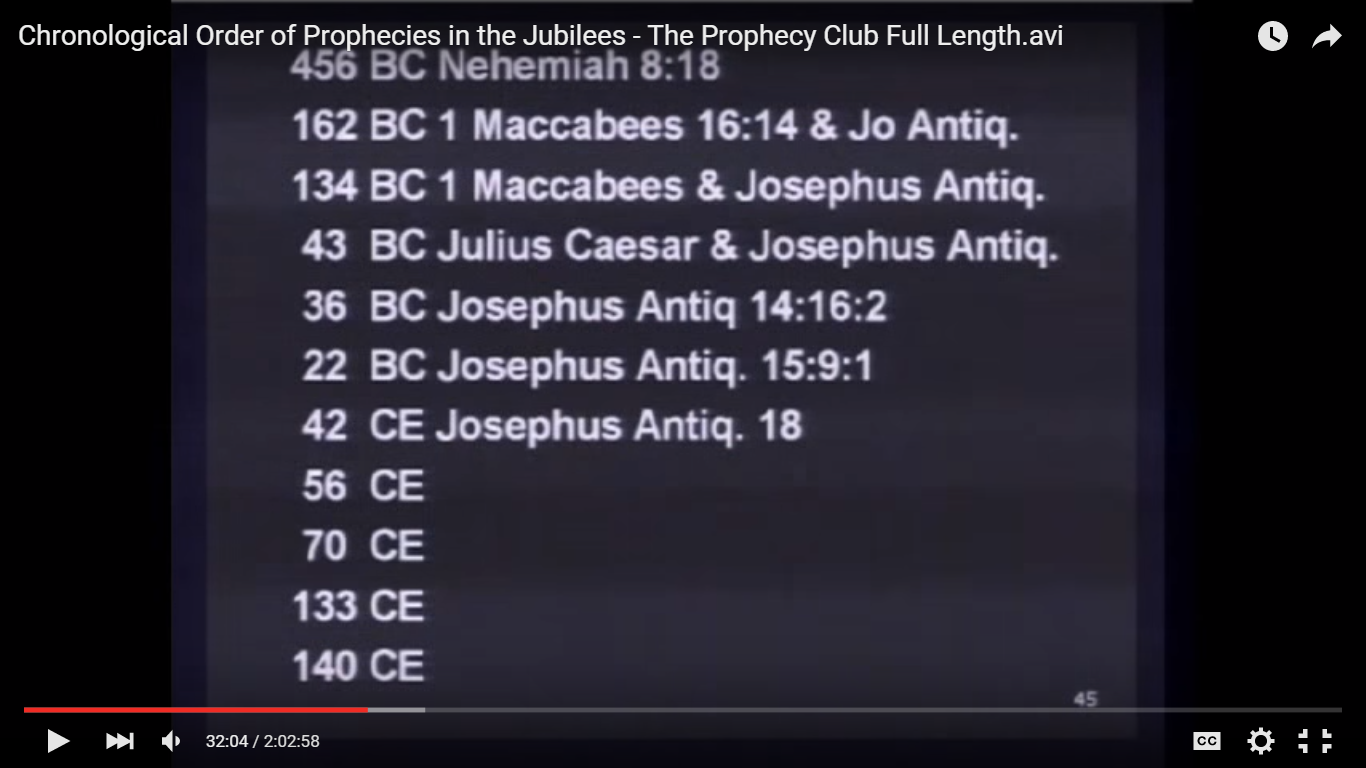
The view of the 70 Weeks I've been favoring had the Decree of Artaxerxes in Nissan 454 BC putting the 70th week in 30-37 AD. But many have, using much of the same evidence, argued for the Decree being Nissan of 455 BC, and a 70th Week that is 29-36 AD. I need to look into that more, but if so that would make both the beginning and ending of the 70 weeks the start of Jubilee years in the above Jubilee model, which makes sense.
I've seen people argue for both 29 and 36 AD Crucifixion models. For the latter that includes Nikos Kokkinos who's theories I may talk about more in a future post. My personal bias remains 30 AD for the moment however. But The Resurrection and Acts 2 Pentecost being Jubilee years has a certain symmetry to it.
This makes the latest Jubilee year to happen Spring 1996-Spring 1997. And before that 1947-1948 which many see as Biblically significant. Before that 1898-1899, and before that 1849-1850.
This model could place the beginning of the 21 year Time of Jacob's Trouble in Spring of 2024 AD.
Or maybe if someone could argue the above proposed Jubilee cycle is off by a year, to make my original 70s Weeks views match up to Jubilees, things would fit better. Then it would be during a Jubilee year modern Israel was founded.
If I switched to a Mid 7th Year or mid 49th Year Rapture view. How do I match up the time-frames? The ministry of the Witnesses and consecration of the Rebuilt Temple would be around the Nissan that would start year 4 of the relevant Sabbatical cycle. The 42 Months The Beast is allowed to continue would begin about 6 months later. And the 1260 days The Woman is in the Wilderness would continue 3 years into The Millennium. Why would that happen? Who knows, perhaps I'll think of a reason later.
But I will still never accept a Non Chronological view of Revelation.
Saturday, April 9, 2016
The Arnion of Revelaion
I'm going to begin this post by repeating (with small adjustments) some of what I said in this now possibly defunct theory. Much of that post I already possibly retracted here.
The KJV of the Book of Revelation uses the word "Lamb" 29 times, all but once of Jesus. All of them are the same Greek word (Strongs number 721), but in 3 different forms. Arnion/Arniou/ArniO.
This word however appears only once in the NT outside Revelation, in John 21:15. There however it is a form distinct from any of the 3 used in Revelation, Arnia. I'm not sure but I think that could qualify as a feminine form, while the 3 in Revelation clearly do not. There it is used of Believers not of Jesus. But unlike in English translations the Greek text doesn't seem plural there, like Jesus is calling The Church as a whole His Arnia.
The suggestion has been made before that "Lamb" is not an accurate translation of this word, and even been suggested before that it should be "Ram". It's controversial because this word is rare even in Ancient Greek usage outside The Bible. Other Greek words are known to have existed for Lambs and Rams and Goats, the other words for Ram aren't used in the New Testament however (I give no credence to the Septuagint). The main one would be Krios, the Greek name for the constellation Aries, The Ram.
When John, this same Author, in his Gospel quotes in Greek John The Baptist calling Jesus "The Lamb of God" in 1:29&36 he uses Amnos (Strongs number 286). Likewise Acts 8:32 and 1 Peter 1:19 when alluding to Isaiah 53:7 and the Passover Lamb also use Amnos, though Peter spelled it Amnou. In Hebrew also Isaiah 53:7's "Lamb to the Slaughter" uses the same word used of the Passover Lamb in Exodus 12, Strongs number 7716, Seh.
Revelation 5 tells us the Arnion has seven horns. Revelation 13:11 tells us the Beast out of The Earth has 2 horns like an ArniO. While lambs do have horns they're very small and not too noticeable, and so outside Revelation no Biblical references to Lambs mention that they have horns. But they are mentioned in reference to other animals, including the Ayil, and Goats.
And the Shofar (one of two Hebrew words translated Trumpet) was specifically a Trumpet made from a Ram's horn. It's the Shofar sounded on the Yom Kippur proceeding the Jubilee Year in Leviticus 25:9. And traditionally Rams horns are sounded on Yom Teruah, though the Biblicalness of that is debated by Kariates and others.
In the Book of Joshua chapter 6 at the fall of Jericho seven Shofars were sounded. If Arnion means Ram then it would be natural to speculate a connection between the seven horns of the Arnion in Revelation 5, and the seven trumpets sounded by the seven angels later. Others have argued those seven angels are also the seven spirits refereed to, though I've disagreed with that in the past, but I've now updated that post. And Jesus is described as having a voice like a Trumpet.
The repeat is over now.
While I had argued very recently before for the idea of it meaning Ram, my considering that Ayil maybe doesn't mean Ram weakens much of that.
I also learned recently that Shofars are not always Ram's Horns, they can be among other things, Goat's Horns too. (The KJV using Ram's Horn in Joshua 6 is mistranslated, the word used there is actually Jubilee). So the Shofar part of the Ram theory about the Seven Horns in Revelation 5 can also apply to Goats.
Arnion meaning Goat has not been argued for before from what I can find. But as I said Arnion was very rarely used. In Revelation it's first use din Chapter 5 where the Arnion is next to God on His Throne being described as the Arnion as it had been slain. This could be connected to the Blood of the Yom Kippur Sin offering being sprinkled on the "Mercy Seat".
The End Times are viewed as being largely about the Fall Feasts rather then the Spring Feasts. While Numbers 28-29 called for a lot of sacrifices on nearly all the Leviticus 23 Holy Days. Only one Fall Holy Day day is affiliated with a specific special Sacrifice the way Passover is. And that's Yom Kippur, The Sin Offering which was a Goat, described in detail in Leviticus 16.
A Greek word for Goat is used 3 times in the New Testament, in 3 different forms (Strong number 2055 and 2056). EriphOn and Eriphia in Matthew 25:32-33 the Sheep and Goats judgment, and Eriphon in Luke 15:29. In Luke it's at the end of the Prodigal Son parable, used by the older brother to disparagingly describe the animal that hadn't been offered to him in comparison to what his brother is getting now.
So none of those are of a Goat as representing Jesus, and possibly all meant to be derogatory. And neither is by the same human author as Revelation.
While they begin with different letters Ar and Er could reflect a common etymological origin.
And the thing is Hebrew has two different words for Goat or Kid (the KJV translates both as both at different times).
Sayir (Strong number 8163) and Ez (Strong number 5795). The two words are often used in the same verse. Anytime you see "a kid of the goats", Kid is Sayir and Goat is Ez.
Ez first appears in Genesis 15:9, the first appearance of several words for the Sacrificial Animals. Saiyr first appears in Genesis 37:31 which also uses Ez. Both are used in Leviticus 16, but Saiyr much more frequently. And both are used of the Sin offerings called for in Numbers 28-29. And both are used of the He-Goat or Rough-Goat that represents Greece in Daniel 8.
Azazel, the name of the Yom Kippur Scapegoat, is a compound word combining Ez and Azal (Strongs 235) In a sense both Yom Kippur Goats represent Jesus, He both carries our Sins and Dies for them. But I've also argued for a sense in which the Azazel goat could represent Satan, the Antichrist/Falseprophet or the unbelievers in general. This could make sense with Goats representing those cast into Aionios fire (sheeps and Goats judgment). So maybe that has something to do with the second beast having horns "like an ArniO".
In both Leviticus 17:7 and 2 Chronicles 11:15, Saiyr appears and is translated "devils" in the KJV. The context is describing idols or false gods that are being worshiped. Perhaps similar to the Greek goat-god Pan, or the Egyptian Goat of Mendes. In Isaiah 13:21 and 34:14, Saiyr is translated Satyr. A Greek mythological term that originally just refereed to the male counterparts of the Meaneds of Dionysus, but in time came to be thought of as Faun like creatures, which I think is what the KJV translators had in mind.
Isaiah 34 is about Edom, which is interesting since Saiyr is spelled the same as Seir in Hebrew, which is taken to mean Hairy and used to describe Esau's hairiness in Genesis 27. Also in Genesis 27 Jacob uses Goat skins to mimic the feel of Esau's hairiness. Song of Solomon 4:1 and 6:5 use Ez to describe the thickness of Shulamith's hair.
Ez seems to have no feminine equivalent used in Scripture. But Saiyr has Saiyrah, used in Leviticus 4:28 and 5:6. (Correction, Uzzah is a feminine form of Ez, but it only ever appears as a name.)
I'm thinking maybe Eriphon should be viewed as the Greek equivalent to one of those Hebrew words and Arnion the other. Which is which I could go either way on, but I'm leaning towards Eriphon as Saiyr since Paul uses Esau as an idiom for the Gentiles in Romans 9-11. The Septuagint I already know uses Arnion for neither, fortunately I don't trust it. But it may be interesting to see how it uses Eriphon. I don't feel like doing that myself right now, maybe for a future follow up.
Josephus in Antiquities of The Jews Book 3:231 says "ho men gar kata agnoian eis touto propesôn arna kai eriphon thêleian tôn autoetôn prospherei". Which William Whiston translated, " But if a person fall into sin by ignorance, he offers an ewe lamb, or a female kid of the goats, of the same age;". Arna is another form of Arnion, of it's NT appearances most similar to Arnia.
Josephus was not doing a Greek Translation of Scripture. But he was here clearly alluding to one of the verses where the feminine Saiyrah was used. Both verses also use Ez. Leviticus 4:28 includes no animal names besides those, but 5:6 does. It sounds like Josephus intent here was to be talking about Sin offerings, which are defined as being for sins committed in ignorance, which makes 4:28 the better fit. But later the same account mentions Lambs, so it's still unclear even what Josephus meant Arna to mean.
Modern Satanism's use of Goat imagery has caused Christians to develop an unhealthy aversion to Goat imagery. Even Torah observant Christians will talk about goats positively only when it's about Torah verses that require them too. I've talked about the negative references to goats here, but let's not forget based on Leviticus 16, a Goat can represent Jesus just as much as a Lamb can.
Maybe Arnion isn't Greek in origin at all. Because for other subjects I've attempted to research the Etymology of Arnon, the name of a River mentioned in The Hebrew Bible. And found that name has been suspected to be related to Arabic, Aramaic and Syriac words for a type of Goat.
Monday, January 25, 2016
My Hypothesis for the fulfillment of the Fall Feasts in Revelation
I watched much of Michael Rood's Prophecies in the Fall Feasts. He says much that I found wonderfully edifying, especially on the Seventh Trumpet. But I disagree on the Final Week beginning and ending in Tishri, I see the Fall Feasts as chiefly the midway point.
I want to lay out my hypothesis here, and while I'll be linking to earlier posts I'm also going against some things I said before in those same posts. My mind does change as I study more.
I have a post on how the Two Witnesses and the 7th Trumpet fulfill Yom Teruah. And about the Rapture of The Man-Child. But I have one thing to add for Yom Teruah.
I'm hesitant to build doctrine on Rabbinic Traditions the way Michael Rood does, but some are interesting. One idea not gained directly from The Bible is the days of Awe which begin with Yom Teruah and end with Yom Kippur in which the gates of Heaven are open. Well one more thing we are told about the Seventh Trumpet in Revelation 11 is that the God's Temple in Heaven and the Ark of the Covenant was seen. Genesis 24:55 could provide a basis for a period of ten days.
2 Chronicles 31 has the first fruits of Hezekiah's harvest begin being heaped up in the third month (the month of Pentecost) and finished in the Seventh month when they are gathered up and placed in the secret chambers of YHWH's House. The beginning of Revelation 11 tells us the city of Jerusalem will be mostly Gentiles during the first half of the Week. At the end when most of those people believe The Witnesses after their ascension, that is when he Fullness of the Gentiles is come in.
The days of Awe are the days you can seek atonement, the Judgment is set on Yom Kippur, but it's carried out on Tabernacles. According to Rabbinic views at least. That can happen to fit what I will lay out below, but it's not necessary for my argument.
The main interpretation of the twin Goats of Yom Kippur is that both point to Jesus, one bears our Sins and the other's Blood is shed for them. One is Jesus bearing The Cross the other is him On It. Biblical symbolism can be layered however, so that preferred view need not conflict with others.
Including the possibility of seeing Satan or other villainous figures in the Scapegoat. I've argued on this blog before about both Cain and Barnabas. I've also thought about the Goats of the Sheeps and Goats judgment being cast out. I really don't like the Book of Enoch's popularity, but it does reflect a possibly very old tendency to see Satan in the Azazel/Scapegoat by calling it's most unique fallen angel Azazel.
What's relevant here is IF you think such a connection is valid, it can justify seeing Yom Kippur as the day Satan is cast out of Heaven.
My study of Isaiah 14 has lead to me to a conclusion that the Eight King ascending out of the Abyss happens after, probably the same day, Satan is cast out of Heaven. Since I made that study I no longer view his death has needing to happen during the end times.
[Update note: my perspective on Isaiah has changed rendering this point moot.]
Traditional Jewish interpretations of the chronology of Exodus say the 40 days Moses was on Mt Sinai from Exodus 24:18-31:18 were Elul and the Days of Awe. Near the end of that period is when chapter 32 tells us they made the Golden Calf. When Moses came down on Yom Kippur they were worshiping it. Antiochus Epiphanes' Abomination of Desolation was set up 10 days before it was consecrated.
So connecting the Abomination to Yom Kippur could make a lot of sense. But I still think it possible there is an abomination of sorts at the start of the Week. But putting these pieces together really helps my theory that the Image of Revelation 13 is the Eight King. If you're thinking "but he has to kill the Witnesses before Yom Teruah" well I think that Beast is actually the second one. Ascending out of the Bottomless Pit can apply to both, but Apollyon is The False Prophet.
I think maybe the mortal sword wound being healed isn't a death and resurrection itself but a sign that he's already resurrected.
But for those that insist the Abomination must happen both at about the middle of the week and before the Rapture. I would consider placing it maybe when the Witnesses die three and a half days before the Rapture. Or maybe a week before on Elul 23 the day referenced at the end of Haggai 1. Or maybe 10 days before, Jesus refereed to 10 days of tribulation in the message to Smyrna. Or maybe the beginning of Elul referenced at the start of Haggai 1. Post-tribbers think Matthew 21-28 must span three and a half years because of other Biblical importance to that time frame, but Jesus mentioned no specific time lengths.
Yom Kippur imagery possibly still exists in Revelation 14 as well. In the past I've written off theories that the Rapture doesn't happen all at once. I'm now more open to that but not in any sense of them being separated by years, but rather less then half a month. The Church is caught up on Tzom Gedaliah at the latest after being glorified on Yom Teruah. If you're not saved by the Last Trumpet it's too late to be the Bride, but maybe not too late be a guest at the wedding. No one I think gets Raptured alive after Yom Kippur.
The Son of Man on the Cloud with the Sickle and Crown is both the High Priest and the Shekinah Glory which are prominent in Leviticus 16. The 144,000 I see s being a specific group of Church Age believers from each Tribe of Israel, but also representing the whole in a sense.
Those who argue Jesus was born on Tabernacles (a theory I find impossible) like to Translate John 1:14 "And the Word was made flesh, and dwelt among us," as "And the Word was made flesh, and tabernacled among us". Well if any use of "dwell" or it's word forms can justify an illusion to Tabernacles, let's look at Revelation 13:6 talking about The Beast.
"And he opened his mouth in blasphemy against God, to blaspheme his name, and his tabernacle, and them that dwell in heaven." I've long viewed this as proof we are Raptured by this point. Now I don't think we're at Tabernacles yet, I see this as the II Thessalonians 2 abomination event. But it shows the conditions are in place.
One of the themes of Revelation 14 is the Grape Harvest. The Grape Harvest has to be done before Tabernacles, Tabernacles is the festival to celebrate the Harvest. One thing you can point out to undermine people's assumptions about how the Last Supper relates to Passover is to point out that there is no Torah basis for drinking wine on Passover or during the days of Unleavened Breast. The only Holy Day where wine is mentioned is the Feast of Tabernacles in Deuteronomy 16.
When I was real little, I used to visualize God filling seven bowls with his Wrath as him vomiting into them. As I got older I started thinking of that as silly and immature. Until when I used to listen to Chuck Missler's seminars a lot how he'd cite verses I can't remember right now as saying our Sin is like a vile stench in God's nostrils.
And now I'm thinking of this Grape and Wine connection. You know how when someone gets drunk off red wine they puke vomit that looks kinda blood red? Well imagine then seven bowls filled with God's blood red vomit, two of which are poured into the world's water supply. It will logically become red like blood.
The Blood=Wine connection didn't begin with the Last Supper. It's implied in the very etymology of the Hebrew words for them according to Strongs. It's implied in Genesis 49:11 and Deuteronomy 32:14 which refer to wine as the blood of grapes. And Isaiah 63 which talks about Blood and Winepresses. And it's repeated again at the end of Revelation 14, talking about God's Wrath.
Revelation 20 tells us those post Rapture Saints martyred for not taking The Mark will be beheaded. Revelation 15 has them all in Heaven before the Bowls of Wrath are poured out. I don't think this persecution will last very long, Revelation 13 seems to give the Beasts the means to kill most resisters pretty quickly. I don't think any die after the Bowls have started. Revelation 14:13 says.
Does that mean I think once the Bowls start the only people on earth without The Mark are the Israelites being protected in Edom? Maybe, maybe not. It could be the troubles caused by the Bowls, even the first Bowl which will effect every Marked person, will hamper the beasts' ablity to kill anyone else.
John The Baptist was also beheaded, only other NT reference to that form of capital punishment, it's is pretty rare in Tanakh too, only occurrence I can recall is Jehu using it.
When I argued for Jesus being born in December, I also conjectured John was conceived between Yom Kippur and Tabernacles. I now favor the 14th of Tishri as the day his conception process started paralleling Jesus on the 14th of Nisan- First Fruits. Since one theme of that was Jesus being conceived at the same time frame (on the Hebrew calendar) as his Death and Resurrection, perhaps likewise John was beheaded on the 14th of Tishri.
Contrary to the Blood Moon hype, the 14th not 15th days of Biblical Months are the Full Moons. The least important thing I'll mention in this thread is that if one model I'm speculating for when this might play out is correct, the 14th of Tishri in question will be a Lunar Eclipse.
Because I view Revelation as Chronological. I believe the time allotted for the Bowls must span about three and a half years, the 42 months the beast reigns and 1260 days Israel is in the widlerness. Arguments for a shorter time for the Bowls include Chris White and other Pre-Wrathers saying they're a month, Michael Rood saying they span the days of awe, and Rob Skiba saying they're all one day. The only shorter model I could entertain is them spanning the seven days of Tabernacles.
But I've found an answer for how to bring the Tabernacles connection and spanning three and a half years together.
I've argued before the First Bowl must happen soon after The Mark is instituted. Back then I was willing to allow half a year between them, but now I think closer to five days. Then in my Great City post I observed how the remaining 6 bowls came in pairs.
The first Bowl I think will be the 15th of Tabernacles immediately following the Midway point drama I've just discussed. One year later the 2nd and 3rd bowls will be poured out on the 16th and 17th of Tishri, destroying the world's water supply.
One year after that the 4th day of Tabernacles will see the Sun become really super hot. But that I don't see lasting a long time. In John 7 the midst of the Feast is when Jesus (The Sun of Righteousness) made his presence known. The next day it will be blotted out, and based on Isaiah 13 that continues at least to the fall of Babylon.
One year after that, the last Tabernacles during the seven years, will see the last two days fulfill the last two bowls.
Haggai 2 refers to the 21st day of the Seventh month as a day YHWH will shake the nations. I see that as alluding to the great earthquake of the 7th Bowl, the greatest of any in history including the more commonly quoted Sixth Seal.
Because of how Haggai 2 ties into Hanukkah and my careful reading of the Maccabees account. I think the 21st of Tishri was actually the day the Maccabees liberated Jerusalem, but it wasn't till the 24th of Kislev that they had cleansed everything, then the following 8 days they Rededicated The Temple with a sort of second Tabernacles. Antiochus Epiphanes did not die till awhile later, contrary to speculation I did before I read the accounts more carefully, we don't know when exactly.
As I said in the Great City post, the 7th Bowl is when Jerusalem is divided in three, and then after that God will judge Babylon. That day is a judgment on Jerusalem, but also part of it's liberation, the beginning of it being reshaped into what we see in Ezekiel 40-48.
The eighth day I think will be Revelation 17-18 (and to an extent early 19) the Judgment on Babylon.
Esther 2:16 says Esther became the King's Wife in the Tenth Month (Tebet) of the seventh year. It doesn't say what day. Hanukkah begins in late Kislev but always ends in Tevet/Tebet. The New Moon of Tevet is always during Hanukkah.
The next event in Revelation's timeline is the Marriage Supper. Michael Rood talks about Jewish weddings being traditionally a seven day feast followed by an eighth day, thus justifying placing it on Tabernacles. But remember Hanukkah is eight days because it was a second Tabernacles.
And The Bride of Christ is also His Temple, so it makes sense that the Feast of Dedication (which Jesus observed in John 10:22) will be the Wedding Feast in which He dedicates Himself to His Bride.
Also in Revelation 1-2 the Seven Churches (which typify the entire Church) are represented by Seven Lampstands. Hence the importance of the Menorah to Hanukkah. And Zechariah 4 has the two olive trees, the Witnesses next to it. Jewish Weddings traditionally have Two Witnesses. Jews also like to link Zechariah 4 to Hanukkah, seeing the Olive Trees on each side of the Menorah as foreshadowing the two added candles of the Hanukkah Menorah.
Jesus called himself "The Light of The World" in John 8, but He also called us in Matthew 5:14 "Ye are the light of the world. A city that is set on an hill cannot be hid."
I disagree with the view that during this time-frame two thirds of all Jews will be wiped out in a holocaust that surpasses Hitler's. I think that one detail of Zechariah 13 is being misused. This will be a time that Israel (The Woman of Revelation 12) is protected in the Wilderness like in the days of Moses (which Tabernacles is supposed to be a memorial of). There will be hardships, but I agree with those who assert that viewing the end times as God and Satan torturing the Jews until they repent is in fact a sneaky kind of antisemitism. I believe this time results in their finally accepting Yeshua as their Messiah, but it will be what's done for them not to them that brings that about.
This isn't the final fulfillment of Tabernacles however, Zechariah 14 tells us it'll be observed in The Millennium. And I've argued before that Tabernacles will be when New Jerusalem descends and the Eight Day when Time (as we know it) stops. Though when I talked about that in the past I was more open to the Seven Millenniums theory that I now oppose.
I now have a follow up on the Spring Feasts.
I want to lay out my hypothesis here, and while I'll be linking to earlier posts I'm also going against some things I said before in those same posts. My mind does change as I study more.
I have a post on how the Two Witnesses and the 7th Trumpet fulfill Yom Teruah. And about the Rapture of The Man-Child. But I have one thing to add for Yom Teruah.
I'm hesitant to build doctrine on Rabbinic Traditions the way Michael Rood does, but some are interesting. One idea not gained directly from The Bible is the days of Awe which begin with Yom Teruah and end with Yom Kippur in which the gates of Heaven are open. Well one more thing we are told about the Seventh Trumpet in Revelation 11 is that the God's Temple in Heaven and the Ark of the Covenant was seen. Genesis 24:55 could provide a basis for a period of ten days.
2 Chronicles 31 has the first fruits of Hezekiah's harvest begin being heaped up in the third month (the month of Pentecost) and finished in the Seventh month when they are gathered up and placed in the secret chambers of YHWH's House. The beginning of Revelation 11 tells us the city of Jerusalem will be mostly Gentiles during the first half of the Week. At the end when most of those people believe The Witnesses after their ascension, that is when he Fullness of the Gentiles is come in.
The days of Awe are the days you can seek atonement, the Judgment is set on Yom Kippur, but it's carried out on Tabernacles. According to Rabbinic views at least. That can happen to fit what I will lay out below, but it's not necessary for my argument.
The main interpretation of the twin Goats of Yom Kippur is that both point to Jesus, one bears our Sins and the other's Blood is shed for them. One is Jesus bearing The Cross the other is him On It. Biblical symbolism can be layered however, so that preferred view need not conflict with others.
Including the possibility of seeing Satan or other villainous figures in the Scapegoat. I've argued on this blog before about both Cain and Barnabas. I've also thought about the Goats of the Sheeps and Goats judgment being cast out. I really don't like the Book of Enoch's popularity, but it does reflect a possibly very old tendency to see Satan in the Azazel/Scapegoat by calling it's most unique fallen angel Azazel.
What's relevant here is IF you think such a connection is valid, it can justify seeing Yom Kippur as the day Satan is cast out of Heaven.
My study of Isaiah 14 has lead to me to a conclusion that the Eight King ascending out of the Abyss happens after, probably the same day, Satan is cast out of Heaven. Since I made that study I no longer view his death has needing to happen during the end times.
[Update note: my perspective on Isaiah has changed rendering this point moot.]
Traditional Jewish interpretations of the chronology of Exodus say the 40 days Moses was on Mt Sinai from Exodus 24:18-31:18 were Elul and the Days of Awe. Near the end of that period is when chapter 32 tells us they made the Golden Calf. When Moses came down on Yom Kippur they were worshiping it. Antiochus Epiphanes' Abomination of Desolation was set up 10 days before it was consecrated.
So connecting the Abomination to Yom Kippur could make a lot of sense. But I still think it possible there is an abomination of sorts at the start of the Week. But putting these pieces together really helps my theory that the Image of Revelation 13 is the Eight King. If you're thinking "but he has to kill the Witnesses before Yom Teruah" well I think that Beast is actually the second one. Ascending out of the Bottomless Pit can apply to both, but Apollyon is The False Prophet.
I think maybe the mortal sword wound being healed isn't a death and resurrection itself but a sign that he's already resurrected.
But for those that insist the Abomination must happen both at about the middle of the week and before the Rapture. I would consider placing it maybe when the Witnesses die three and a half days before the Rapture. Or maybe a week before on Elul 23 the day referenced at the end of Haggai 1. Or maybe 10 days before, Jesus refereed to 10 days of tribulation in the message to Smyrna. Or maybe the beginning of Elul referenced at the start of Haggai 1. Post-tribbers think Matthew 21-28 must span three and a half years because of other Biblical importance to that time frame, but Jesus mentioned no specific time lengths.
Yom Kippur imagery possibly still exists in Revelation 14 as well. In the past I've written off theories that the Rapture doesn't happen all at once. I'm now more open to that but not in any sense of them being separated by years, but rather less then half a month. The Church is caught up on Tzom Gedaliah at the latest after being glorified on Yom Teruah. If you're not saved by the Last Trumpet it's too late to be the Bride, but maybe not too late be a guest at the wedding. No one I think gets Raptured alive after Yom Kippur.
The Son of Man on the Cloud with the Sickle and Crown is both the High Priest and the Shekinah Glory which are prominent in Leviticus 16. The 144,000 I see s being a specific group of Church Age believers from each Tribe of Israel, but also representing the whole in a sense.
Those who argue Jesus was born on Tabernacles (a theory I find impossible) like to Translate John 1:14 "And the Word was made flesh, and dwelt among us," as "And the Word was made flesh, and tabernacled among us". Well if any use of "dwell" or it's word forms can justify an illusion to Tabernacles, let's look at Revelation 13:6 talking about The Beast.
"And he opened his mouth in blasphemy against God, to blaspheme his name, and his tabernacle, and them that dwell in heaven." I've long viewed this as proof we are Raptured by this point. Now I don't think we're at Tabernacles yet, I see this as the II Thessalonians 2 abomination event. But it shows the conditions are in place.
One of the themes of Revelation 14 is the Grape Harvest. The Grape Harvest has to be done before Tabernacles, Tabernacles is the festival to celebrate the Harvest. One thing you can point out to undermine people's assumptions about how the Last Supper relates to Passover is to point out that there is no Torah basis for drinking wine on Passover or during the days of Unleavened Breast. The only Holy Day where wine is mentioned is the Feast of Tabernacles in Deuteronomy 16.
When I was real little, I used to visualize God filling seven bowls with his Wrath as him vomiting into them. As I got older I started thinking of that as silly and immature. Until when I used to listen to Chuck Missler's seminars a lot how he'd cite verses I can't remember right now as saying our Sin is like a vile stench in God's nostrils.
And now I'm thinking of this Grape and Wine connection. You know how when someone gets drunk off red wine they puke vomit that looks kinda blood red? Well imagine then seven bowls filled with God's blood red vomit, two of which are poured into the world's water supply. It will logically become red like blood.
The Blood=Wine connection didn't begin with the Last Supper. It's implied in the very etymology of the Hebrew words for them according to Strongs. It's implied in Genesis 49:11 and Deuteronomy 32:14 which refer to wine as the blood of grapes. And Isaiah 63 which talks about Blood and Winepresses. And it's repeated again at the end of Revelation 14, talking about God's Wrath.
Revelation 20 tells us those post Rapture Saints martyred for not taking The Mark will be beheaded. Revelation 15 has them all in Heaven before the Bowls of Wrath are poured out. I don't think this persecution will last very long, Revelation 13 seems to give the Beasts the means to kill most resisters pretty quickly. I don't think any die after the Bowls have started. Revelation 14:13 says.
And I heard a voice from heaven saying unto me, "Write, Blessed are the dead which die in the Lord from henceforth: Yea, saith the Spirit, that they may rest from their labours; and their works do follow them."I've speculated before this could mean from here on all believers who die are resurrected and raptured right away. But if not I think these martyrs will be Raptured when Tabernacles starts.
Does that mean I think once the Bowls start the only people on earth without The Mark are the Israelites being protected in Edom? Maybe, maybe not. It could be the troubles caused by the Bowls, even the first Bowl which will effect every Marked person, will hamper the beasts' ablity to kill anyone else.
John The Baptist was also beheaded, only other NT reference to that form of capital punishment, it's is pretty rare in Tanakh too, only occurrence I can recall is Jehu using it.
When I argued for Jesus being born in December, I also conjectured John was conceived between Yom Kippur and Tabernacles. I now favor the 14th of Tishri as the day his conception process started paralleling Jesus on the 14th of Nisan- First Fruits. Since one theme of that was Jesus being conceived at the same time frame (on the Hebrew calendar) as his Death and Resurrection, perhaps likewise John was beheaded on the 14th of Tishri.
Contrary to the Blood Moon hype, the 14th not 15th days of Biblical Months are the Full Moons. The least important thing I'll mention in this thread is that if one model I'm speculating for when this might play out is correct, the 14th of Tishri in question will be a Lunar Eclipse.
Because I view Revelation as Chronological. I believe the time allotted for the Bowls must span about three and a half years, the 42 months the beast reigns and 1260 days Israel is in the widlerness. Arguments for a shorter time for the Bowls include Chris White and other Pre-Wrathers saying they're a month, Michael Rood saying they span the days of awe, and Rob Skiba saying they're all one day. The only shorter model I could entertain is them spanning the seven days of Tabernacles.
But I've found an answer for how to bring the Tabernacles connection and spanning three and a half years together.
I've argued before the First Bowl must happen soon after The Mark is instituted. Back then I was willing to allow half a year between them, but now I think closer to five days. Then in my Great City post I observed how the remaining 6 bowls came in pairs.
The first Bowl I think will be the 15th of Tabernacles immediately following the Midway point drama I've just discussed. One year later the 2nd and 3rd bowls will be poured out on the 16th and 17th of Tishri, destroying the world's water supply.
One year after that the 4th day of Tabernacles will see the Sun become really super hot. But that I don't see lasting a long time. In John 7 the midst of the Feast is when Jesus (The Sun of Righteousness) made his presence known. The next day it will be blotted out, and based on Isaiah 13 that continues at least to the fall of Babylon.
One year after that, the last Tabernacles during the seven years, will see the last two days fulfill the last two bowls.
Haggai 2 refers to the 21st day of the Seventh month as a day YHWH will shake the nations. I see that as alluding to the great earthquake of the 7th Bowl, the greatest of any in history including the more commonly quoted Sixth Seal.
Because of how Haggai 2 ties into Hanukkah and my careful reading of the Maccabees account. I think the 21st of Tishri was actually the day the Maccabees liberated Jerusalem, but it wasn't till the 24th of Kislev that they had cleansed everything, then the following 8 days they Rededicated The Temple with a sort of second Tabernacles. Antiochus Epiphanes did not die till awhile later, contrary to speculation I did before I read the accounts more carefully, we don't know when exactly.
As I said in the Great City post, the 7th Bowl is when Jerusalem is divided in three, and then after that God will judge Babylon. That day is a judgment on Jerusalem, but also part of it's liberation, the beginning of it being reshaped into what we see in Ezekiel 40-48.
The eighth day I think will be Revelation 17-18 (and to an extent early 19) the Judgment on Babylon.
Esther 2:16 says Esther became the King's Wife in the Tenth Month (Tebet) of the seventh year. It doesn't say what day. Hanukkah begins in late Kislev but always ends in Tevet/Tebet. The New Moon of Tevet is always during Hanukkah.
The next event in Revelation's timeline is the Marriage Supper. Michael Rood talks about Jewish weddings being traditionally a seven day feast followed by an eighth day, thus justifying placing it on Tabernacles. But remember Hanukkah is eight days because it was a second Tabernacles.
And The Bride of Christ is also His Temple, so it makes sense that the Feast of Dedication (which Jesus observed in John 10:22) will be the Wedding Feast in which He dedicates Himself to His Bride.
Also in Revelation 1-2 the Seven Churches (which typify the entire Church) are represented by Seven Lampstands. Hence the importance of the Menorah to Hanukkah. And Zechariah 4 has the two olive trees, the Witnesses next to it. Jewish Weddings traditionally have Two Witnesses. Jews also like to link Zechariah 4 to Hanukkah, seeing the Olive Trees on each side of the Menorah as foreshadowing the two added candles of the Hanukkah Menorah.
Jesus called himself "The Light of The World" in John 8, but He also called us in Matthew 5:14 "Ye are the light of the world. A city that is set on an hill cannot be hid."
I disagree with the view that during this time-frame two thirds of all Jews will be wiped out in a holocaust that surpasses Hitler's. I think that one detail of Zechariah 13 is being misused. This will be a time that Israel (The Woman of Revelation 12) is protected in the Wilderness like in the days of Moses (which Tabernacles is supposed to be a memorial of). There will be hardships, but I agree with those who assert that viewing the end times as God and Satan torturing the Jews until they repent is in fact a sneaky kind of antisemitism. I believe this time results in their finally accepting Yeshua as their Messiah, but it will be what's done for them not to them that brings that about.
This isn't the final fulfillment of Tabernacles however, Zechariah 14 tells us it'll be observed in The Millennium. And I've argued before that Tabernacles will be when New Jerusalem descends and the Eight Day when Time (as we know it) stops. Though when I talked about that in the past I was more open to the Seven Millenniums theory that I now oppose.
I now have a follow up on the Spring Feasts.
Thursday, January 21, 2016
Yom Teruah and Trumpets
I talked about the controversy of affiliating Yom Teruah with Trumpets in my initial Seventh Trumpet post. I went back and forth on Psalm 81 more recently.
On one of the Karaite websites I follow I noticed that they object to affiliating Trumpets with Yom Teruah. Even Karaites can be fallible.
The Hebrew word for neither kind of Trumpet is used in Leviticus 23:24 or Numbers 29, that is correct. To me as I argued before whether it's the Shofar or the Silver Trumpet is irrelevant, Revelation's Trumpets I believe draw on both as does The Rapture Trumpet.
The Karaites like Chris White feel Teruah without a clear Trumpet reference refers to the people making noise, not a Trumpet. Thing I've noticed though is that many Bible verses that use Teruah grammatically of the people shouting also reference Trumpets, if not in the same verse very near by.
Revelation 11 also has voices shouting and making Alarm in Heaven after the Seventh Trumpet sounds.
Jeremiah 4:19 and Zephaniah 1:16 both use Teruah in reference to the Shofar, with the KJV translating it Alarm. Joshua 6 uses it while also talking about the Trumpets at the battle of Jericho. Psalm 150, the last Psalm (and a short one), uses it in verse 5 in reference to Cymbals but Trumpets were mentioned earlier. Also 2 Chronicles 13:12, 15:14 and Psalm 47:5. And Amos 2:2 uses it and the Shofar.
2 Samuel 6 15 and 1 Chronicles 15:28 use it and also mention Trumpets while talking about when David brought The Ark to Jerusalem. Revelation 11 tells use after the Seventh Trumpet is sounded that the Ark will be seen in the Temple in Heaven.
Some verses that use the word without mentioning Trumpets directly, are referring to "The Alarm of War". Numbers 10 and Joshua 6 both tell me we can infer the Alarm of War involves Trumpets.
Still, in The Torah this is the Holy Day we're told the least about. It's not mentioned in Deuteronomy 16 or Ezekiel 45. Yom Kippur is also absent from those chapters but it has Leviticus 16 dedicated to it.
Nehemiah 7:23-8:12 is all on this day, and it makes that day pretty important, though no Trumpets are referenced.
Before that however was Ezra 3, in verses 1-2 and 6-7 talking about the first year of the return from captivity (though some argue a time jump between verses 6 and 7). Verses 8-9 jump to the Second Month of the Second year to talk about Zerubbabel and Jeshua starting their work. I can't help but wonder if it can be conjectured while not clearly stated, that verse 10 has jumped forward to the anniversary of what was recorded before, that that day is supposed to be the day for consecrating the foundations during this period.
If so it's interesting that Ezra 3:10 refers to Trumpets, and says "after the ordinance of King David", and then verses 11 and 13 use Teruah 3 times with the KJV translating it Shout.
What can be interesting in terms of a Tishri Rapture in general is 2 Chronicles 31, talking about Hezekiah's reforms. Verses 5 and 6 talks about offering made for The Temple at Hezekiah's command, including First Fruits offerings. Then verse 7 says.
"In the third month they began to lay the foundation of the heaps, and finished them in the seventh month."
Early in the third month is when Pentecost happens, could this time frame be a type of the time frame of The Church? Our foundation laid at Pentecost and finished in Tishri? Because after this these offerings were gathered up and stored in the "chambers in the house of the LORD" in verses 10 and 11.
While I don't like to build doctrine on Extra Biblical Jewish Traditions, especially ones not attested before The Talmud in the 2nd Century. The customs that went on during the first Century Second Temple period were an influence on the imagery of the New Testament. I've already done a post on how Yom Teruah customs tie into the Two Witnesses.
Numbers 10 is about the Silver Trumpets sounding every Holy Day and New Moon. What is interesting about Yom Teruah is it is the 7th New Moon of the year.
Saturday, October 10, 2015
I've decided the 2018-2025 theory is unlikely
I blogged last month on how my standards for it were pretty high and specific. And now I've decided the odds of the Temple being up and ready in less then two and a half years is a stretch. So I'm abandoning that theory for now, but if suddenly big news happens with The Temple I will consider returning to it.
My mind has again returned to the 2030-2037 theory. And not for the reasons I had mentioned that theory a few times in my last 2018-2025 post, including a recent update of it.
I don't like how my first post on that theory put the Blood Moon connection right in the title. That's something I mentioned only as a hook to get people with a Blood Moon fixation interested. I included in that post Chris White's video debunking the Blood Moon theory. The Lunar eclipses are useful because it helps me be certain when the Full Moons of those months are, and thus to deduce the Lunar Cycles from there.
I had also made that post back when I more or less trusted the Rabbinic Calendar, and before I decided to agree with the Karaites.
What happened was earlier today, October 10th 2015, I was thinking about observations I made in my Pagan Holidays and Christmas posts. And Developed a hunch that Maybe the Resurrection of the Witnesses, and soon after The Church might happen on September 25th, which would put their Execution at about Sunrise on the 22nd, the Autumnal Equinox. Because they will be dead for three and a half days.
And the next day the Beast may declare a Global Holiday celebrating his defeat of them, like how Augustus made his Birthday September 23rd a new Holiday dedicated to Apollo(Apollyon).
And I had firmly already determined that their Resurrection, and the Seventh Trumpet, revolves around the Sunset that starts Yom Teruah. At the midway point of the Finale Week. Backed up by timelines suggested here.
So I decided to look using Stellarium for a year when the Sunset the begins Yom Teruah could likely be the Sunset of September 25th. And the best date in the near future I found just so happened to be 2033, the Yom Teruah that would mark the midway point in the 2030-2037 model I'd thought of before.
A Solar Eclipse is supposed to happen on the 23rd of September 2033. And the Rabbinic Calendar likely has Yom Teruah either that day or the 24th. But I've concluded using Stellarium that when the Crescent of the New Moon will likely first be visible in Israel is most likely Sunset of September 25th.
Now if that New Moon is Biblically Yom Teruah or not depends on when the Barley Harvest happens in Spring of 2033. But when it's that late already I doubt the Harvest could be late enough to delay it, in fact the Rabbis already expect 2033 to have a second Adar. The Kariate reckoning usually only has everything a month later in years there isn't a Second Adar for the Rabbis.
The Lunar Eclipse in October happens on what would if this is correct be the 14th of Tishrei. I have realized lately that it's not even true Full Moons happen on the 15th of Hebrew Months, the Biblical New Moon is the Crescent not when the moon is completely hidden. The Full Moon more likely falls on the 14th, there was a Full Moon probably when Jesus was in Gethsemane.
I have pointed out before how only the Resurrection happens "In the Twinkling of an Eye", at the Last Trump. I think we may very well walk the Earth Resurrected briefly before the actual Rapture, like those Resurrected soon after Jesus in 30 AD.
The Moon will be under the Feet of Virgo within 24 hours, by Sunset of September 26th 2033. The Rapture of the Man-Child happens either while the Moon is under The Woman's Feet, (but if that Woman is Virgo or not is uncertain), or sometime soon after based on Revelation 12.
Revelation 14 I have a feeling is Yom Kippur, it's certainly before Tabernacles. I believe the Zion in Revelation 14 is the Heavenly Zion, and that the 144,000, and thus the whole Church are Raptured when this happens.
Once again, a link for the people who think Date Setting is inherently wrong.
Tying in Rob Skiba's theory about 20 years of Jacob's Trouble, would begin that time in 2017 AD.
Sunday, September 27, 2015
Possible Psalm 81 Retraction
In my main Seventh Trumpet post I had cited Psalm 81 as evidence for affiliating Yom Teruah with Trumpet sounding. And my overall point in that post remains regardless of the relevance of this Psalm. But it turns out there are possible translation issues with that verse.
I had cited the KJV rendering, as is usually my default, of verse 3.
There are a few issues I have since discovered. Which I found looking into why many modern Bibles replace "in the time appointed" with Full Moon.
1. The Hebrew doesn't use the usual Hebrew phrase for Appointed Time, Mowed, but rather Keceh, which the Strongs says means full or fullness.
2. The usual word for the "new" part of New Moon, Rosh, isn't the Hebrew in the verse. Just the word Codesh which is affiliated with the Moon as well as with Months. But not the standard Hebrew word for Moon which is Yerah.
3. The reference to "solem feast day" isn't Mowed either, but chag, which unlike other words translated Feast is assumed to specifically mean a feast or festival. I've been told recently that only the pilgrimage days are feasts/festivals. Two of those happen on or right after Full Moons, and none on a New Moon.
According to Numbers 10 the Silver Trumpets are sounded on all the Appointed Times. The Hebrew here references the Shofar however. It's possible the types of Trumpets are not meant to be as distinguished from others as some insist they should be.
Modern Bibles are clearly wrong to reference the New and Full Moon both, this is a single day being refereed to according to the grammar. If it's a Solemn Feast Day that's Full Moon linked, it's either Passover of Tabernacles.
The word in question for "fullness" is only used once elsewhere in Scripture. Proverbs 7:20. There again the KJV renders it Appointed.
It is strong number 3677, but it's root is 3680. That word is taken as meaning things like cover, hide, conceal. So that sounds more like the New Moon or a solar Eclipse (the eve of the Hebrew New Moon which is the crescent) were the Moon isn't visible at all.
Numbers 10 does say to sound the Silver Trumpets on all the Holy Days, but it's usually only Yom Teruah (or Yom Kippur but only for the Jubilee) specifically associated with Trumpets. Especially the Shofar.
I still think my original view on this may be right, but that makes those who insist Yom Teruah and Yom Kippur are not Feasts mistaken. Solomon's 14 day Festival went through Yom Kippur, which doesn't work if Yom Kippur is a Fast Day as tradition as convinced people.
The Septuagint agrees with the KJV on this verse, I have major issues with the Septuagint, but those come down to how it's used against the KJV, and the Masoretic text in general, here I'm simply wondering how to interpret what the Masoretic text says. And I do think now the KJV and LXX are both mistaken in exactly how to express the verse, but possibly closer to the correct intent then the Full Moon view.
Thing is this would be the only verse in The Bible making the Full Moon significant, (with only one other mentioning it at all, based on the same word). Certain Feast Days happen to occur near the Full Moon, but it's how long after the New Moon they are counted. And saying the 15th of each month is the Full Moon is a mistake based on a wrong understanding of the Biblical New Moon. The Full Moon is actually the 14th more often then not.
I always find it significant when God does the opposite of The Pagans. The Full Moon is constantly significant to Pagans, but The Bible seems to be more focused on New Moons.
This PDF argued in-favor of the Full Moon interpretation. But in doing so reveals how that interpretation has it's roots in the opinions of the Pharasitic Rabbis of the first and second centuries, who went on to influence Jerome. I give Jerome credit for being the first "Church Father" to use Hebrew rather then the Septuagint for the Old Testament, but he should have sought his advice from Kariates rather then Rabbis.
And that PDF's argument against the "covering" interpretation seems overly technical for a word that is used only twice.
My hunch now is that this refers to when the Moon comes out of hiding, the Biblical New Moon.
This is an issue I'm gonna to dig deeper on.
On a side note, tonight is the Blood Moon (but in Kariate Biblical reckoning it's not Tabernacles after all, Tabernacles starts tomorrow night). Here is Chris White's refutation of that again.
He could have added that it's barely visible in Israel, this last one being the only one visible there at all.
I'm gonna put Rob Skiba's recent longer video here too, though he says plenty I don't agree with (like on the Flat Earth).
I had cited the KJV rendering, as is usually my default, of verse 3.
Blow up the trumpet in the new moon, in the time appointed, on our solemn feast day.Yom Teruah is the only day that is both a New Moon and one of the Leviticus 23 Feast Days.
There are a few issues I have since discovered. Which I found looking into why many modern Bibles replace "in the time appointed" with Full Moon.
1. The Hebrew doesn't use the usual Hebrew phrase for Appointed Time, Mowed, but rather Keceh, which the Strongs says means full or fullness.
2. The usual word for the "new" part of New Moon, Rosh, isn't the Hebrew in the verse. Just the word Codesh which is affiliated with the Moon as well as with Months. But not the standard Hebrew word for Moon which is Yerah.
3. The reference to "solem feast day" isn't Mowed either, but chag, which unlike other words translated Feast is assumed to specifically mean a feast or festival. I've been told recently that only the pilgrimage days are feasts/festivals. Two of those happen on or right after Full Moons, and none on a New Moon.
According to Numbers 10 the Silver Trumpets are sounded on all the Appointed Times. The Hebrew here references the Shofar however. It's possible the types of Trumpets are not meant to be as distinguished from others as some insist they should be.
Modern Bibles are clearly wrong to reference the New and Full Moon both, this is a single day being refereed to according to the grammar. If it's a Solemn Feast Day that's Full Moon linked, it's either Passover of Tabernacles.
The word in question for "fullness" is only used once elsewhere in Scripture. Proverbs 7:20. There again the KJV renders it Appointed.
He hath taken a bag of money with him, and will come home at the day appointed.Other translations also say "full moon" instead of "day appointed' here.
It is strong number 3677, but it's root is 3680. That word is taken as meaning things like cover, hide, conceal. So that sounds more like the New Moon or a solar Eclipse (the eve of the Hebrew New Moon which is the crescent) were the Moon isn't visible at all.
Numbers 10 does say to sound the Silver Trumpets on all the Holy Days, but it's usually only Yom Teruah (or Yom Kippur but only for the Jubilee) specifically associated with Trumpets. Especially the Shofar.
I still think my original view on this may be right, but that makes those who insist Yom Teruah and Yom Kippur are not Feasts mistaken. Solomon's 14 day Festival went through Yom Kippur, which doesn't work if Yom Kippur is a Fast Day as tradition as convinced people.
The Septuagint agrees with the KJV on this verse, I have major issues with the Septuagint, but those come down to how it's used against the KJV, and the Masoretic text in general, here I'm simply wondering how to interpret what the Masoretic text says. And I do think now the KJV and LXX are both mistaken in exactly how to express the verse, but possibly closer to the correct intent then the Full Moon view.
Thing is this would be the only verse in The Bible making the Full Moon significant, (with only one other mentioning it at all, based on the same word). Certain Feast Days happen to occur near the Full Moon, but it's how long after the New Moon they are counted. And saying the 15th of each month is the Full Moon is a mistake based on a wrong understanding of the Biblical New Moon. The Full Moon is actually the 14th more often then not.
I always find it significant when God does the opposite of The Pagans. The Full Moon is constantly significant to Pagans, but The Bible seems to be more focused on New Moons.
This PDF argued in-favor of the Full Moon interpretation. But in doing so reveals how that interpretation has it's roots in the opinions of the Pharasitic Rabbis of the first and second centuries, who went on to influence Jerome. I give Jerome credit for being the first "Church Father" to use Hebrew rather then the Septuagint for the Old Testament, but he should have sought his advice from Kariates rather then Rabbis.
And that PDF's argument against the "covering" interpretation seems overly technical for a word that is used only twice.
My hunch now is that this refers to when the Moon comes out of hiding, the Biblical New Moon.
This is an issue I'm gonna to dig deeper on.
On a side note, tonight is the Blood Moon (but in Kariate Biblical reckoning it's not Tabernacles after all, Tabernacles starts tomorrow night). Here is Chris White's refutation of that again.
He could have added that it's barely visible in Israel, this last one being the only one visible there at all.
I'm gonna put Rob Skiba's recent longer video here too, though he says plenty I don't agree with (like on the Flat Earth).
Subscribe to:
Posts (Atom)