I know that's a controversial suggestion, if true it probably invalidates one or the other of two theories on Bible Prophecy I've advocated on this Blog (the Wilderness of Revelation 12 being Mt Sinai, or the Babylon of 17 being East of the Euphrates), maybe both given other factors.
If true it would prove Mystery Babylon is Israel in a Rebellious state before her ultimate salvation, as I'm unshakable on The Woman of 12 being Israel and The Church being The Man-Child. But it would NOT prove Jerusalem, rather it contradicts it, this is Israel after fleeing. (So either way this Babylon is still probably East of the Jordan.)
We often see the Wildness refuge of Revelation 12 as a repeat of the Exodus-Deuteronomy wandering, Israel fell into Idolatry then too. And in DeMille's movie The Ten Commandments, he draws on Revelation 17 imagery in depicting the Golden Calf incident.
Now, here is the first clue that lead me to consider this possibility.
The word "Wilderness" is used in the Book of Revelation three times, in the Greek it's also the same word all three times, even the same form of the word (Eremon rather then Eremos). In Revelation 12 verses 6 and 14 it refers to the place where The Woman is taken to be protected. But then in Chapter 17 verse 3, John is taken to The Wilderness to see a Woman sitting on a Beast. And all three seem to use the definite article, The Wilderness, not a wilderness.
That I noticed months ago really, it kept sticking in my head but I felt it's conflict with my other theories and how they fit together meant I shouldn't read too much into it.
Then today I was for a completely different theory I've been working on, studying various usages of Hebrew words for Spear/Lance/Javelin. And I happened to notice something profound in Jeremiah, aspects of this have probably been used by Babylon is Jerusalem theorists before, but I doubt they noticed the Revelation 12 relevance.
Jeremiah 6:23 and 50:42 are saying almost the exact same thing. In Hebrew it's more similar then in the KJV as there Lance and Spear are the same word. The only difference is thar one says the Daughter of Zion and the other says the Daughter of Babylon.
And in both cases the verses right before and after are also profoundly similar. Jeremiah 6:24 is part of the reason we know the Woman of Revelation 12 is Israel, but we overlook Jeremiah 50:43 using the same term. And in 6:22/50:41, could the Kings of this "northern" nation be the 10 Kings of Revelation 17? And the King of Babylon either The Antichrist or a Decoy Antichrist, claiming to be Messiah Ben-Joseph and/or the Imam Mahdi?
Now the problem with using this to prove Babylon is Jerusalem is that Jeremiah 6 read from the beginning makes clear the Children of Zion have already fled The Land. While Jeremiah 50 and 51 is repeatedly tied to the Land of the Chaledeans and of Babylon. And God calls his faithful people to leave.
Could the "Mountains" Jesus told the people to flee to after the Abomination of Desolation in Matthew 24 be the Seven Mountains?
Chuck Missler likes to talk about the Woman of Revelation 17 boasting that she is not "widowed and divorced" as a contrast to Israel, described by The Prophets as widowed and divorced. But others have interpreted that "boast" as being a denial.
And then there is Zachariah 5. We've long speculated that Woman is the Revelation 17 Woman. But she's transported with parallel wing imagery to Revelation 12 which we overlook. And in Daniel 7 the Lion representing Babylon has Eagle's Wings which are plucked.
Micah 4:9-10 seem to refer to the Daughter of Zion going to Babylon after travailing in Childbirth.
Returning to what I've argued before that the Woman of Revelation 12 is in a sense Rachel. In Genesis 31, after Joseph is born and Jacob leaves Laban's household which I view as a possible type of the birth of the Man-Child and The Rapture in Revelation 12. Rachel stole Laban's Teraphim idols, and in verses 34 and 35 she sits on them, and claims to Laban she is menstruating to avoid being searched. What color does that imagery evoke? Red, the color of Scarlet. And this incident took place in Gilead interestingly.
And if you still insist on linking the Woman of Revelation 12 to the
constellation Virgo (called Bethulah by Semites) in some fashion.
Isaiah 37:22 refers to a "Virgin Daughter of Zion" (along with 2 Kings 19:21 and Lamentations 2:13) while Isaiah 47:1
refers to a "Virgin Daughter of Babylon". The word for Virgin being
Bethulah in each of those.
Now if this is true, which previous theory should I consider abandoning? I don't know, but let's consider some things.
If in any way Israelites fleeing the Fall of Jerusalem in 70 AD is a type picture of the End Times flight (Jesus uses similar language of both in Luke 21 and Matthew 24) then that doesn't narrow it down. Because some went to Arabia, like the ancestors of many Arabian Jewish communities and the Lemba. But also many went to Mesopotamia where there were already Jewish communities in Seleucia, Nisibis, Osroene and a Jewish Kingdom in Adiabene, and in time wrote the Babylonian Talmud.
If you are a fan of The Book of Enoch (which I'm not, but I've studied it), that book does refer to a Seven Mountain formation, but where this range is supposed to be isn't made clear. Some theories say Mount Hermon (relevant to other parts of the book) is one of these mountains. Which is interesting in that... A: the form of Wilderness used in Revelation, Eremon, could also work as a Greek transliteration of Hermon, Eremon is also used of a "Desert Place" near Bethsadia which is near Hermon. And B: 1 Chronicles 5:23-25 says Seven Families dwelt there, who transgressed the law and went a whoring after foreign gods.
But another theory proposed is that the Seven Mountains of Enoch are to the South not North, and possibly one of the Seven is Sinai. Sinai did have other mountains near it, like Mount Hor where Aaron was buried, and there is some dispute on if Horeb is the same Mountain or near it. And Mount Seir is often refereed to as if it's close by. And there is a Mount Paran. And Mt Sin also.
Independent of all this many aren't convinced by my argument that the references to the Euphrates in Revelation proves Babylon must be East of it and with the Kings of The East. Maybe they're right and I'm jumping to conclusions.
And another detail of Revelation 17 I've overlooked in expressing my past theories is that strictly speaking it is only the 10 Horns described as hating the woman and seeking to destroy her, not the 8th King himself directly. So again all of those could be more complicated then we're prepared for.
On the other hand. Jeremiah 6 begins by talking about Benjamin specifically, the Prophecy began sooner, but still, it's interesting given my Argument that in a sense the Woman of Revelation 12 is Rachel. And I have an argument for linking Modern Israel to Saul typologically. Esther talking about Jews who didn't return to Judea but stayed in the east, is centrally a Benjamite family, descended from the Kinsman of Saul whom David spared. Hilel The Elder was also a prominent Benjamite born in Mesopotamia. The families who sinned in Hermon I mentioned before were of Eastern Manasseh who were deported by Assyria. Could it be the Shiites are descended from Joseph (and many Jews of the region from Benjamin), while the Kurds are a product of a mingling of the Medes and Naphtali?
People like to use Micah 2:12 as evidence Israel's wilderness
dwelling will be in Bozrah of Edom. I criticized that in my Sinai post
by pointing out the lack of any other Edom references here, and other
places are called Bozrah like in Moab, and that it means "sheep fold"
and the context here reflects that.
But in light of this theory it is interesting to note that a name suspiciously similar to Bozrah is Basra, which I've discussed before as possibly being the Babylon of Revelation 17&18.
Or maybe it won't all be in one place, maybe they'll start at Sinai and then wander. I already said I think the scale of the Numbers wandering was larger then most think it was. I remain confused on the exact geography of Basra, including which side of the Euphrates it is on. Maybe they'll wander all of the land I view as allotted to Ishmael.
So the assumption in Mystery Babylon debates has been that she can't be both Israel in rebellion and geographically in Mesopotamia. But that Assumption I now feel is wrong.
Wednesday, October 5, 2016

Saturday, October 1, 2016
Yom Teruah is coming up
Nehemia Gordon did a study just recently called "How Yom Teruah became Rosh Hoshanna". Which is informative.
He also talks about how the sounding of the Jubliee on Yom Kippur was not during the Jubilee year but to announce it was coming in the middle of the 49th Year, a fact I'd already heard, but not from a source as reliable as him. I find that intriguing on a number of levels.
Overlap that with aspects of my Time of Jacob's Trouble post, and maybe I should leave my Mid-Trib variant view and consider founding a Mid Seventh Year Rapture view. That would affiliate the Seventh Trumpet and Last Trump of The Rapture with the Jubliee Trumpet, making the end of Revelation 11, all of 12 and start of 13 about Yom Kippur, the rest of 13 and all of 14 and 15 between Yom Kippur and Tabernacles, and the Seven Bowls of God's Wrath poured out on the seven days of Tabernacles, with Haggai 2 supported the 7th Bowls being the 21st of Tishrei. This would adjust my Fall Feasts hypothesis.
The Seventh Trumpet account mentions God's Temple in Heaven being opened and The Ark of His Covenant being seen. That kinda fits Yom Kippur.
Then I would really have to change this blog's URL.
There are other factors I still have to consider. There is already a Pre-Seventh year view, but they're under the false impression that Nehemia is refuting, that Tishrei can begin a year.
I watched awhile ago a Prophecy Club video called The Chronological Order of the Prophecies in The Jubilees. There is much of this person's views that are clearly wrong, from his supporting the Britam view of the Lost Tribes, to trying to make the 120 years of Genesis 6 point to 6000 years. But his evidence for a reckoning of the Jubilees that would have the next jubilee year starting in Spring of 2045 AD (with the Jubilee Trumpet then in fall of 2044) is compelling. Here is a still I took regarding the Sabbatical Years.
The view of the 70 Weeks I've been favoring had the Decree of Artaxerxes in Nissan 454 BC putting the 70th week in 30-37 AD. But many have, using much of the same evidence, argued for the Decree being Nissan of 455 BC, and a 70th Week that is 29-36 AD. I need to look into that more, but if so that would make both the beginning and ending of the 70 weeks the start of Jubilee years in the above Jubilee model, which makes sense.
I've seen people argue for both 29 and 36 AD Crucifixion models. For the latter that includes Nikos Kokkinos who's theories I may talk about more in a future post. My personal bias remains 30 AD for the moment however. But The Resurrection and Acts 2 Pentecost being Jubilee years has a certain symmetry to it.
This makes the latest Jubilee year to happen Spring 1996-Spring 1997. And before that 1947-1948 which many see as Biblically significant. Before that 1898-1899, and before that 1849-1850.
This model could place the beginning of the 21 year Time of Jacob's Trouble in Spring of 2024 AD.
Or maybe if someone could argue the above proposed Jubilee cycle is off by a year, to make my original 70s Weeks views match up to Jubilees, things would fit better. Then it would be during a Jubilee year modern Israel was founded.
If I switched to a Mid 7th Year or mid 49th Year Rapture view. How do I match up the time-frames? The ministry of the Witnesses and consecration of the Rebuilt Temple would be around the Nissan that would start year 4 of the relevant Sabbatical cycle. The 42 Months The Beast is allowed to continue would begin about 6 months later. And the 1260 days The Woman is in the Wilderness would continue 3 years into The Millennium. Why would that happen? Who knows, perhaps I'll think of a reason later.
But I will still never accept a Non Chronological view of Revelation.
He also talks about how the sounding of the Jubliee on Yom Kippur was not during the Jubilee year but to announce it was coming in the middle of the 49th Year, a fact I'd already heard, but not from a source as reliable as him. I find that intriguing on a number of levels.
Overlap that with aspects of my Time of Jacob's Trouble post, and maybe I should leave my Mid-Trib variant view and consider founding a Mid Seventh Year Rapture view. That would affiliate the Seventh Trumpet and Last Trump of The Rapture with the Jubliee Trumpet, making the end of Revelation 11, all of 12 and start of 13 about Yom Kippur, the rest of 13 and all of 14 and 15 between Yom Kippur and Tabernacles, and the Seven Bowls of God's Wrath poured out on the seven days of Tabernacles, with Haggai 2 supported the 7th Bowls being the 21st of Tishrei. This would adjust my Fall Feasts hypothesis.
The Seventh Trumpet account mentions God's Temple in Heaven being opened and The Ark of His Covenant being seen. That kinda fits Yom Kippur.
Then I would really have to change this blog's URL.
There are other factors I still have to consider. There is already a Pre-Seventh year view, but they're under the false impression that Nehemia is refuting, that Tishrei can begin a year.
I watched awhile ago a Prophecy Club video called The Chronological Order of the Prophecies in The Jubilees. There is much of this person's views that are clearly wrong, from his supporting the Britam view of the Lost Tribes, to trying to make the 120 years of Genesis 6 point to 6000 years. But his evidence for a reckoning of the Jubilees that would have the next jubilee year starting in Spring of 2045 AD (with the Jubilee Trumpet then in fall of 2044) is compelling. Here is a still I took regarding the Sabbatical Years.
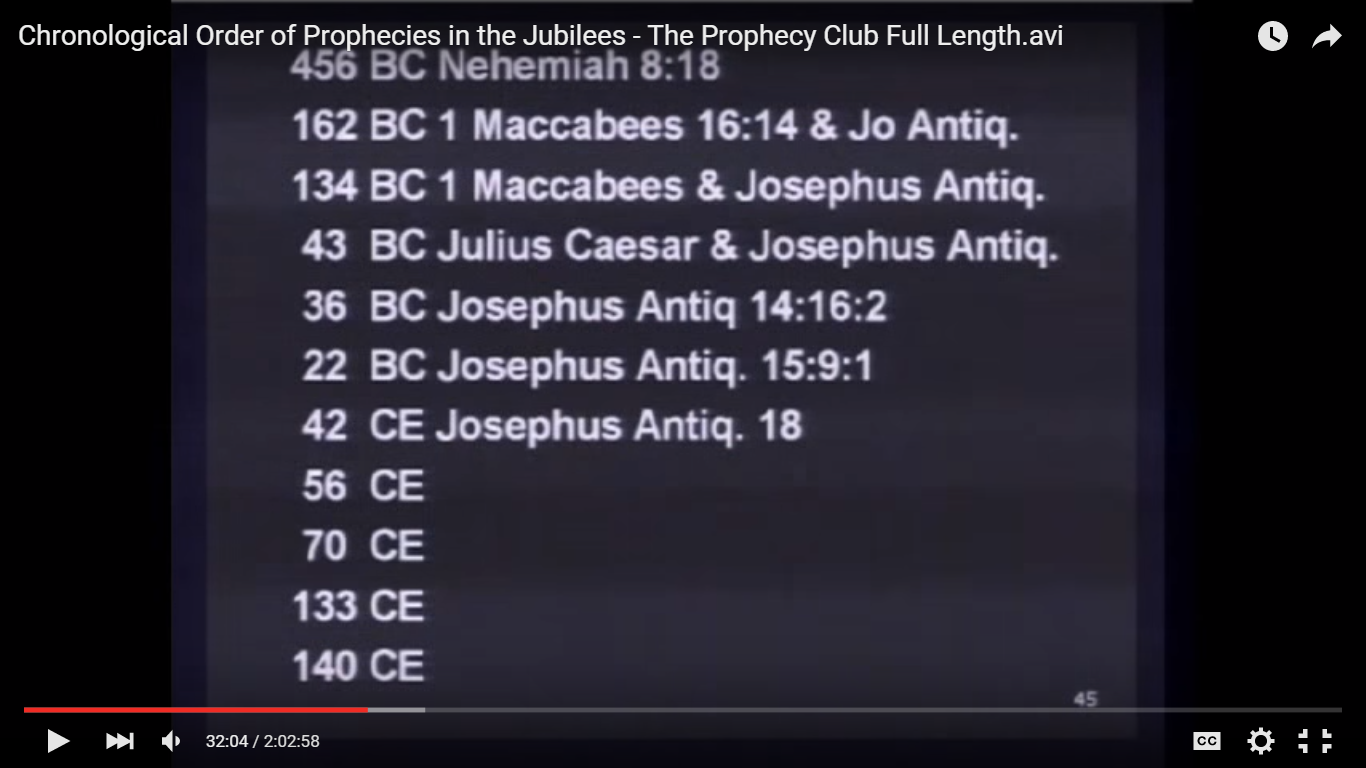
The view of the 70 Weeks I've been favoring had the Decree of Artaxerxes in Nissan 454 BC putting the 70th week in 30-37 AD. But many have, using much of the same evidence, argued for the Decree being Nissan of 455 BC, and a 70th Week that is 29-36 AD. I need to look into that more, but if so that would make both the beginning and ending of the 70 weeks the start of Jubilee years in the above Jubilee model, which makes sense.
I've seen people argue for both 29 and 36 AD Crucifixion models. For the latter that includes Nikos Kokkinos who's theories I may talk about more in a future post. My personal bias remains 30 AD for the moment however. But The Resurrection and Acts 2 Pentecost being Jubilee years has a certain symmetry to it.
This makes the latest Jubilee year to happen Spring 1996-Spring 1997. And before that 1947-1948 which many see as Biblically significant. Before that 1898-1899, and before that 1849-1850.
This model could place the beginning of the 21 year Time of Jacob's Trouble in Spring of 2024 AD.
Or maybe if someone could argue the above proposed Jubilee cycle is off by a year, to make my original 70s Weeks views match up to Jubilees, things would fit better. Then it would be during a Jubilee year modern Israel was founded.
If I switched to a Mid 7th Year or mid 49th Year Rapture view. How do I match up the time-frames? The ministry of the Witnesses and consecration of the Rebuilt Temple would be around the Nissan that would start year 4 of the relevant Sabbatical cycle. The 42 Months The Beast is allowed to continue would begin about 6 months later. And the 1260 days The Woman is in the Wilderness would continue 3 years into The Millennium. Why would that happen? Who knows, perhaps I'll think of a reason later.
But I will still never accept a Non Chronological view of Revelation.
Thursday, September 29, 2016
Solomon's Temple was NOT in the City of David.
If you think it was, I suggest you read 1 Kings 8:1, the account of The Ark being placed in The Temple.
The land that Solomon built The Temple on, David purchased after the whole Census and Plague episode recorded in 2 Samuel 24 and 1 Chronicles 21, (and referenced again in 2 Chronicles 3:1). So it can't possibly be the same spot near the Gihon Spring where David placed The Ark when he began his reign in Jerusalem.
In 2 Samuel 24:23, though English translations sometimes obscure this, Araunah (Ornan in Chronicles) is called a King. He was the King of a separate Kingdom, so the land he owned was clearly not within The City of David.
There are also many reasons why you wouldn't put a threshing floor anywhere near a spring.
Now I don't know if the Second Temple was on the same spot as the first. But I believe the evidence places the Second Temple's Holy of Holies about where the Al-Kas Fountain currently is, and that the Antonia Fortress was where the Dome of The Rock is.
Prophetic verses get used to back up saying there is a spring or river under The Temple. Ezekiel 40-48's Temple will be no where near the same spot as Solomon's, it's miles north of Jerusalem, I've argued about where Beth-El was. And by then events like the 7th Bowl of Wrath will have totally changed the geography of the region.
In both Poetic and Prophetic books Zion gets used poetically, it doesn't always mean it's strict Geographical definition it has in the two verses that started this post.
"Then Solomon assembled the elders of Israel, and all the heads of the tribes, the chief of the fathers of the children of Israel, unto king Solomon in Jerusalem, that they might bring up the ark of the covenant of Yahuah out of the city of David, which is Zion."And also 2 Chronicles 5:2
"Then Solomon assembled the elders of Israel, and all the heads of the tribes, the chief of the fathers of the children of Israel, unto Jerusalem, to bring up the ark of the covenant of Yahuah out of the city of David, which is Zion."David's Tabernacle was not on the same land as Solomon's Temple, that's where these "The Temple wasn't on The Temple Mount" people are confused.
The land that Solomon built The Temple on, David purchased after the whole Census and Plague episode recorded in 2 Samuel 24 and 1 Chronicles 21, (and referenced again in 2 Chronicles 3:1). So it can't possibly be the same spot near the Gihon Spring where David placed The Ark when he began his reign in Jerusalem.
In 2 Samuel 24:23, though English translations sometimes obscure this, Araunah (Ornan in Chronicles) is called a King. He was the King of a separate Kingdom, so the land he owned was clearly not within The City of David.
There are also many reasons why you wouldn't put a threshing floor anywhere near a spring.
Now I don't know if the Second Temple was on the same spot as the first. But I believe the evidence places the Second Temple's Holy of Holies about where the Al-Kas Fountain currently is, and that the Antonia Fortress was where the Dome of The Rock is.
Prophetic verses get used to back up saying there is a spring or river under The Temple. Ezekiel 40-48's Temple will be no where near the same spot as Solomon's, it's miles north of Jerusalem, I've argued about where Beth-El was. And by then events like the 7th Bowl of Wrath will have totally changed the geography of the region.
In both Poetic and Prophetic books Zion gets used poetically, it doesn't always mean it's strict Geographical definition it has in the two verses that started this post.
Friday, September 23, 2016
The Mormon Doctrine of Jesus and Lucifer being brothers
First this is about LDS Mormonism specifically, groups like Temple Lot that reject the Cosmic Pluralism of Smith and Young's later teachings view Satan about the same as Protestants and Evangelicals who are KJV only do.
Here is a Mormon Website defending Mormonism against this accusation.
Yes it is true that this Mormon doctrine makes all Angels and Humans brothers of Jesus and Lucifer also. And indeed The Bible also calls all Angels including Satan "Sons of God" in Job and Genesis 6. And The New Testament calls Adam and all Believers "Sons of God". And I thank this webpage for reminding me of Hebrews 12:9 and how that could be relevant to the Nephilim view vs Sethite view debate. But also just like in The Bible, Satan has a certain seniority over the others besides Jesus who is the First Born.
My objection to the Mormon view of how Jesus and Satan are related is not so much that it elevates Satan (my view of Satan may well be a more powerful entity then the LDS view, he's the Archon of the Kosmos), it's that it subtly demotes Jesus.
On that very page, in it's answer to "Q. What about the Jesus and Satan being brothers claim?" They say "However, Jesus chose to honor and glorify his Father while Satan chose to rebel against and dishonor Him. Jesus and Satan are polar opposites–literally as different as any two individuals can possibly be." Meaning they're arguing the difference between Jesus and Satan begins with the choices they made, they were equal in creation. I believe Jesus is the ONLY Begotten Son of God, John 3:16, not just the First Born, though First Born of Creation is also one of his titles. He is The Word made Flesh.
The LDS view of Jesus and Lucifer is not unlike Manwe and Melkor in Tolkien's cosmology. All the Anuir were created from the thoughts of Eru Iluvatar, but Manwe and Melkor were twins essentially as the First Born of his thought, but it was the choices they made that made them opposites.
I doubt Tolkien was copying Mormonism specifically, he was drawing on mythological motifs that are common and Ancient. From Thor and Loki as rival sons of Odin to Vishnu and Shiva of Hinudism. And the Zurvanism form of Zoroastrianism has Zurvan in the Elohim role, and Ahura-Mazda and Angra Manyu as the good and evil rivals he created.
But the beginning of this motif is perhaps Enlil and Enki as the chief sons of Anu in Sumerian Mythology. Just do a Google search with Enlil, Enki and either Satan or Lucifer as the main keywords and you'll find many websites and articles saying Enlil is like Yahuah/Yahweh (LDS Mormons believe Jesus is Jehovah while Elohim is God The Father) and Enki is The Serpent of Genesis 3. Sometimes from Christians saying this is Satan's earliest corruption of the Biblical world view. Meaning they're not saying it's okay to worship Enlil, but that Enlil was devised in some ways to reflect how Satan wants people to view Yahuah. Rob Skiba has also talked about this subject.
There is definitely a subtext to the Sumerian myths that present Enlil as bad compared to Enki. Also the earliest Temple of Eridu (the original Babel) was devoted to Enki. Enki is presented as the one who gave Mankind knowledge and civilization. Enlil is presented as sending the Flood while Enki warned the Noah figure. In Akkadian and some other Semitic Mesopotamian texts Enki is called Ea.
I wonder if Tolkien's account of how Luthien puts Morgoth to sleep to take one of his Silmarils could be his puerile re-imagining of the myth of how Inanna obtained Enki's me.
In the Baal Cycle and other texts of Ugarit, the Enlil role seems to be played by Baal (sometimes also called Hadad/Hadar/Adad/Adar) and the Enki role by Yam and maybe also Lotan, scholars disagree on if Lotan is Yam or an instrument of Yam. And the role of Anu is played by El.
Baal worship is probably the most frequently condemned false Worship in the Hebrew Bible. But remember God dislikes being identified with a Pagan god just as much as being rejected altogether, we see that in the Golden Calf incident where they called the Calf Yahuah.
Hosea 2:16 refers to Baal as a name or title Yahuah has been called, but as one he doesn't like. Of course the main context there is how Ish and Baal are both words for Husband (marriage is the major theme of Hosea) but Baal also means Lord while Ish is a word for man as in male gender that is introduced in Genesis 2. So I see this as mainly being about how the marriage of Genesis 3 will be done away with in favor of the marriage of Genesis 2.
The devout Baal worshipers Ahab and Jezebel named at least three of their children YHWH theophoric names, Athaliah, Ahaziah and Jehoram.
Zachariah 12, I have already mentioned before as possibly using Hadad-Rimmon as a title or idiom of Christ Crucified.
The Tel Dan Stele was made either by Hazael of Aram-Damascus or by Jehu, both were anointed Kings by Elisha on instructions originally given to Elijah by Yahuah. Both should have known full well that Yahuah made them King, but the author of the Stele says Hadad made him King. Jehu did continue the Sins of Jeroboam.
In Hebrew Lotan could come from putting a Lamed as a prefix before Tan, the basic root word for Dragon, which would mean "To the Dragon". Some have connected the Ugarit Lotan to the Biblical Leviathan. The name Lotan does occur in Genesis 36 in the Horite genealogy.
Isaiah 27:1 has a phrase translated "the dragon that is in the sea". But in the Hebrew this is only three words. "Tanyin asher Yam", Yam being the Hebrew word for the Sea. It could be this whole phrase is a name or title of Satan and that we have a Biblical basis for using Yam as a name for Satan. I notice this could parallel Ehyeh asher Ehyeh "I Am that I Am", maybe it could be "The Dragon that is Yam"?
Psalm 74:13 could also be interesting in this context, and also Ezekiel 29:3. Or Ezekiel 32:2 where the word for Dragon is translated "Whale" in the KJV.
Some Canaanite texts call Yam Judge-Nahar (Nahar being interpreted to mean river) Nahar is a name that could easily be related to Nahash, the word for Serpent in Genesis 3 and 49 and other places. Rivers are Serpent like in a sense.
There is some evidence that Chemosh and Moloch were just the Moabite and Ammonite forms of the same deity. Since Chemosh seems to have been depicted as a Fish god I'd say they're more likely a Yam/Enki figure. And that the Philistine Dagon is the same as them also, Dagon comes from the Hebrew word for fish.
In Egyptian mythology the rival brothers are Osiris and Set.
While we're used to thinking of Set as the Satan figure particularly thanks to Aquino's Temple of Set. In the context of the mythical motifs I'm discussing here, it should be noted that Set slew the Egyptian Lotan figure, the coiling Serpent Apep. And that the Hycsos who came from the Levant seemed to favor Set because he was the easiest to identify with Baal being a storm god, albeit of sand storms. Perhaps the Genesis 36 name Shobal is a shortening of Seth-Baal?
Maybe originally Osiris and Apep were the same or linked, but in time the enemy of the heroic Set and the enemy of the villainous Set were separated. Osiris is often depicted as having Green skin, scholars usually explain this as being because he was a Vegetation god. But I know of no direct connection with vegetation besides that modern comparative mythology logic seems to see every "dying and rising god" as either a vegetation god if now a solar one.
The fact that Osiris and Horus are so firmly linked to the person of the Pharaoh himself, makes the possibly of Osiris as a Serpent god interesting in light of Ezekiel 29 and 32. And Egypt is also mentioned in Isaiah 27. And also how Rahab (who is unfortunately sometimes transliterated the same as Rachab) is often interpreted as both a Lotan figure and as a name for Egypt or whoever rules it.
Orisis also has overlooked aspects of being a Goat god, from his connection to The Goat of Mendes, to his name being connected to the Hebrew Seir/Sayir. How does that fit with my having just argued he's a Sea Serpent god? Well the constellation Capricorn is depicted as Half Goat and Half Fish, and it's been depicted that way for over 3000 years. The History and Mythology section of it's Wikipedia page says the Babylonians viewed Capricorn as a depiction of Ea aka Enki.
That can be interesting in light of my argument that every use of "Lamb" in Revelation is perhaps really Goat. We'd have the Second Beast having Goat like Horns but speaking with a Dragon's voice.
Horus could then be equated to Marduk, the son of Enki who in the Enuma Elis takes on the position previously held by Enlil in earlier myths.
However Egyptian mythology can be confusing, partly because it changed over time, and much of it was different tradition of the Upper and Lower kingdoms being fused together. As such another Enki/Yam figure could be Sobek, who was depicted as a Crocodile, and also viewed an an embodiment of The Nile (paralleling Yam as Nahar). And came to be linked to the Pharonic power similarly to Horus and Osiris. And another Enlil/Baal figure could be Amon, who in Carthage was identified with Baal as Baal Hamon, (and with Zeus by the Greeks as Zeus-Amon). And another Anu figure could be Atum.
And then there is that one Masonic ritual where the secret word is JaBalOm which is a merging together of the names of Jehovah, Baal and Amon into a single name.
Geb/Seb/Keb is also sometimes depicted as a Crocodile or Snake. And he is also described as the Father of Snakes, like Nehebkau. He was the father of Osiris and Isis and Set and Nebthet. Geb is also considered a god of the Earth, and Enki means "Lord of The Earth".
Perhaps Geb and Sobek were originally the same. Of the sons of Enki, Marduk who went on to take aspects of Enlil could be equated to Set. Dumuzid/Tammuz father is never directly stated, but his sister Ngeshtin-ana is called a daughter of Enki and Ninhurshag. Hislop derived mythology makes Tammuz sound like Horus, but he was actually more like Osiris.
In the Sumerian poem Inana and Bilulu, one figure Inana gets revenge on for being involved in the killing of Dumuzi/Dumuzid is Jirjire, the son of Bilulu. Jirjire is turned into a Desert god of bad weather, making him a lot like Set, a god associated with the Desert and Sand Storms and other bad whether, which is why the Greeks sometimes identified him with Typhon. Marduk seems like a god we only know by the name the Semitic Mesopotamians called him, as if he doesn't go all the way back to Summer. Perhaps Jirjire became Marduk?
Set has somewhat of a minor solar deity association via his riding in Ra's Chariot to battle Apep. Marduk too however is while not the main sun god a name that meant "Solar Bull".
Inanna's position in the Anunnaki genealogy is often confused. And I think this comes from the attempts to give aspects of Enlil to Marduk. She is both the direct daughter of Anu, fitting Ashteroth/Astarte of the Canaanite panethon. And a daughter of Ningal and Nanna, perhaps explaining the Greek Asteria who has a name related to Astarte and is a daughter of lunar deities. And her being a twin Sister of Utu may relate her to the Eye of Ra or other feminine solar deities. And she's sometimes a daughter of Enki, making her a sibling possibly of Ngeshtin-ana and possibly Dumuzi, making her fit Isis relationship to Osiris. But I think Isis isn't the only Egyptian goddess who's a reflection of Innana, I think so is Iusaaset and possibly Hathor.
Because Greek mythology (which the Romans copied) did a lot of splitting up mythological roles. The Sea-god (Pontus, Oceanos, Nereus, Poseiden, Triton, Neptune) and the Dragon/Monster to be slain (Typhon, Ophion, Ladon, Hydra, Cetus) figures become firmly separated. So that in Tolkien, Ulmo and Osse are separate from Morgoth, Glaurung and Ancalagon. Meanwhile Enki's status as a god of Wisdom and Prophecy gets taken by Apollo/Asclepius and Hermes/Mercury. Mercury seems to have also been the Planet that Enki was associated with in Sumerian astrology. And Apollo has a surprising number of Serpent associations, like Python, the "Spirit of Divination" in Acts 16.
Zeus seems to be both the Anu/El role and Enlil/Baal role depending on the context of the myth, same with Cronos, and Ouranos is the one who's name has the same meaning as Anu, the Heavens. The original from of Zeus/s name was Dios, which like El also becomes a word for god in various forms in various languages, including Theos and Deus. This caries over to the Roman mythology, where Zeus is identified with Jove and Jupiter. I've argued before that the name Jove may be a corruption of Yahuah/Jehovah. Dionysus/Bacchus/Bromis descends from Hadad's vegetation and fertility god aspects.
Gnosticism takes this basic mythological pattern and further complicated it with Platonic Philosophical concepts. Often by identifying Yahuah/Yahweh with the Demiurge/Ialdobath, and the Serpent of Genesis 3 with Jesus.
In Vedic mythology Enlil/Baal is Indra, Enki/Yam is Vaurna, Anu/El is Dyaus, and the Lotan figure is Vritra.
I've talked before about how in Shinto mythology Susanoo can be viewed as Baal. In that context Orochi is Lotan, but I also think Yam can be equated to Ryujin, the Sea-Dragon god ruling from his undersea palace Ryugu-jo. The theory about the Ningi-Jimmu genealogy that suggests it's based on Jacob and Joseph puts Ryujin in the position of the Egyptian Priest of On, father of Asenath. Which could be interesting in light of Egypt's relevance so far.
Other Far Eastern mythologies have Dragon King gods as well. From the Arabian Knights, the tale of "Abdullah the Fisherman and Abdullah the Merman" also involves an undersea civilization. Job 26:5 says "Raphaim are formed under the waters, and the inhabitants thereof". Which can be interesting to compare to Psalm 74:13.
Rob Skiba talks about understanding The Bible from a mythological POV. Much of where he goes with that I disagree with, but perhaps we should consider that the Beast "rising out of the sea" might be more literal then we at first assume?
The Greek word translated Sea in Revelation 13:1 is Thalassa, which in mythology is the name of the wife of Pontus, the most primordial sea god. Thalassa was identified with Tiamat by Berossus, in which context Pontus is equated to Abzu of the Enuma Elis, in which Tiamat is slain by Marduk son of Enki. But originally Abzu was just the name for the Abyss, the Enki Temple in Eridu was called the E-Abzu. Thorkild Jacobsen has hypothesized that Abzu was an early form of Enki.
Pontus happens to also be very phonetically similar to the name of a Kingdom in northern Turkey who's royal family in the Hellenistic and Greco-Roman period was mingled with the Seleucid Dynasty.
Most assume the "Seat of Satan" in Pergamon/Pergamos was the Altar of Zeus, but I've argued on this Blog it was the Temple to Serapis. Serapis was a Hellenistic cult that combined the Egyptian gods Osiris and Apis. But Samuel Noah Kramer argued that Serapis was Enki.
While this kind of comparative mythology research is fun, it's important never to forget that The Bible is strictly monotheistic. God The Father and God The Son are the same Person along with The Holy Spirit. But Satan is merely a created being, the most powerful created being perhaps, but still merely created.
Update June 12th 2017: I'm aware that counterarguments can exist for identifying YHWH with Enki/Yam rather then Enlil/Baal. I want to address those.
Saying Enlil and Baal are Satan I am fine with in the sense that all false worship serves the interest of Satan, and Satan can appear as any god if that's the best god to appear as in a given situation.
My problem with arguing for Enki/Yam as being the Pagan names for YHWH is how I fear that could serve the interests of a deception predicated on claiming Jesus is Baal and the New Testament Satan is YHWH and the Old Testament Satan wasn't evil. There are ways to misuse viewing Ezekiel 38 and Revelation 20 as describing the same invasion to back that up.
There could be two sides to that hypothetical deception. One is a Gnostic like cosmology being Pro-Jesus with it. But it could also be a False Jewish Messiah Claimant seeking to vilify Jesus and The New Testament.
The argument might start with the Son of Rehoboam who succeeded him as King of Judah being named both Abijah ad Abijam, a Yah theophoric name and a Yam theophoric name. Being used to support them being names of the same being. Abijah I think was born while Solomon was king, maybe even in the first half of his reign before he started going off course, since Rehoboam was a year old already when Solomon started his 40 year reign. So I think he was named Abijah at birth. But he was an idolator during his reign as King and so may have changed his theophoric to Yam to reflect his Polytheism.
One Ugrarit text says Yaw in place of Yam, which seems to be a scribal error, yet people try to use this to support saying Yam was YHWH anyway. And it's been argued the Akadian name of Enki, Ea, could be how Yah would be appear in the Akkadian alphabet. But that's about as valid as the theory of connecting Yah to the Egyptian name for the Moon.
The Bible does call Yahuah the "Lord of The Earth" which can equate to the meaning of Enki, En meaning Lord and Ki meaning Earth. (Baal of course also means Lord, Adonai and Baal could be used as synonyms). But that is because The Bible is Monothestic and not Polytheistic. Yahuah is the ultimate Lord of everything, but the New Testament does depict Satan as the current Archon of the Kosmos, who offered the Kingdoms of the World to Jesus and will in Revelation 13 give them to The Beast. Yahuah being depicted as riding on Clouds fits Canaanite Baal imagery and the meaning of Enlil, Lord of the Sky.
Ahab and Jezebel broke with most Northern Kingdom rulers by worshiping Baal under that name and Astarte. But at the same time they also continued the Sins of Jeroboam, they didn't view that is in conflict with the Baal religion.
When Enki and Yam are depicted as Animals rather then Human, it's usually as Aquatic, Amphibious Serpentine or Reptilian creatures, rarely as any Mammals. The only Biblical basis for YHWH being seen that way is Jesus using the Brazen Serpent as a symbol of himself in John 3.
Usually when Israelites worshiped the Name of YHWH in an Idolatrous and Polytheistic fashion, it was as a Calf or Bull. The Golden Calf in Exodus, and then the Calf Jeroboam set up at Dan and Bethel. I've come to agree with Jeroboam's Dan being Baalbek. Showing that Idol had the name of Baal applied to it. This Calf imagery also appears in the Baal cycle of Ugarit when Baal fakes his death using the body of a Calf.
I repeat, I am NOT!!! arguing for it being okay to worship Baal. We worship YHWH only under that name or the YHW Theophoric name of Yeshua/Iesous/Jesus, "Yahuah is Salvation".
The point is the mythology of Baal is tied to Satan's desire to vilify God. Even the Baal cycle of Ugarit ostensibly written by people who worshiped Baal as their Patron Deity, depicts him as a usurper, El meant for Yam to rule. Plenty have talked about how Enlil looks bad in the Sumerian stories. And Japanese mythology mostly vilifies Susanoo, at least compared to their Matron Megami Amaterasu.
The primary basis for identifying Satan with Enlil is Ephesian 2:2 saying "Prince of the Power of the Air". Thing is, there is no proof that is about Satan, it takes more then just being apparently about an evil spiritual entity. Revelation 12 verifies that Satan, The Devil, the Old Serpent, The Great Dragon, and the leader cast out of Heaven in Isaiah 14 are all the same. I think that Belzebub for example is probably distinct, Belzebub is the chief of the Demon, entities without physical forms of their own which Satan doesn't qualify as.
Friday, September 9, 2016
The Little Horn of Daniel 7
I've explained my basic view of how Daniel 7 relates to Revelation 13&17, and later elaborated on that. Now I want to talk about the issue of The Little Horn, and how I've become unsure it's as directly relevant to The Antichrist issue as we assume.
I've explained that I view the Ten Horns as Ten Nations that emerged from the Western Roman Empire. I've given two theories on how to identify those Ten. The WEU theory, and the Danite theory.
This post also has some tangential relevance to my last Daniel 11 post.
Basically I have been considering that the Little Horn of Daniel 7 is an 11th Nation or Government to arise after those, rather then being necessarily the same as the Eight King of Revelation 17 or any other individual. I have three basic theories to suggest on which nation that could be.
First is the United States of America. Since the Little Horn isn't directly described as a King like the Ten are, perhaps that fits America being a Republic, that isn't in Europe but founded on European/Roman cultural pillars.
And perhaps the fact that since the U.S. was created, revolutions in Europe somewhat inspired by the American Revolution have removed some but not all European Monarchies. Could have something to do with the Three Horns being uprooted.
This could overlap with my American Antichrist theories. And perhaps also my America and Egypt observations as well dependent on how much you think the Little Horn of Daniel 8 is connected to the Little Horn of Daniel 7.
Second could be the European Union (or whatever it becomes) itself as a transnational Government. Which could fit better with the WEU theory on the Ten Horns. And perhaps #Brexit is the beginning of Three Horns being uprooted.
Third candidate could be Modern Greece. Officially it gets counted as the 10th Nation to join the EU when it joined in the 80s, which Bible Prophecy enthusiasts made a big deal of. But since the UK can be considered two nations in one (England and Scotland), you could also argue Greece was really the 11th.
That theory works best for making The Little Horn of Daniel 8 still the same Little Horn. And I've discussed Modern Greece's possible relevance to Bible Prophecy before, in the Last Roman Emperor post, and my main Historicism post.
Wednesday, August 24, 2016
Maybe Daniel 11 isn’t about Antiochus Epiphanes at all
[Update March 2022: I've mostly abandoned this theory for now, but I'm still open to returning to it.]
Saturday, August 6, 2016
America and Egypt
I posted recently about reasons to potentially associate The Beast with Egypt. But I've also discussed the possibility of an American Antichrist, (and tied that into Lost Tribes speculation and Mormon eschatology). In this post I want to explain why those ideas need not be mutually exclusive.
My Egypt post was largely geographical, and was clear that the West/EU would be the source of his military strength. Which means we could be dealing with a U.S. backed Egyptian leader, or a U.S. military presence in Egypt. But one could also go the other way, and since America is ethnically diverse suspect it'll be a U.S. President of Egyptian ancestry. Or maybe a combination of those factors.
But let's talk about why it could make sense thematically.
The thing I find really funny about all these right wing Christians saying "America needs to support Israel to be right with God", is that in The Hebrew Bible God constantly condemned Israel for turning to Gentile Nations instead of Him, defining it as a lack of faith in Him. That nation was most commonly Egypt, especially for the Southern Kingdom/Judah, though the Hasmoneans turned to Rome in First Maccabees Chapter 8. Interestingly after Augustus conquered Egypt the Roman Caesars took over the Pharonic Worship in Egypt.
But for modern Israel it is the United States of American they keep turning to instead of God. In that sense we are very much the modern Egypt.
As far as the desire to identify America with Manasseh (which I've considered) goes. We should remember the mother of Manasseh and Ephraim was an Egyptian, Asenath, the daughter of the High Priest of On.
It's interesting then that our Great Seal is all Egyptian imagery with Latin writing, derived from Masonic Symbolism. The Eagle was a Roman symbol, but Albert Pike wrote that in Masonic Imagery sometimes an Eagle really represents the Egyptian Bennu bird, called the Phoenix in Greco-Roman writings.
The Washington Monument is also molded after an Egyptian Obelisk. But there was also a lot of Roman architectural influences in Washington DC.
Freemasonry uses a lot of Egyptian symbolism in general. But some forms of it are particularly Egyptian. One was the Order of Memphis-Misriam founded by Cagliostro in 1776, the same year on the base of the Pyramid due to being when the Declaration of Independence was signed.
America like Ancient Egypt has been divided between North and South. And has a Capital at the border of that division but also the midst of the original 13 Colonies. And America like Ancient Egypt enslaved many Black Africans.
So the relationship between America and Egypt is something to keep an eye on.
Update September 2017: I've pretty retracted this assessment with my England and Egypt study. Though what I've talked about here can help back that up given how much American's History is tied to England's.
Subscribe to:
Posts (Atom)